 MineArchive
Cocking Quarry
| Also known as | Cocking Lime Works, Midhurst Brick & Lime Company |
|---|---|
| Location | Cocking, near Midhurst, West Sussex — 50.9470, -0.7523 (approximate) |
| Commodity | Chalk |
| Type | Quarry |
| Worked | By 1715–1999 |
| Maximum depth | An open chalk quarry; no depth applies. |
| Operators | Midhurst Brick & Lime Co. Ltd (1926–1993), Dudman Group (1993–1999) |
Overview
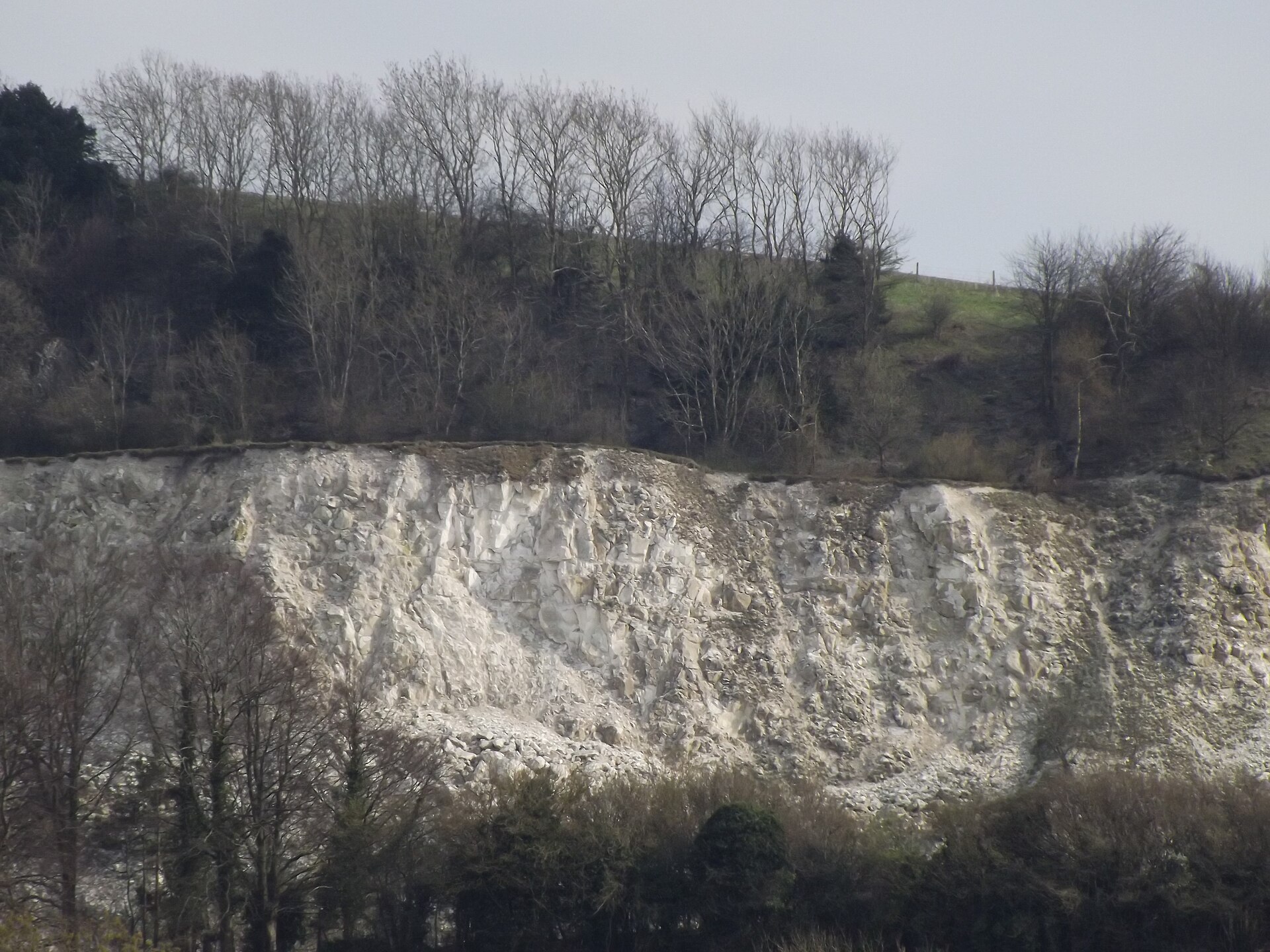
Cocking Quarry and its lime works lie on the South Downs just south of the village of Cocking in West Sussex, close to the South Downs Way and on land owned by the Cowdray Estate. Lime kilns are recorded in the parish from 1715 and a chalk pit on Cocking Hill from 1768. The lime burnt here went to make Midhurst White bricks and served agriculture; later production turned to 'Calco', a patented mixture of lime and powdered chalk, and to powdered chalk sold as 'Nurslim' for gardens and nurseries. The kilns sit in a small chalk pit of about 3 hectares at a spot known as The Butts; the main quarry is about 500 m south-east and 80 m higher, covering about 6 hectares, the two linked by an embanked roadway built in 1962. All work ceased in 1999 and both sites have been abandoned since.
History
The earliest known mention of lime working in the parish is in Cowdray Estate documents of 1715, referring to two isolated lime kilns then in use, and an estate map of 1768 shows a chalk pit on Cocking Hill. The tithe map of 1842 assigns the chalk pit to the Rev. Thomas Valentine, incumbent at Cocking church, and an estate map of 1830 shows further kilns at Wolverstone Farm. In September 1833 an earthquake caused a rockfall in a chalk pit here which killed a workman, William Marshall. The 1874 Ordnance Survey 25-inch map shows three lime kilns in the parish — one near the head of Sun Combe, since lost in later quarrying, and two in the lower pit nearer the village — probably small wood-fired flare kilns making grey hydraulic lime. The estate leased the pits and kilns to a succession of tenants: Pepper and Sons of Amberley in 1906, Frederick Searle in 1921 and then his brother Eli, who in 1924 took Robert Dunning into partnership on terms that Dunning would build new flare kilns on the site of the old wood ones. Dunning acquired the Midhurst Brickworks the following year, which had been making sand-lime bricks since 1913, and in 1926 Benjamin Cloke became owner of the Midhurst Brick & Lime Company and with it the Cocking works. The Dudman Group acquired the site in 1993 and all work ceased in 1999.
Geology
The workings cut the Chalk of the South Downs. The lower pit, in which the kilns stand, is at a spot called The Butts, used for archery practice in the twelfth century; the main quarry lies about 500 m to the south-east just south of Sun Combe, some 80 m higher up the hill. The chalk was burnt for lime and, latterly, ground for sale as a powder in its own right.
Geological setting: Sedimentary Beds and Seams (well documented example)
Workings
The earliest pits were dug by hand with kilns close beside them. As the faces deepened, workmen were suspended on ropes from the top of the cliff and broke the chalk by hand — a method that lasted until the 1940s, when explosives were first used on the quarry face. Blasting then took place two or three times a week, often on Sunday mornings, and drew regular complaints from the village about cracked ceilings and broken windows. Expansion began in 1906 under the Pepper lease, and by 1914 a 2 ft gauge tramway ran between the lower chalk pit and the lime kiln; it appears on Ordnance Survey six-inch maps from 1914 into the 1970s, and sections of rail and rolling stock chassis survive on the site. In 1962 an embanked roadway was built between the upper quarry and the kilns so that lorries could carry chalk down directly.
Closure
Production of sand-lime bricks at Midhurst ended in 1985, and in its last years Cocking concentrated on Calco and Nurslim. Dudman Chalk & Lime Ltd bought a lease on the works in 1993 and ceased all operations at both the quarry and the kilns in 1999; the company, trading as Cocking Lime Works under the Midhurst Brick & Lime Co. Ltd name, became defunct the same year.
What remains
Both the quarry and the lime works are abandoned and have been since 1999. They stand on Cowdray Estate land and are not open to the public. The south battery of lime kilns and the screening plant survive, and the works are a well-known subject for industrial photographers and urban explorers, with dated reports from 2016, 2017, 2020 and June 2022. The lower pit is now heavily overgrown.
The south battery of lime kilns and the screening plant stand, together with traces of the 2 ft gauge tramway including sections of rail and rolling stock chassis, and the embanked roadway of 1962 linking the upper quarry to the kilns.
Nearby mines
- Fernhurst Furnace (North Park Furnace) — 6.9 miles (11.1 km) N
- Buriton Chalk Pit — 9.0 miles (14.5 km) W, Hampshire
Straight-line distance, within 9 miles (15 km). Show on the map.
Recorded claims
Individual factual claims, each attached to the source(s) that support it below. Where sources disagree, both are kept.
- The earliest known mention of lime workings in the parish of Cocking is in Cowdray Estate documents of 1715, referring to two isolated lime kilns then in use; a Cowdray Estate map of 1768 shows a chalk pit on Cocking Hill. 1
- In September 1833 William Marshall was killed by an earthquake in a chalk pit at Cocking. 1
- As the chalk pits deepened, workmen were suspended with ropes from the top of the cliff and broke the chalk by hand. Explosives were not used to break chalk from the quarry face until the 1940s, after which blasting took place two or three times a week, often on Sunday mornings, provoking complaints from the village about cracked ceilings and broken windows. 1
- Cocking was the source of lime used to manufacture Midhurst White bricks and for agricultural purposes. Sand-lime brick production at Midhurst ceased in 1985, and later output concentrated on 'Calco', a patented mixture of lime and powdered chalk, and plain powdered chalk marketed as 'Nurslim'. 1
- Dudman Chalk & Lime Ltd purchased a lease on the works in 1993 and ceased all operations there in 1999; the company traded as Cocking Lime Works under the Midhurst Brick & Lime Co. Ltd name and became defunct in 1999. 1
- A dated exploration report of June 2022 records the works as abandoned and accessible, with the kiln batteries and screening plant standing. 2
Photographs & further reading
An unusually detailed account of a small quarry: the Cowdray Estate leases from 1715 onward, the succession of tenants, the shift from hand-worked faces to blasting in the 1940s, the tramway, and the products from hydraulic lime to Calco and Nurslim.
View sourceSources
- (secondary) Cocking Lime Works — Wikipedia
- (observational) Report: Cocking Lime Works, West Sussex — June 2022 — 28DaysLater urban exploration forum
Record created: 4 September 2026 · Last researched: 4 September 2026