 MineArchive
Brymbo Colliery
| Location | Brymbo, west of Wrexham — 53.0640, -3.0640 (approximate) |
|---|---|
| Commodities | Coal, Ironstone |
| Type | Coal |
| Worked | By 1792–1938 |
| Maximum depth | Unknown. |
| Operators | John Wilkinson (1792–1808), The Brymbo Coal Company (1880–1900) |
Overview
Coal was being dug at Brymbo, west of Wrexham, from at least the fifteenth century, when the first coal barons of the district were the Grosvenors of Eaton and the Myddeltons of Chirk Castle. The modern industry begins in 1792, when the ironmaster John Wilkinson bought Brymbo Hall and its estate from the Assheton-Smith family for £14,000 and set about mining the coal and ironstone beneath it; by 1796 he had a blast furnace on the site, and by 1821 there were 41 coal pits on the Brymbo Hall estate alone. Larger deep mines followed in the nineteenth century and most of the village was built to house the men who worked them. The official list of collieries at work in 1880 returns "Brymbo, Wrexham, The Brymbo Coal Company". The collieries ran into geological and financial trouble by the Depression; the area’s last deep mine closed in 1938 and the Smelt drift in 1967.
History
The story of coalmining at Brymbo goes back to the fifteenth century, although it was then little more than surface digging; early records show the first coal barons as the Grosvenors of Eaton, near Chester, and the Myddeltons of Chirk Castle. What changed the place was John "Iron Mad" Wilkinson, who bought Brymbo Hall and its estate from the Assheton-Smith family in 1792 for £14,000, began developing it, mined coal and ironstone and built an ironworks that became the Brymbo Steelworks; his first blast furnace was up east of the Hall by 1796 and produced 884 tons of iron in its first year. By 1821 the Brymbo Hall estate alone carried 41 coal pits.
Through the nineteenth century a number of larger deep mines were sunk around the area and the majority of the village of Brymbo was built as accommodation for the miners and ironworkers, on and around the steep sides of Brymbo Hill. The official list of collieries at work returns the colliery in 1880 under the Brymbo Coal Company, one of several concerns working the estate’s coal alongside the ironworks it fed. Subsidence from the workings was a constant: the first church in Brymbo, St John’s, consecrated in 1838, had to be closed in 1869 after it was affected by subsidence, and its replacement St Mary’s was built in 1872 on the outskirts of the village.
Following successful steelmaking experiments the Brymbo Steel Company was incorporated in 1884 and steel production began in 1885, and the works prospered for decades while the collieries that had started it did not. Many of the area’s pits ran into geological and financial difficulty by the time of the Great Depression; the area’s last deep mine, the Plas Power pit near Southsea, closed in 1938, and the Smelt drift west of the village in 1967. Much of the remaining coal was taken by opencast working immediately west of the steelworks between 1972 and 1975. The steelworks itself closed in stages between 1990 and 1991.
Geology
The Denbighshire coalfield on the western edge of the Cheshire plain, where coal and ironstone lie close enough together that one estate could feed its own furnaces — which is exactly what Wilkinson bought Brymbo Hall to do. The ground has proved unstable above the workings: subsidence closed the parish church within thirty years of its consecration, and the topography of Brymbo Hill later forced the expanding steelworks onto an artificial plateau of slag that buried most of the neighbouring village of Lodge.
Geological setting: Sedimentary Beds and Seams (well documented example)
Workings
Shallow pits at first and a great many of them — 41 on the Brymbo Hall estate by 1821 — followed by a smaller number of larger deep mines through the nineteenth century, all of them subordinate to the ironworks and later steelworks the coal was raised to supply. The last of the deep mines in the area closed in 1938 and the last drift, the Smelt, in 1967; what coal was left went by opencast between 1972 and 1975.
Closure
Many of the Brymbo collieries ran into geological and financial problems by the time of the Great Depression. The area’s last deep mine, the Plas Power pit near Southsea, closed in 1938; the Smelt drift west of the village lasted until 1967, and the remaining coal was extracted by opencast working immediately west of the steelworks during 1972-75.
What remains
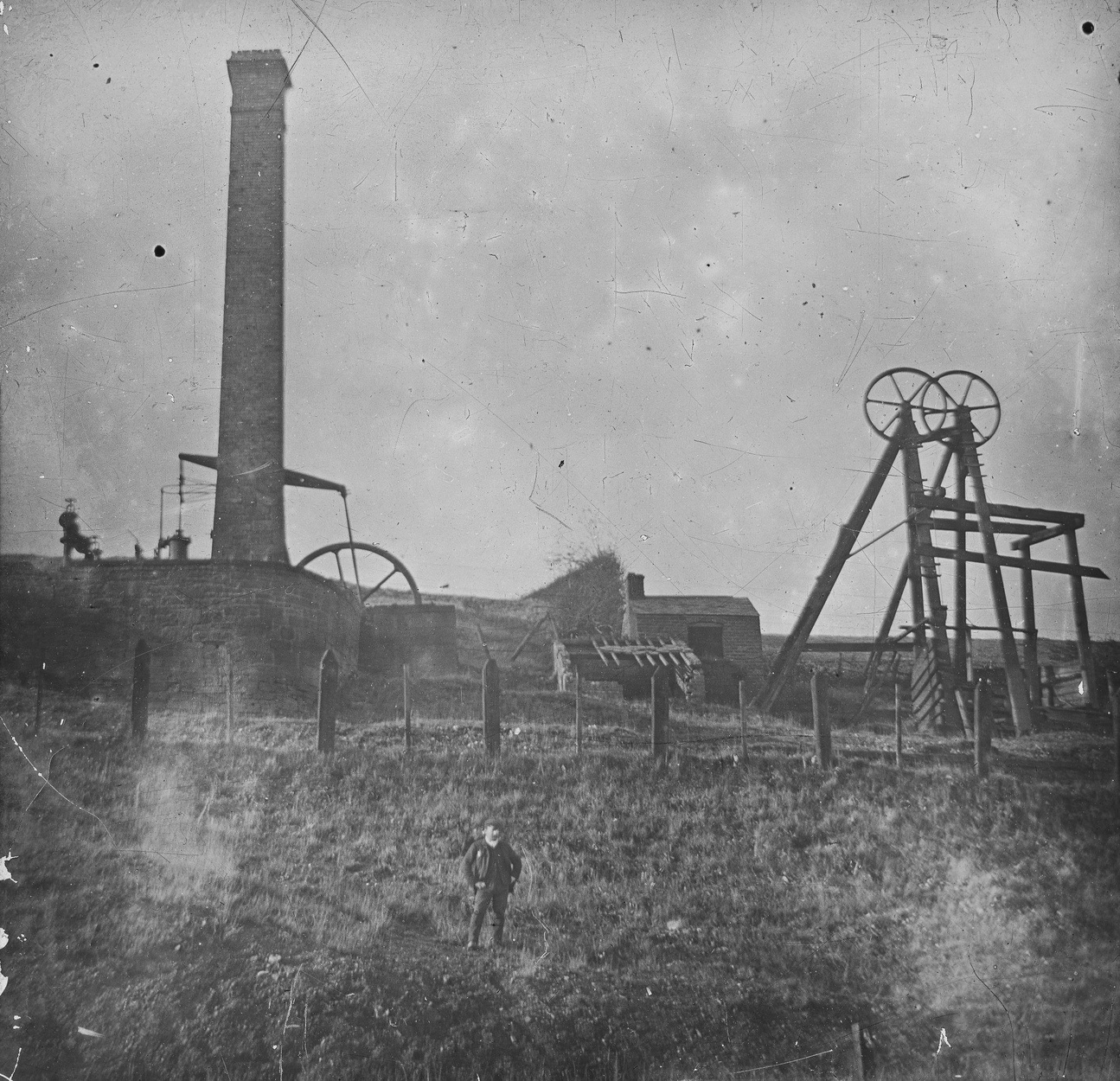
The colliery ground is part of the wider Brymbo industrial site, west of the village. The steelworks that the coal was raised to feed closed in 1990-91 and its remains, including Wilkinson’s furnace ground, have since been conserved as an industrial heritage site. A photograph of the old Brymbo works, probably Cae Penty Colliery, survives in the Geoff Charles collection at the National Library of Wales.
The Brymbo ironworks and steelworks site west of the village, now an industrial heritage attraction, and the miners’ and ironworkers’ housing that makes up most of Brymbo itself. St Mary’s church of 1872, built to replace the church that subsidence closed, stands on the outskirts.
Related mines
- Smelt Colliery — Both were worked by John Wilkinson and then by the Brymbo Coal Company from 1846; the Smelt outlasted the Brymbo pits, closing in 1967 as the last mine in the district.
Nearby mines
- Vron Colliery — 0.2 miles (0.3 km) W
- Pentrefron Colliery — 0.4 miles (0.6 km) SW
- Talwrn Colliery — 0.6 miles (0.9 km) S
- Plas Power Colliery — 0.7 miles (1.2 km) SE
- Smelt Colliery — 0.9 miles (1.5 km) N
Straight-line distance, within 9 miles (15 km). Show on the map.
What's uncertain
Points where sources disagree or the record could not be settled; both accounts are kept. All open questions in the archive.
- The BGS mine-plans catalogue holds a Mining Remediation Authority abandonment plan titled 'Brymbo' (catalogue 6286, Drowsall, Powell & Queen (Wall & Bench), dated 1914); the catalogue gives no location and the plan's details do not clearly tie it to this working, so it may belong to another of the same name. (uncertain) 4
Recorded claims
Individual factual claims, each attached to the source(s) that support it below. Where sources disagree, both are kept.
- The official list of collieries at work in 1880 returns the pit as "Brymbo, Wrexham, The Brymbo Coal Company". 1
- John Wilkinson bought Brymbo Hall and its estate from the Assheton-Smith family in 1792 for £14,000, mined coal and ironstone there and had erected his first blast furnace east of the Hall by 1796, producing 884 tons of iron in that first year. 2,3
- By 1821 there was a total of 41 coal pits on the Brymbo Hall estate alone. 2
- Coalmining at Brymbo goes back to the fifteenth century, although it was then little more than surface digging; early records show the first coal barons as the Grosvenors of Eaton and the Myddeltons of Chirk Castle. 2
- The first church in Brymbo, St John’s, consecrated in 1838, was closed in 1869 after being affected by subsidence, and St Mary’s was built in 1872 on the outskirts of the village to replace it. 2
- Many of the area’s collieries ran into geological and financial problems by the time of the Great Depression; the last deep mine, the Plas Power pit near Southsea, closed in 1938 and the Smelt drift in 1967, with the remaining coal taken by opencast working west of the steelworks during 1972-75. 2
- The BGS mine-plans catalogue holds a Mining Remediation Authority abandonment plan titled 'Brymbo' (catalogue 6286, Drowsall, Powell & Queen (Wall & Bench), dated 1914); the catalogue gives no location and the plan's details do not clearly tie it to this working, so it may belong to another of the same name. (uncertain) 4
Photographs & further reading
The works the coal was raised to feed, from Wilkinson’s furnace of 1796 through the 1884 incorporation of the Brymbo Steel Company to the closure of 1990-91 — the frame the colliery only makes sense inside.
View sourceSources
- (secondary) List of coal mines UK 1880 — Coalmining History Resource Centre
- (secondary) Brymbo — Wikipedia
- (secondary) Brymbo Steelworks — Wikipedia
- (primary) BGS / Mining Remediation Authority mine plans: BRYMBO — British Geological Survey / Mining Remediation Authority
Record created: 6 September 2026 · Last researched: 6 September 2026