 MineArchive
Brereton Colliery
| Also known as | Brereton Collieries, Brick Kiln Colliery |
|---|---|
| Location | Brereton, Rugeley, Staffordshire — 52.7412, -1.9296 (exact) |
| Commodities | Coal, Fireclay, Ironstone |
| Type | Coal |
| Worked | By at least 1814–July 1960 |
| Maximum depth | Unknown. The Cannock Chase seams near Rugeley lie at around 1,600 feet, roughly twice the depth of those in the South Staffordshire field beyond the Bentley Fault, but that describes the coalfield rather than this colliery. |
| Operators | Earl of Shrewsbury (1834–?), Brereton Collieries Ltd. (?–1946), National Coal Board (1947–1960) |
Overview
A long-lived colliery at Brereton on the edge of Rugeley, at the northern end of the Cannock Chase coalfield, in existence by at least 1814 and worked until July 1960. It belonged for much of the nineteenth century to the Talbot earls of Shrewsbury, later to Brereton Collieries Ltd, and passed to the National Coal Board in 1947. It sold household, manufacturing and steam coal and also raised ironstone and fireclay, and by the 1930s employed around 1,410 people. Two separate disasters mark its history: a firedamp explosion in the shaft in 1861 that killed seven, and an inrush of water into the Coppice Pit in 1908 that killed three and left their bodies entombed.
History
Coal was being got at Brereton well before the colliery took its modern form. The Victoria County History records it in existence by at least 1814 and being worked in 1834 by Earl Talbot, and by at least 1817 there was a wharf south-east of Rugeley connected by rail to the colliery, a line whose course could still be made out near the Wesleyan almshouses in Brereton in the 1950s. The Marquess of Anglesey and Earl Talbot, later Earl of Shrewsbury, were the two landowners who put coal mining on a proper footing at Brereton in the middle of the century; the neighbouring Hayes Colliery was worked by Joseph Palmer by 1834 and by the Marquess of Anglesey in 1851, and closed before 1928.
The present drawing shaft was sunk in 1876. In February 1861, before that, an explosion of firedamp in one of the shafts killed seven men and produced an unusually pointed inquest verdict about ventilation (see Disasters, below). A second disaster came on 15 February 1908, when water broke into the Coppice Pit and three men were drowned in the dip workings; the question of recovering their bodies reached the floor of the Commons a month later.
The colliery grew steadily. The government Lists of Mines record 70 employed in 1894 and 122 by 1896, but by 1905 the returns are made separately for two pits, Coppice with 181 and Hayes with 549. Thereafter the figures are for the group: 748 in 1910, 684 in 1915, 1,020 in 1923, and 1,410 from 1933 through 1940, falling to 1,210 in 1947. The seams worked are given as the Shallow, the Yard and the Deep. Alongside coal for household, manufacturing and steam use the colliery raised ironstone throughout, and fireclay in the 1890s.
It was still a substantial concern after nationalisation. Writing in 1957 the Victoria County History noted that much of the coal had been worked out but expected production to continue for about fifteen years. It did not: the colliery closed in July 1960, and the National Coal Board's attention in the district turned to the new pit it was then preparing at Lea Hall Farm.
Geology
Brereton stands at the northern corner of the Cannock Chase coalfield, a rough triangle between Brereton, Essington and Pelsall. The field lies immediately north of the South Staffordshire coalfield and is separated from it by the Bentley Fault, and its seams are far deeper: about 1,600 feet near Rugeley against about 800 feet in South Staffordshire. The colliery worked seams named the Shallow, the Yard and the Deep, and the measures carried ironstone and fireclay as well as coal, all three of which appear in its output returns. Water was the recurring problem in these measures: it flooded the lower seams after a fault was struck before the 1861 explosion, and it broke into the Coppice Pit again in 1908, still flowing through the submerged workings at 500 gallons a minute a month later.
Geological setting: Sedimentary Beds and Seams (well documented example)
Workings
The colliery was worked from more than one pit and the returns treat it as a group: in 1905 the Lists of Mines record Coppice and Hayes separately under the Brereton name. The present drawing shaft was sunk in 1876. The colliery had a rail connection from an early date, to a wharf south-east of Rugeley by at least 1817, and a colliery line ran to Brereton sidings. Both of the colliery's disasters turned on the interaction of shafts and water: in 1861 a fault had let water into the lower seams and it rose until it cut off the connection between the two shafts, ending the ventilation of the sump in which the explosion then happened; in 1908 the dip workings of the Coppice Pit were submerged and the management's effort went into keeping the water out of the main workings rather than unwatering the ground where the bodies lay.
Closure
Brereton closed in July 1960 after roughly a century and a half of working. The Victoria County History, written in 1957, recorded that much of the coal had by then been worked out but expected another fifteen years of production, so the closure came sooner than the industry locally had assumed. The Cannock Chase seams around Rugeley are deep, around 1,600 feet, and the National Coal Board's investment went instead into the new Lea Hall pit north of the town, boreholes having finally proved coal there by 1956.
What remains
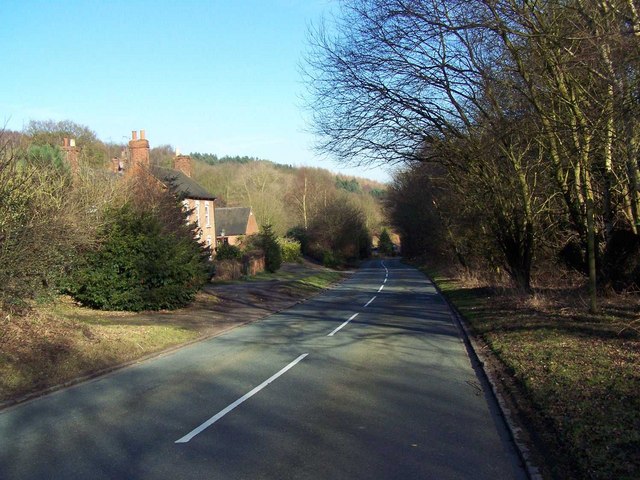
The colliery is gone. A Geograph photograph from 2008 records the house near Slade House Farm that stood opposite the old colliery, once called Brick Kiln Colliery, and was for many years the home of various colliery officials. Around Brereton the industrial past survives mainly in names and alignments: Colliery Road and Coalpit Lane, the crossing where the Brereton Colliery Company's railway crossed Colliery Road, and the site of the main and air shafts of the earlier Hill Pit, which worked between 1800 and 1850 on Lord Paget's land.
No colliery structures are recorded as standing. The course of the early railway to the Rugeley wharf could still be distinguished near the Wesleyan almshouses in Brereton when the Victoria County History was written in the 1950s, and the wharf itself went out of commercial use between 1940 and 1956. A miners' memorial to Brereton and Lea Hall collieries has been dedicated at Rugeley.
Related mines
- Wimblebury Colliery — Cannock Chase pits on the Rugeley side, worked in the same coalfield.
Nearby mines
- West Cannock Colliery — 2.2 miles (3.5 km) SW
- Cannock Wood Colliery — 2.3 miles (3.7 km) SW
- East Cannock Colliery — 2.8 miles (4.5 km) SW
- Cannock Chase No. 8 Colliery — 3.3 miles (5.3 km) S
- Wimblebury Colliery — 3.4 miles (5.4 km) SW
Straight-line distance, within 9 miles (15 km). Show on the map.
Disasters & major incidents
-
Brereton Colliery Explosion
6 February 1861 · Explosion · 7 fatalities
Seven men and boys were killed by an explosion of firedamp in one of the shafts of the Brereton collieries near Rugeley on 6 February 1861. A fault had been struck, water had flooded the lower seams and had risen far enough, a few days earlier, to cut the connection between the two shafts and so end the ventilation of the sump. The managers knew it and did nothing. Gas gathered under the scaffold covering the sump, escaped as dirt was cleared from it and fired at a workman's candle. Two men were found in the sump and five more, suffocated by afterdamp, in the workings near the shaft. The colliery had no artificial ventilation of any kind. -
Brereton Colliery Inrush
15 February 1908 · Flooding / Inundation · 3 fatalities
Water from a water-bearing stratum broke into the dip workings of the Coppice Pit at Brereton Collieries on 15 February 1908, drowning three men; a month later the bodies still lay entombed, management's efforts having gone entirely into keeping the main workings dry rather than recovering them.
What's uncertain
Points where sources disagree or the record could not be settled; both accounts are kept. All open questions in the archive.
- Writing in 1957 the Victoria County History recorded that much of the coal had been worked out but that production was expected to continue for about fifteen years. The colliery in fact closed in July 1960. (disputed) 2,1
Recorded claims
Individual factual claims, each attached to the source(s) that support it below. Where sources disagree, both are kept.
- Brereton Colliery was in existence by at least 1814 and in 1834 was being worked by Earl Talbot. By at least 1817 a wharf south-east of Rugeley was connected by rail to the colliery. The present drawing shaft was sunk in 1876. 1
- Government Lists of Mines record 70 employed in 1894, 122 in 1896 and 1900, then separate returns in 1905 for Coppice (181) and Hayes (549), and thereafter 748 in 1910, 1,020 in 1923, 1,410 from 1933 to 1940 and 1,210 in 1947. Output is given as 350,000 tons through the 1930s and 300,000 tons in 1947. 2
- The colliery sold household, manufacturing and steam coal, and also raised ironstone throughout its recorded returns and fireclay in 1894. The seams worked were the Shallow, the Yard and the Deep. 2
- A month after water broke into the Coppice Pit, the Home Secretary told the Commons that no steps had yet been taken to unwater the submerged dip workings where the bodies lay, that the management's effort had gone into keeping water out of the main workings, that the feeder was still flowing at 500 gallons a minute, and that if no inquest could be held a special inquiry would be desirable. 3
- Writing in 1957 the Victoria County History recorded that much of the coal had been worked out but that production was expected to continue for about fifteen years. The colliery in fact closed in July 1960. (disputed) 2,1
- The BGS mine-plans catalogue holds a Mining Remediation Authority abandonment plan titled 'Brereton (Pit)' (catalogue WM164, Bottom Robins, Yard, Bass, New Mine, Shallow, Deep, Mealy Grey, dated 1960). 4
Photographs & further reading
Owners from the Earl of Shrewsbury to the National Coal Board, output and employment by List of Mines year from 1894 to 1947 including the separate 1905 returns for the Coppice and Hayes pits, the seams worked, and a roll of men killed at the colliery including the seven of the 1861 explosion and the three of the 1908 inrush.
View sourceThe county history's economic account of Rugeley, which dates Brereton Colliery to at least 1814, records Earl Talbot working it in 1834 and the drawing shaft sunk in 1876, covers the neighbouring Hayes and Fair Oak collieries, and describes the early rail connection to the wharf south-east of the town.
View sourceAlbert Stanley asking the Home Secretary what was being done to recover the men entombed in the Coppice Pit, and Herbert Gladstone's answer on the state of the flooded workings and the likelihood of a special inquiry.
View sourceSources
- (primary) Rugeley: Manors and economic history, Victoria County History of Staffordshire, vol. 5 — British History Online, University of London
- (primary) Brereton Colliery — Durham Mining Museum
- (primary) Brereton Colliery Disaster, HC Deb 18 March 1908 vol 186 cc570-1 — Hansard, UK Parliament
- (primary) BGS / Mining Remediation Authority mine plans: BRERETON (PIT) — British Geological Survey / Mining Remediation Authority
Record created: 10 September 2026 · Last researched: 10 September 2026