 MineArchive
Bedlington 'A' Colliery
| Also known as | Bedlington A Pit, Sleekburn A, The Auld Pit, Bedlington Engine Pit |
|---|---|
| Location | Bedlington (formerly Sleekburn), Northumberland — 55.1402, -1.5725 (exact) |
| Commodity | Coal |
| Type | Coal |
| Worked | 28 September 1838–25 September 1971 |
| Maximum depth | About 600 ft (base of the Low Main seam, sinking section) |
| Operators | Bedlington Coal Co. Ltd (?–1947), National Coal Board (1947–1971), Davison, Easton, Anderson, Stodart, Bates & Henderson |
Overview
The first pit of the Bedlington Colliery, sunk in 1838 at what was then Sleekburn and long called 'the Auld Pit'; it employed over 1,300 men in the 1930s and outlived its sister pits to close in 1971.
History
Bedlington 'A' Pit, also the Engine Pit, was the first shaft of the Bedlington Colliery, twelve miles north of Newcastle. It was begun on 28 September 1838, and was originally called Sleekburn 'A' or 'the Auld Pit'. The account of its sinking records the Moorland or 70-fathom seam at about 50 feet, the Glebe or High Main at about 231 feet, and below the Grey, Yard, Bensham and Five Quarter, the Low Main, six feet thick, at about 600 feet. A partnership of Davison, Easton, Anderson, Stodart, Bates and Henderson held the colliery in the 1850s; from the 1860s it was the Bedlington Coal Company's. The Doctor (D) Pit was sunk nearby in 1854, the E Pit opened in 1859 and the F or Bomarsund Pit in 1905.
The A Pit raised steam coal, and later household coal, from the Five Quarter, Plessey and Yard, and in the 1950s from the Busty, Harvey, High Main, Low Main, Main and Beaumont seams. Its workforce grew from 839 in 1894 to over a thousand by 1910 and 1,347 in 1935 and 1940; in 1947, when the National Coal Board took it over, 906 men raised 299,000 tons. At its peak it produced 320,000 tons a year.
The Beaumont or Harvey workings were abandoned in May 1968, and by 1970 the pit was working the Tilley and Top Main. It was the last of the Bedlington pits: the E Pit closed in 1962, Bomarsund in 1965 and the Doctor Pit in 1968, and the A Pit, with 568 men, closed on 25 September 1971. The pithead site now lies within a housing development.
Geology
Northumberland coalfield: the Moorland or 70-fathom seam (2 ft 8 in) at about 50 ft, the Glebe or High Main (4 ft 7 in) at about 231 ft, the Grey, Yard and Bensham, the Five Quarter at about 532 ft, and the Low Main (6 ft) at about 595 to 601 ft. Later work reached the Plessey, Harvey, Busty, Beaumont, Tilley and Top Main.
Workings
The A or Engine Pit, the first of the Bedlington Colliery's shafts, alongside the Doctor (D), E and F (Bomarsund) pits.
Closure
The Beaumont or Harvey workings were abandoned in May 1968; the pit closed on 25 September 1971, the last of the Bedlington Colliery's pits.
What remains
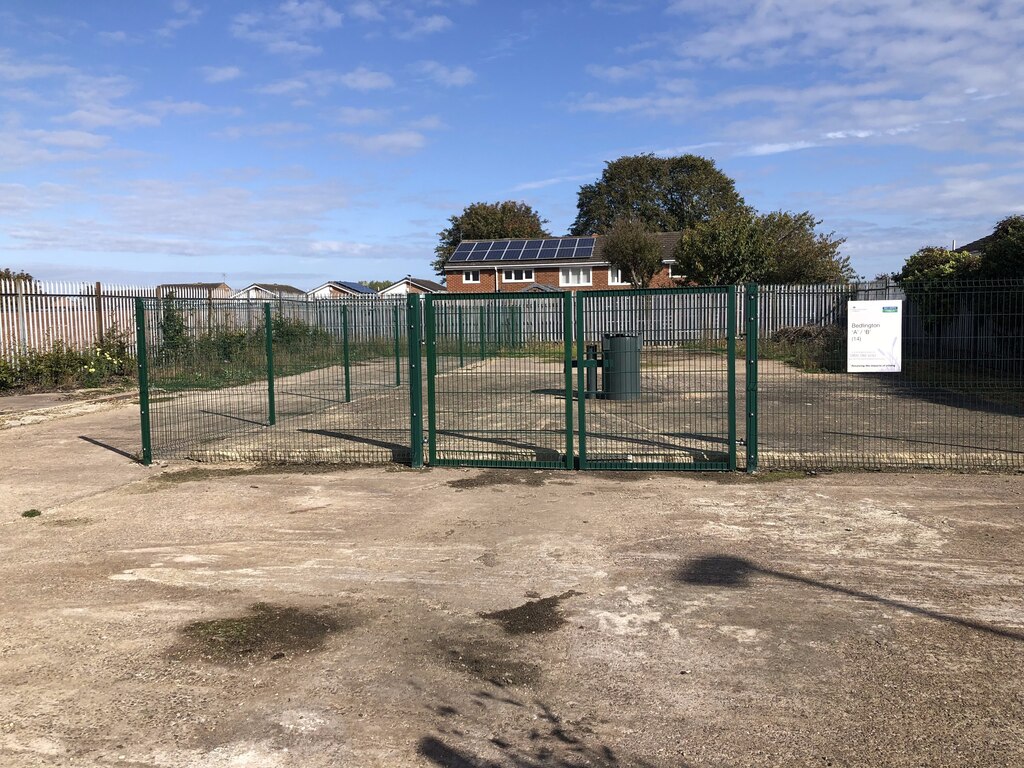
A fenced concrete compound marks the pithead site, in the middle of a housing development (photographed 2025).
A fenced compound on the pithead site.
Redevelopment
The pithead site now lies in the middle of a housing development.
Related mines
- Bedlington 'D' Colliery — Two pits of the one Bedlington Colliery, owned together by the Bedlington Coal Co. from the 1860s and by the NCB from 1947.
- Bomarsund Colliery — The F Pit of the same Bedlington Colliery and Bedlington Coal Co.
- West Sleekburn Colliery — The E Pit of the same Bedlington Colliery and Bedlington Coal Co.
Nearby mines
- Bomarsund Colliery — 0.1 miles (0.2 km) N
- Choppington 'B' Pit — 0.4 miles (0.6 km) N
- Choppington 'A' Pit — 0.5 miles (0.8 km) NW
- Bebside Colliery — 1.2 miles (1.9 km) SE
- West Sleekburn Colliery — 1.2 miles (1.9 km) N
Straight-line distance, within 9 miles (15 km). Show on the map.
Recorded claims
Individual factual claims, each attached to the source(s) that support it below. Where sources disagree, both are kept.
- The A or Engine Pit was begun on 28 September 1838. 1,2
- Bedlington 'A' was originally called Sleekburn 'A' or 'the Auld Pit'. 3
- The Low Main seam, six feet thick, lay at about 600 feet in the A Pit. 2
- At its peak the A Pit produced 320,000 tons a year and employed 980 men. 3
- The A Pit employed 1,347 men in 1935 and 906 in 1947, when it raised 299,000 tons. 1
- Bedlington 'A' worked from 1838 until it closed in 1971. 1,3,4
- The Beaumont or Harvey workings of Bedlington 'A' were abandoned on 20 May 1968. 5
Photographs & further reading
The museum's page for the whole Bedlington Colliery, with the A, Doctor, E and F pits' owners, employment and seams year by year.
View sourceSources
- (primary) Bedlington Colliery — Durham Mining Museum
- (primary) Bedlington Colliery: strata at the Engine or A Pit — Durham Mining Museum
- (secondary) Local History (East Bedlington Parish Council) — East Bedlington Parish Council
- (secondary) Bedlington 'A' (Buddlepit Mine Database) — Buddlepit
- (primary) BGS mine plan: Bedlington 'A', Beaumont or Harvey seam — British Geological Survey
Record created: 6 October 2026 · Last researched: 6 October 2026