 MineArchive
Ystrad Einion Mine
| Also known as | Dolgoch Mine, Ystrad Einon Mine |
|---|---|
| Location | Cwm Einion (Artists' Valley), near Furnace, Ceredigion — 52.5269, -3.9077 (exact) |
| Commodities | Copper, Lead, Silver, Zinc |
| Type | Metal |
| Worked | 18th century–1903 |
| Maximum depth | 30 fathoms |
| Operators | Adam Mason, Pryse family of Gogerddan |
Overview
A small lead, copper and zinc mine in Cwm Einion, remembered less for its output — which was modest and unprofitable — than for the underground waterwheel it left behind, one of only two surviving and accessible in the UK.
History
Ystrad Einion was worked in a small way from the 18th century, with recorded spells around 1745-60 and again from 1853. Adam Mason, a Lancastrian entrepreneur, took the lease in the 1870s and invested over £3,000 modernising the mine, sinking a winze to the 12-fathom level in 1871 and installing a 16-foot underground waterwheel to pump and haul. A new engine shaft reached 30 fathoms and a mile-and-a-half leat was built to supply the site's waterwheels, but full production did not begin until 1891, once reserves were confirmed — and those reserves proved disappointing. An 1891 report found just 11 workers on site, and by 1897 output remained modest. The mine closed in 1903 and much of its machinery was sold or scrapped. Mason's lease was from the Pryses of Gogerddan. The 1891 returns show how little the investment bought: 5 tons of silver-bearing lead worth £37, 10 tons of zinc ore worth £15 and 5 tons of copper ore worth £7, from a workforce of nine men underground and two lads above. The workings ran to four levels, entered by adits and linked by shafts to a final depth of 50 fathoms, the Engine Shaft at the top of the site 460 feet deep; three waterwheels, fed by a leat from the River Einion two kilometres upstream, drove the pumps and winding drum, the stone breaker and crusher, and the jiggers and buddles.
Geology
Ystrad Einion works a north-east/south-west lode, an orientation unusual in mid-Wales and largely confined to the Dyfi estuary area.
Workings
Development below adit level centred on the 1871 winze and the later 30-fathom engine shaft, powered by the underground waterwheel and its supply leat.
Closure
Two gated adits remain accessible and the 16-foot underground waterwheel survives in place.
What remains
A scheduled ancient monument with landscaped public access; two gated adits remain accessible, and the 16-foot underground waterwheel survives in place — one of only two such wheels left in any abandoned UK mine, the other being at Brewery Shaft in Cumbria.
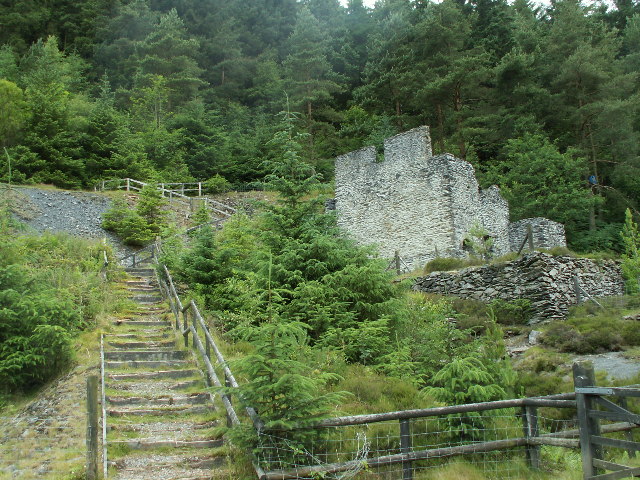
Surviving remains include the crusher house, three wheel pits, two buddle circles, the jigger building, two stone ore bins, a smithy, an ore store, settling troughs and ponds, a gunpowder magazine and the tramways and incline; the 460-foot Engine Shaft stands at the top of the site.
Nearby mines
- Esgair Hir and Esgair Fraith Mines — 2.1 miles (3.4 km) SE, Powys
- Bwlch Glas Mine — 2.8 miles (4.5 km) S
- Eaglebrook Mine — 3.4 miles (5.4 km) SE
- Rhyd Fach Mine — 3.7 miles (6.0 km) SE
- Hafan Mine — 3.9 miles (6.3 km) SE
Straight-line distance, within 9 miles (15 km). Show on the map.
Recorded claims
Individual factual claims, each attached to the source(s) that support it below. Where sources disagree, both are kept.
- The mine's 16-foot underground waterwheel is one of only two surviving and accessible in any abandoned UK mine, the other being at Brewery Shaft, Cumbria. 1
- The mine is officially catalogued as a National Coal Board mineral plan (KP16979) at grid reference SN78SW, confirming lead and copper as the recorded minerals. 2
- Adam Mason leased the land from the Pryses of Gogerddan and sank over £3,000 in equipment; an 1891 report notes just 11 workers, nine men underground and two lads aged between 13 and 18 above ground, and in 1891 the mine produced 5 tons of silver-bearing lead (£37), 10 tons of zinc ore (£15) and 5 tons of copper ore (£7). Water came by a leat from the River Einion 2 km upstream to three waterwheels: one for the pumps and winding drum at the main shaft, one for the stone breaker and crusher, one for the jiggers and buddles. Other features are waste tips, two stone ore bins, a smithy, an ore store, settling troughs and ponds, a gunpowder magazine and tramways with an incline; below ground are four levels of workings entered by adits and linked by shafts to 50 fathoms, with the underground waterwheel (NPRN 415676) surviving in place. The site is at SN 70680 93820. 3
- Buddlepit records the mine, also known as Dolgoch, as worked from 1700 to 1903, at 52.52705, -3.906939 (SN 7073 9384), with a 460-foot Engine Shaft at the top of the site, the crusher and waterwheel buildings below it with two overgrown buddle pits in front, and the deep adit further down the hill leading at once to an intersection with a stope above, where the underground waterwheel and its pumps stand. 4
Sources
- (secondary) Ystrad Einion Mine
- (primary) Ystrad Einion Mine (BGS Mine Plan #17049) — British Geological Survey
- (primary) Ystrad Einion Lead, Silver, Zinc and Copper Mine (Coflein, NPRN 33908) — Royal Commission on the Ancient and Historical Monuments of Wales
- (secondary) Ystrad Einion aka Dolgoch (Buddlepit Mine Database) — Buddlepit / Mining History Trust
Record created: 22 August 2026 · Last researched: 24 September 2026