 MineArchive
Watergate Colliery
| Location | Washingwells, near Sunniside, Gateshead, Tyne and Wear — 54.9337, -1.6543 (approximate) |
|---|---|
| Commodity | Coal |
| Type | Coal |
| Worked | 1924–20 August 1964 |
| Maximum depth | About 522 feet (Victoria seam) |
| Operators | Priestman Collieries Ltd (1924–1947), National Coal Board (1947–1964) |
Overview
A Priestman coking-coal colliery near Sunniside, Gateshead, opened in 1924 and closed on 20 August 1964, whose site is now Watergate Forest Park.
History
Watergate Colliery lay at Washingwells near Sunniside, about three miles south-west of Newcastle, in the parish of Lamesley. Priestman Collieries Ltd opened it in 1924. The company housed miners on its Broom Lane estate and built a designated footpath with flights of brick steps from the estate down to the colliery so the miners got to work on time.
It raised coking and steam coal, employing 411 in 1925 and 802 by 1930, and its coal went to Dunston Staiths on the Tyne by the Tanfield line. A. Walker was the first manager and J. Elliott managed it through the 1930s. The Hutton seam was given up in July 1938, and the colliery worked the Brockwell, Five Quarter, Stone Coal, Tilley and, at the end, Harvey seams.
The National Coal Board took over in 1947, when 714 men raised 196,000 tons. Employment rose under the Board, reaching 920 men in 1960 and 1961. On 3 July 1947 an explosion of gas killed a hewer, and the fore overman who went to rescue him also died (see Disasters, below).
Watergate closed on 20 August 1964 with 853 men still on its books. After the pit heap was reclaimed in the 1990s the site became Watergate Forest Park, opened in 2000.
Geology
Durham Coal Measures. The shaft section passed the Hutton at about 105 feet, the Beaumont at 277, the Tilley at 316, the Stone Coal at 348 and the Brockwell at 457, and reached the Victoria at about 522 feet. The colliery worked the Brockwell, Busty, Five Quarter, Hutton, Stone Coal, Tilley and Harvey for coking coal.
Workings
A shaft colliery working several seams at once; the Hutton was abandoned on 11 July 1938 and the Brockwell in 1963. Coal left by the Tanfield line for shipment at Dunston Staiths. A cobbled footpath and flights of steps, built of colliery bricks stamped 'APC', linked the company's Broom Lane estate with the pit.
Closure
The colliery closed on 20 August 1964, still employing 853 men.
What remains
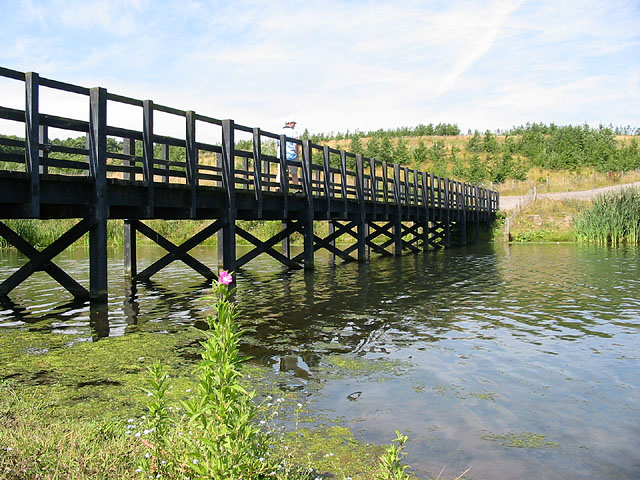
The site is Watergate Forest Park, a 24-hectare Gateshead Council park with a lake, woodland and waymarked paths and steel sculptures inspired by the area's history. The miners' cobbled path and steps from Broom Lane survive in Washingwell Wood.
The cobbled footpath and the 'miners' steps' of colliery brick and concrete, with a second, less well-preserved flight uncovered by park volunteers.
Redevelopment
The pit heap was reclaimed in the 1990s and Watergate Forest Park opened on the site in 2000 as a Gateway to the Great North Forest, with over 120,000 trees planted.
Related mines
- Blaydon Burn Colliery — Both Priestman Collieries Ltd pits until nationalisation in 1947.
Nearby mines
- Marley Hill Colliery — 1.8 miles (2.9 km) SW
- Paradise Colliery — 2.1 miles (3.4 km) N
- Redheugh Colliery — 2.2 miles (3.5 km) NE
- Kibblesworth Colliery — 2.7 miles (4.3 km) SE, County Durham
- Andrews House Colliery — 2.7 miles (4.4 km) SW, County Durham
Straight-line distance, within 9 miles (15 km). Show on the map.
Recorded claims
Individual factual claims, each attached to the source(s) that support it below. Where sources disagree, both are kept.
- Watergate Colliery opened in 1924 and closed on 20 August 1964; Priestman Collieries Ltd owned it until 1947, when the National Coal Board took over. 1,2
- Employment was 411 in 1925, 802 in 1930, 920 in 1960 and 1961, and 853 in 1964. 1
- In 1947 the colliery produced 196,000 tons of coking coal. 1
- The coal was taken to Dunston Staiths by the Tanfield line of the LNER. 3
- Priestman Collieries Ltd built a footpath from their Broom Lane housing estate to the colliery so that the miners got to work on time; the cobbled path and steps of bricks stamped 'APC' survive. 4
- The Hutton seam at Watergate was abandoned on 11 July 1938. 5
- Plans of the Brockwell seam at Watergate record its abandonment in 1963. 6
- The shaft section reached the Victoria seam at 522 feet. 7
- A. Walker was manager in 1925, J. Elliott in 1930 and 1935, and C. Coulson from 1945 to 1950. 8
- Watergate Forest Park opened in 2000 on the site of Watergate Colliery after reclamation in the 1990s, and over 120,000 trees were planted. 3,9
Photographs & further reading
Employment, output and seams from 1925 to 1964, the shaft section, managers and the names of those killed.
View sourceThe Tyne and Wear Historic Environment Record entry for the miners' footpath and steps from Broom Lane to the colliery.
View sourceA visitor's guide to the forest park on the colliery site, with its trails, lake and sculptures.
View sourceSources
- (primary) Durham Mining Museum - Watergate Colliery — Durham Mining Museum
- (primary) Watergate Colliery (HER 7000) - Sitelines — Tyne and Wear HER (Sitelines)
- (secondary) Watergate Forest Park in Gateshead - Fabulous North — Fabulous North
- (primary) Watergate Colliery, miners' steps (HER 9302) - Sitelines — Tyne and Wear HER (Sitelines)
- (primary) Durham Mining Museum - Catalogue of plans of abandoned mines for Watergate Colliery — Durham Mining Museum
- (primary) BGS mine plans: Watergate (Brockwell seam, abandoned 1963) — British Geological Survey / Mining Remediation Authority
- (primary) Durham Mining Museum - Watergate Colliery: shaft details — Durham Mining Museum
- (primary) Durham Mining Museum - Watergate Colliery: colliery management — Durham Mining Museum
- (observational) Watergate Forest Park (Geograph, Chris Tweedy, 2003) — Geograph
Record created: 1 October 2026 · Last researched: 1 October 2026