 MineArchive
Victoria Pit, Nitshill
| Also known as | Victoria Colliery, Nitshill |
|---|---|
| Location | Nitshill, south-west Glasgow |
| Commodity | Coal |
| Type | Coal |
| Maximum depth | 1,050 feet (downcast shaft) |
| Operators | Coats family (?–1851) |
Overview
The Coats family's deep coal pit at Nitshill, south-west of Glasgow, sunk when the Hurlet seams began to fail and said to be the deepest in Scotland, with the Free Trade pit as its upcast. On 15 March 1851 an explosion killed 61 of the 63 men and boys underground, one of the worst mining disasters in Scotland.
History
When the coal and ironstone seams at Hurlet began to fail, pits were sunk at Nitshill, then a mining village south-west of Glasgow. The most important were the Victoria Pit and the Free Trade pit, which acted as its air shaft and lay a quarter to half a mile away; the two were joined by a warren of old workings. They belonged to the Coats family of Paisley and were thought among the most up-to-date pits in the country.
The Victoria was described in 1851 as the deepest pit in Scotland, 1,050 feet to the bottom of the downcast shaft; the workings rose northwards at about one in five, so that at the upcast they were 780 feet down. They covered some 50 acres, worked by stoop and room with pillars of about 18 by 11 yards. The ventilation was thought so good that the furnace had been stopped for months, and the colliers used naked lights.
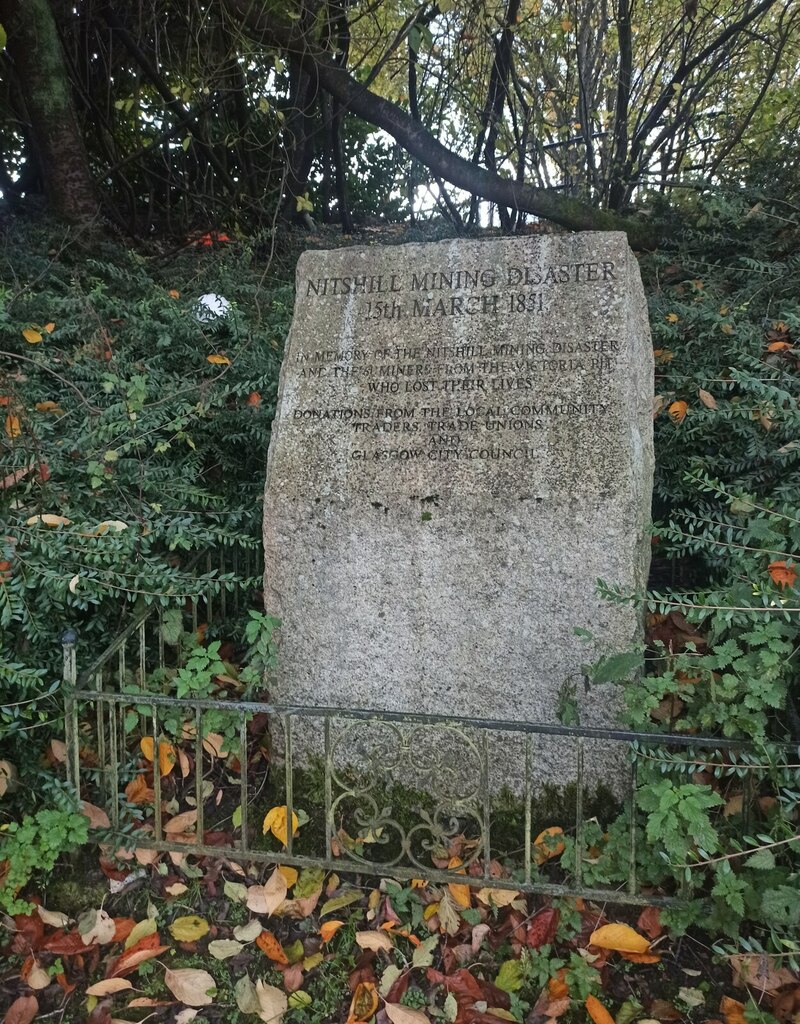
On 15 March 1851 firedamp exploded in the workings and killed 61 of the 63 men and boys below; two survivors were brought up 45 hours later (see Disasters, below). A memorial now stands near Nitshill station.
Geology
A fiery coal seam rising north at about one in five from the downcast towards the upcast.
Workings
A downcast shaft (the Victoria) and an upcast (the Free Trade pit) a quarter to half a mile apart, with a furnace tube; about 50 acres of stoop-and-room workings with brick and deal stoppings.
Closure
Unknown.
What remains
A memorial to the 1851 disaster stands on a small hill beside Nitshill station, next to the war memorial.
Redevelopment
Unknown.
Disasters & major incidents
-
Victoria Pit explosion, Nitshill, 1851
15 March 1851 · Explosion · 61 fatalities
At about twenty to five on the morning of Saturday 15 March 1851 firedamp exploded in the Victoria Pit at Nitshill, owned by the Coats family of Paisley. Of the 63 men and boys below, 61 were killed; two were brought out alive after 45 hours. It was reckoned at the time the worst loss of life in a Scottish mine.
What's uncertain
Points where sources disagree or the record could not be settled; both accounts are kept. All open questions in the archive.
- The pit was 1,050 feet deep at the downcast shaft, the deepest in Scotland. (disputed) 4
- The pit was 120 to 130 fathoms deep. (disputed) 2
Recorded claims
Individual factual claims, each attached to the source(s) that support it below. Where sources disagree, both are kept.
- The Victoria Pit belonged to the Coats family of Paisley. 1,2,3
- The pit was 1,050 feet deep at the downcast shaft, the deepest in Scotland. (disputed) 4
- The pit was 120 to 130 fathoms deep. (disputed) 2
- The Free Trade pit served as the Victoria's air shaft. 1,3
- An explosion on 15 March 1851 killed 61 of the 63 men and boys in the pit. 1,2,5
Photographs & further reading
The local history of the Nitshill pits, the explosion and its memorials.
View sourceNewspaper reports of the 1851 explosion.
View sourceSources
- (secondary) Scottish Mining Website: Nitshill 1851 — Scottish Mining Website
- (secondary) NMRS: Victoria Colliery Explosion, Nithshill, 1851 — Northern Mine Research Society
- (secondary) Nitshill Memories: Coal Mining and the Victoria Pit Disaster — Nitshill Memories
- (secondary) Nitshill Memories: The Victoria Pit Disaster, the explosion — Nitshill Memories
- (secondary) Wikipedia: Nitshill — Wikipedia
- (secondary) Nitshill Memories: The Victoria Pit Disaster, inquiries and memorials — Nitshill Memories
Record created: 11 October 2026 · Last researched: 11 October 2026