 MineArchive
Victoria Pit explosion, Nitshill, 1851
At about twenty to five on the morning of Saturday 15 March 1851 firedamp exploded in the Victoria Pit at Nitshill, owned by the Coats family of Paisley. Of the 63 men and boys below, 61 were killed; two were brought out alive after 45 hours. It was reckoned at the time the worst loss of life in a Scottish mine.
| Date | 15 March 1851 |
|---|---|
| Mine | Victoria Pit, Nitshill |
| Region | Glasgow |
| Primary type | Explosion |
| Associated types | Rescue |
| Fatalities | 61 (61: 53 men and eight lads, by the burial accounts. Two survivors, John Cochran (or Cochrane) and David Coleville, were rescued after 45 hours.) |
| Context | During active mining |
Cause
A stopping was damaged, perhaps by a fall, and with no internal stoppings in the waste the air ran straight to the upcast; firedamp from the waste then fired at the colliers' naked lights. The men had been allowed to start work without an overman's examination, and the furnace had been stopped for months because the ventilation was thought good enough.
What happened
Upwards of sixty colliers went down in gangs from about 3 a.m. with the assistant oversman, Peter Hammond, who carried a Davy lamp; the colliers used ordinary lamps. The blast was heard at Paisley; one cage was blown up the shaft above the pithead frame and fell back with the rope doubled under it. David Coleville, cutting stone at the end of the west level, saw a mass of flame roaring towards him; it turned up the Victoria shaft, and he and Cochran, staggering, caught a breath of fresh air and reached the shaft bottom, where they waited 45 hours in the cold.
Rescue & recovery
Engineers were summoned from Glasgow when early attempts to descend failed; the work went on day and night, though the cage was jammed in the shaft and voices could be heard below. Cochran was brought up first and told rescuers of the second survivor. The bodies were carried to the churchyard of St John's, Darnley Road, Barrhead, over three days.
Investigation & inquiry
The Inspector of Mines found that the stopping had been damaged, that there were no sheath stoppings in the waste, and that the men had started without an inspection. The overseer, Peter Niven, thought a fall had interrupted the ventilation.
Legal & regulatory aftermath
The Coats family headed a fund for the widows and 65 orphaned children with £500 and gave £100 to reward the rescuers; the Earl of Glasgow gave £300 and £50, and the Princes' Theatre held a benefit.
Memorials & commemoration
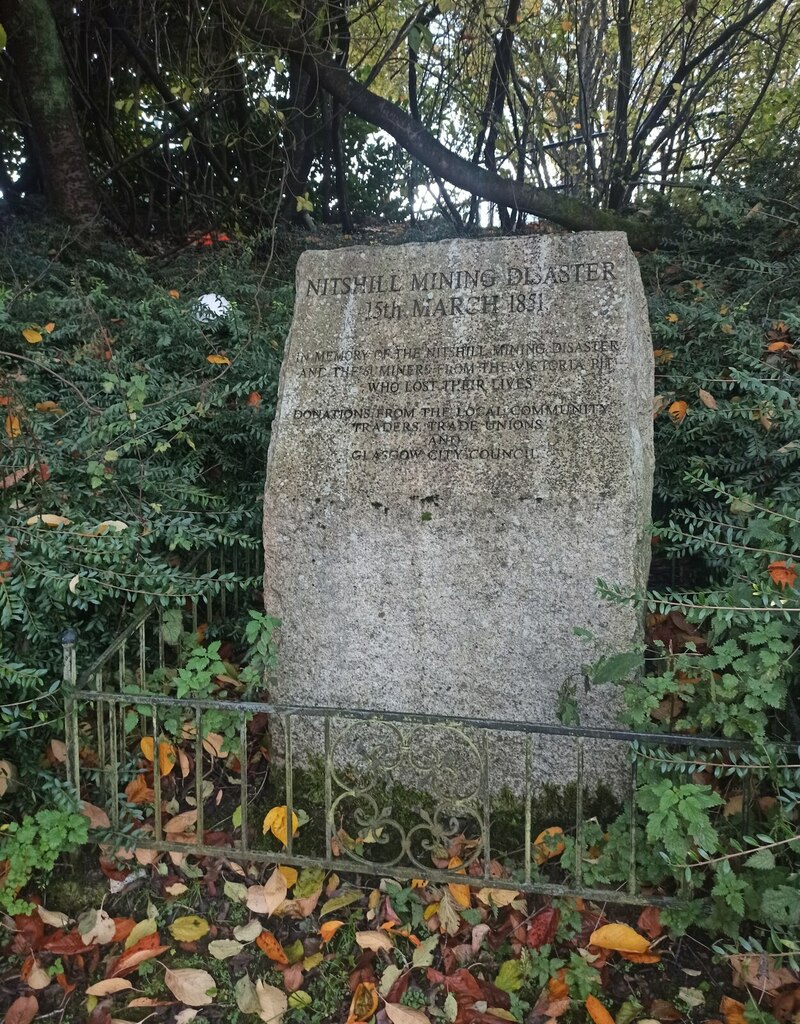
A memorial stands off the main road at Nitshill station beside the war memorial, paid for by the local community, traders, trade unions and Glasgow City Council; its inscription gives the date as 25 March 1851.
What's uncertain
Points where sources disagree or the record could not be settled; both accounts are kept. All open questions in the archive.
- The Nitshill memorial gives the date as 25 March 1851. (disputed) 6
Recorded claims
Individual factual claims, each attached to the source(s) that support it below. Where sources disagree, both are kept.
- An explosion in the Victoria Pit at Nitshill on 15 March 1851 killed 61 of the 63 men and boys underground. 1,2,3
- Two survivors were brought out 45 hours after the explosion. 2,3
- The inspector attributed it to damage to a stopping, which let firedamp from the waste reach the men's naked lights. 4
- The explosion came at about twenty minutes to five in the morning, blowing a cage up the shaft. 5
- The Nitshill memorial gives the date as 25 March 1851. (disputed) 6
Related terminology
Mining terms this disaster is structurally linked to, with the nature of the relationship.
- Cage (contextual relationship)
Named twice in this record, first in the narrative: “…colliers used ordinary lamps. The blast was heard at Paisley; one cage was blown up the shaft above the pithead frame and fell back with…” - Naked Light (contextual relationship)
Named in this record’s cause: “…to the upcast; firedamp from the waste then fired at the colliers' naked lights. The men had been allowed to start work without an overman's…” - Overman (contextual relationship)
Named in this record’s narrative: “…colliers went down in gangs from about 3 a.m. with the assistant oversman, Peter Hammond, who carried a Davy lamp; the colliers used ordinary…” - Pithead (contextual relationship)
Named in this record’s narrative: “…was heard at Paisley; one cage was blown up the shaft above the pithead frame and fell back with the rope doubled under it. David Coleville,…” - Safety Lamp (contextual relationship)
Named in this record’s narrative: “…3 a.m. with the assistant oversman, Peter Hammond, who carried a Davy lamp; the colliers used ordinary lamps. The blast was heard at Paisley;…”
Sources
- (secondary) Scottish Mining Website: Nitshill 1851 — Scottish Mining Website
- (secondary) NMRS: Victoria Colliery Explosion, Nithshill, 1851 — Northern Mine Research Society
- (secondary) Wikipedia: Nitshill — Wikipedia
- (secondary) Nitshill Memories: The Victoria Pit Disaster, inquiries and memorials — Nitshill Memories
- (secondary) Nitshill Memories: The Victoria Pit Disaster, the explosion — Nitshill Memories
- (secondary) Nitshill Memories: Coal Mining and the Victoria Pit Disaster — Nitshill Memories
Record created: 11 October 2026 · Last researched: 11 October 2026