 MineArchive
Taylor Colliery
| Also known as | Taylor Pit |
|---|---|
| Location | Standish Lower Ground, near Wigan, Greater Manchester — 53.5692, -2.6716 (approximate, low confidence) |
| Commodity | Coal |
| Type | Coal |
| Worked | early 1860s–1930 (coal winding) |
| Maximum depth | 586 yards (No. 2 Pit) |
| Operators | John Taylor & Son (1860–1865), Wigan Coal & Iron Co. (1865–1930), Wigan Coal Corporation Ltd (1930–1947), National Coal Board (1947–?) |
Overview
A Standish Lower Ground colliery sunk in the early 1860s by John Taylor & Son and worked by the Wigan Coal & Iron Company from 1865. Its shafts reached the Arley at 489 yards and 586 yards; coal winding ended in 1930 and the pit was kept for pumping and ventilating John Pit.
History
Taylor Colliery, or Taylor Pit, lay at Standish Lower Ground, about a mile and three-quarters west of the West Coast Main Line and three-quarters of a mile north of the Leeds and Liverpool Canal. John Taylor & Son began its shafts in the early 1860s in faulted ground and held it until 1865. The Wigan Coal & Iron Company then worked it until 1930. No. 1 Pit, 12 feet across, wound coal and was the downcast, reaching the Arley at 489 yards. No. 2 Pit, the upcast, met a fault at 90 yards, proved the Arley at 489 yards and went on to 586. A small shaft went down 96 feet to an underground canal. Tunnels were driven through the faults to the Wigan Six Feet, the Pemberton mines and the Haigh Yard.
No. 1 Pit was first fitted for baskets. Wigan Coal & Iron converted it to double-deck cages with wire rope conductors, wound by a twin-cylinder horizontal engine on flat ropes. A furnace at No. 2 Pit ventilated the mine until about 1920, when a Walker Indestructible fan replaced it. The deeper seams were worked out by 1932, the shafts were sealed at about 215 yards, and electric pumps were installed. Coal winding stopped in 1930, and Taylor was kept for pumping and as the upcast for John Pit through the Pemberton Five Feet. In 1920 the company placed a war memorial for the men of Taylor Pit and John Pit in a stone cairn on the edge of Birley Wood, built by the miners.
Geology
Faulted Lancashire Coal Measures: the Ince Four Feet, Ince Seven Feet, Ince Furnace, Cannel, King, Ravine, Haigh Yard, Bone, Smith and Arley, with the Wigan Six Feet and Pemberton mines reached by tunnels through faults.
Workings
No. 1 Pit (12 feet, downcast, coal winding, Arley at 489 yards) and No. 2 Pit (12 feet, upcast, to 586 yards), with a small shaft to an underground canal at 96 feet; cross-measure tunnels through faults; twin-cylinder horizontal winders, double-deck cages; furnace ventilation to about 1920, then a Walker Indestructible fan.
Closure
Coal winding ended in 1930; the deeper seams were exhausted by 1932 and the shafts sealed at about 215 yards. Taylor was retained for pumping and as John Pit's upcast.
What remains
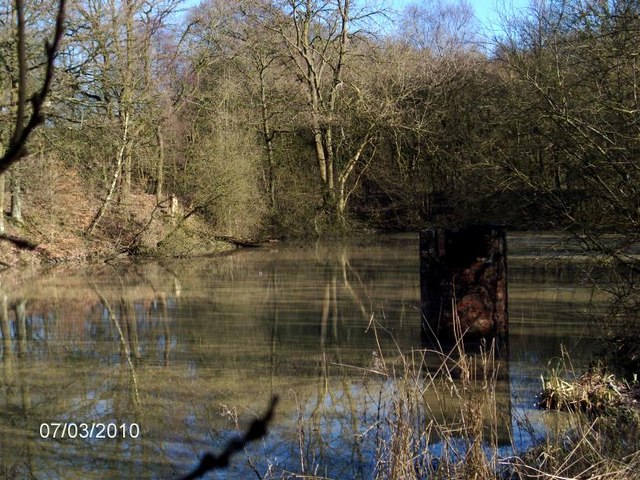
A colliery lodge survives at the former pit, and the 1920 war-memorial cairn stands on the edge of Birley Wood, off Wigan Lower Road.
The memorial cairn of 1920, now without its original plaque, and the colliery lodge.
Redevelopment
Unknown.
Related mines
- John Pit — Linked underground from 1920; Taylor No. 2 Pit was John Pit's upcast.
Nearby mines
- John Pit — 0.2 miles (0.2 km) S
- Orrell Colliery — 1.2 miles (1.9 km) S
- Broomfield Colliery — 1.7 miles (2.8 km) N
- Langtree Colliery — 1.7 miles (2.8 km) N
- Great Haigh Sough — 2.3 miles (3.7 km) E
Straight-line distance, within 9 miles (15 km). Show on the map.
What's uncertain
Points where sources disagree or the record could not be settled; both accounts are kept. All open questions in the archive.
- Its Arley and Yard workings were planned as abandoned in 1921. (uncertain) 2
Recorded claims
Individual factual claims, each attached to the source(s) that support it below. Where sources disagree, both are kept.
- No. 1 Pit reached the Arley at 489 yards; No. 2 Pit proved it at 489 yards and was sunk to 586. 1
- John Taylor & Son held it from 1860 to 1865, then the Wigan Coal & Iron Company to 1930. 1
- Coal winding ceased in 1930; the pit was kept for pumping and ventilating John Pit. 1
- Its Arley and Yard workings were planned as abandoned in 1921. (uncertain) 2
- A 1920 Wigan Coal & Iron war memorial for Taylor Pit and John Pit stands in a cairn on the edge of Birley Wood, built by the miners. 3,4
- A former colliery lodge of Taylor Pit survives. 5
Photographs & further reading
Shafts, seams, winding, ventilation, pumping and closure, from the G. Hayes collection.
View sourceThe 1920 memorial cairn at the former pits and the history of its plaque.
View sourcePhotographs and history of the cairn on the edge of Birley Wood.
View sourceSources
- (secondary) Taylor Colliery — Northern Mine Research Society
- (primary) Mine plan: Taylor, Arley — British Geological Survey
- (secondary) Wigan Coal and Iron Co., Taylor Pit And John Pit - WW1 (Original Memorial Structure) — Imperial War Museums War Memorials Register
- (secondary) Wigan Coal and Iron, Taylor Pit and John Pit (original memorial) — War Memorials Online
- (observational) Taylor Pit (photograph) — Geograph
Record created: 2 October 2026 · Last researched: 2 October 2026