 MineArchive
Shuttle Rake Mine
| Also known as | Shuttle Rake Engine |
|---|---|
| Location | Berristall, south-west of Bradwell, Derbyshire — 53.3118, -1.7689 (approximate) |
| Commodity | Lead |
| Type | Metal |
| Worked | from before 1752 |
| Operators | Joseph Clay (1765–?, owner) — In possession of the Shuttle Rake Engine in 1765 |
A lead mine on Shuttle Rake, Berristall, south-west of Bradwell, whose engine is the first the Bradwell Barmaster recorded, in 1752, and which Joseph Clay of Sheffield held by 1765.
Location
Approximate location. The large pin is this mine; the small round markers are the nearest mines on record. Click one for its page. View on full map
History
Shuttle Rake Mine, worked from the Shuttle Rake Engine on Berristall south-west of Bradwell, stood on one of the major veins of the Bradwell orefield, 19 meers west of the boundary with Hazlebadge liberty. Shuttle Rake runs east to west from the southern flank of Hazlebadge Hill along Intake Dale into Bradwell liberty, then on past Shuttle Rake Head to the Holmes, where it ends abruptly against the Upper Millers Dale Lava. Its history goes back to the mid-seventeenth century, and it was worked for lead along about a mile and a half. The engine is the first the Bradwell Barmaster recorded. In December 1752 the Shuttle Rake Engine Partners, through Matthew Eyley, freed a second taker meer west from their old founder in Shuttle Rake Old Vein, so the founder was older still, and three more meers to the west followed by 1754. A Mr Beech was working the mine in 1760, and in 1765 it was in the possession of Joseph Clay of Sheffield, who also held ground on Dutchman Vein, a branch of the rake.
John Evans, a boy of eight, fell down the shaft at Shuttle Rake Mine while at play. In February 1871 Isaac Middleton, 43, of Smalldale was killed in the mine. The ground around the engine has since been opencast, levelled and restored, but the capped engine shaft survives.
Geology
Shuttle Rake, an east-west vein in the Carboniferous limestone that ends against the Upper Millers Dale Lava; in Intake Dale the lava was met at 52 fathoms in a shaft and was 24 to 25 fathoms thick, very soft and crumbly at the top. The mine worked galena.
Workings
An engine shaft wound by a horse gin on Berristall, 19 meers west of the Hazlebadge liberty boundary, with meers freed westward along the vein. A plan and section of the mine was drawn by J. C. Gilbert in 1948.
What remains
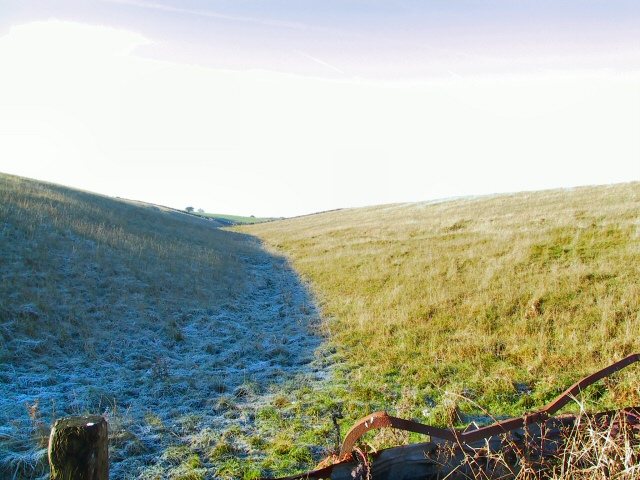
The engine shaft survives, capped, amid levelled and restored land. Most of the rake east of its western end was opencast and restored; part of a gin circle survives on the rake.
The capped engine shaft.
Redevelopment
The rake around the mine was opencast and the land levelled and restored.
Related mines
- Bradwell Edge Mine — Both mines were held by Joseph Clay of Sheffield: the Shuttle Rake Engine in 1765, and Bradwell Edge Mine, freed in his name in 1772.
- Intake Dale Mine — Works the same vein: Shuttle Rake, Intake Dale Mine on its Hazlebadge length east of the Shuttle Rake Engine.
- Rake Head Mine — Both mines were owned by Joseph Clay of Sheffield in the 1750s and 1760s: Mr Clay's Engine at Moss Rake Head and the Shuttle Rake Engine.
Nearby mines
- Chance Mine — 0.5 miles (0.8 km) NE
- Intake Dale Mine — 0.6 miles (0.9 km) E
- Hartle Dale Bottom Mine — 0.7 miles (1.2 km) NE
- Raddlepits Mine — 0.7 miles (1.2 km) NW
- Bank Top Mine — 0.8 miles (1.4 km) NE
Straight-line distance, within 9 miles (15 km). Show on the map.
Further reading
The society's history and gazetteer of the Bradwell lead mines, with the Barmaster's entries for the Shuttle Rake Engine from 1752.
View sourceThe county record of Shuttle Rake, its restored length and its surviving hillocks and gin circle.
View sourceA transcription of Evans's parish history, including his list of deaths at the Bradwell lead mines.
View sourceSources
- (primary) A History and Gazetteer of the Lead Mines within Bradwell Liberty (Bulletin 17-5) — Peak District Mines Historical Society / J.H. Rieuwerts
- (secondary) Bradwell: Ancient and Modern, chapter XIII (Seth Evans, 1912) — Wishful Thinking (transcription)
- (secondary) MDR8796 - Intake Dale Mine and Shuttle Rake, Tideswell, Bradwell and Hazlebadge — Derbyshire Historic Environment Record
Record created: 18 November 2026 · Last researched: 18 November 2026