 MineArchive
Roughton Gill Mine
| Location | Caldbeck Fells, Cumbria — 54.6998, -3.0815 (approximate) |
|---|---|
| Commodities | Barite, Copper, Silver, Zinc, Lead |
| Type | Metal |
| Worked | 12th century (earliest possible)–17th century |
| Maximum depth | Unknown. |
| Operators | Company of Mines Royal (1564–1630) |
Overview
Roughton Gill, in the Caldbeck Fells, was regarded as one of the richest of the mines worked by the German miners the Crown brought to Cumbria in the 1560s — a sister operation to Goldscope in the Newlands Valley, run by the same company barely a decade after it was founded.
History
Mineral deposits in the Caldbeck Fells may have been worked as far back as the 12th century, but documented mining history begins with the arrival of skilled German miners around 1564, brought in under Elizabeth I to develop Cumbria's mineral wealth and share their expertise; their descendants still live in the area today. Roughton Gill was considered one of the richest of the mines these German miners worked in the district, run under the same Company of Mines Royal, and later the Hochstetter family's supervision, that developed Goldscope in the Newlands Valley over the same period. The rich Driggith deposit, nearby, brought renewed activity to the wider Caldbeck Fells district in the early 17th century, and the most substantial phase of exploration across the fells as a whole came much later, from the 1820s onward, when many individual mines in the area were worked, reworked or newly opened.
Geology
The mine worked copper- and lead-bearing veins in the Skiddaw Group rocks of the Caldbeck Fells, the same general mineralised district that produced Goldscope's ore in the neighbouring Newlands Valley.
Geological setting: Hydrothermal Deposits (well documented example), Veins and Lodes (well documented example)
Workings
As with the other Cumbrian mines worked by the German miners of the 1560s, Roughton Gill was developed using contemporary Elizabethan mining and dressing techniques brought over specifically for the purpose by skilled continental miners unfamiliar to England at the time.
Closure
Major German-era working had ended by the mid-17th century, though the wider Caldbeck Fells district, including ground near Roughton Gill, saw renewed exploration in the early 1600s and again, more substantially, from the 1820s onward.
What remains
No underground access to the old vein workings survives today; one former working, Barstow's Trench, has been backfilled. Extensive spoil heaps remain, still containing mineralised material despite generations of collecting. Mineral collecting on the site requires a Lake District National Park Authority permit.
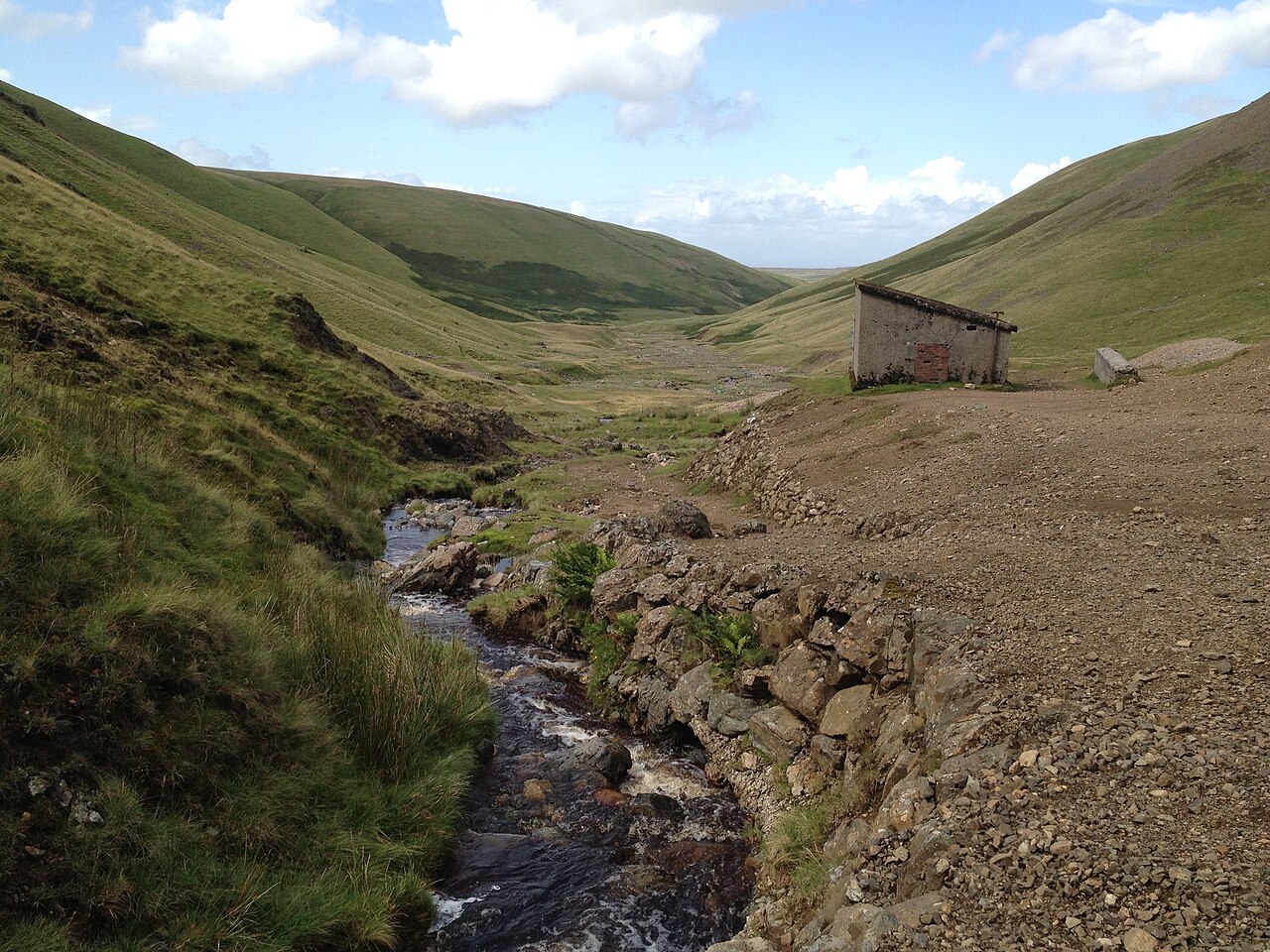
Ruined mine buildings and spoil heaps survive across a wide area of the gill; a sealed building near the head of the gill is a notable surviving structure.
Related mines
- Silver Gill Mine — The Silvergill Vein, exhausted by about 1700, is one of the Roughton Gill veins.
Nearby mines
- Potts Ghyll Mine — 0.8 miles (1.4 km) NE
- Deer Hills Baryte Mine — 0.9 miles (1.5 km) NE
- Brandy Gill Mine — 1.2 miles (2.0 km) E
- Dry Gill Mine — 1.2 miles (2.0 km) E
- Carrock Fell Mine — 1.5 miles (2.3 km) SE
Straight-line distance, within 9 miles (15 km). Show on the map.
Recorded claims
Individual factual claims, each attached to the source(s) that support it below. Where sources disagree, both are kept.
- Sources disagree on the exact closure date: one account gives 1878, another 1894. 1
- The Geological Conservation Review site at NY 304 344 records at least four roughly parallel north-east veins in substantial faults, the South Vein up to nine metres wide in the 'Great Bunch' and worked most with the North Vein; the ores were galena, chalcopyrite and sphalerite in quartz, chalcedony, calcite and barite, the Silvergill Vein was exhausted by about 1700, and the dumps still hold appreciable mineralised material. 1
- The site is selected for its supergene minerals, pyromorphite, cerussite and malachite above all, with mimetite, plumbogummite, hemimorphite, linarite, leadhillite, anglesite, brochantite, tsumebite and the newly described redgillite, examples of which sit in the world's major mineral collections; ancient hand-cut coffin levels remain visible. 1
- German miners came to the Lake District in 1563; mining at Caldbeck began in June 1566, was soon discontinued and resumed in 1568, continued under the Hochstetter family until about 1630, and was not resumed until about 1695. 2
Sources
- (secondary) Roughten Gill Mine
- (secondary) German mines at Caldbeck — Wikipedia
- (secondary) Digging deep beneath those golden daffodils — Whitehaven News
Record created: 22 August 2026 · Last researched: 24 September 2026