 MineArchive
Polmaise Colliery
| Location | Fallin, Stirling — 56.1160, -3.9010 (approximate) |
|---|---|
| Commodity | Coal |
| Type | Coal |
| Worked | From January 1904–December 1983 |
| Maximum depth | Unknown. |
| Operators | Archibald Russell Ltd (1904–1947) |
Overview
A Stirlingshire village pit sunk from 1904 whose closure announcement over disputed 'geological faults' triggered the first walkout of the 1984-85 miners' strike — Fallin was the first colliery in Britain out, and the last back.
History
Polmaise Colliery was developed by Archibald Russell Ltd, with the village of Fallin created specifically to house its workforce when the pit was sunk in 1904 — shafts Nos. 1 and 2 that January, Nos. 3 and 4 from that August, with the No. 3/4 pit producing coal by April 1906. Often among the most productive and profitable pits in the Scottish coalfield, Polmaise 3 and 4 went on to become Stirling's last operational colliery and the last village pit working anywhere in Scotland.
The National Coal Board announced its proposal to close Polmaise on 13 December 1983, and in January 1984 cited 'geological faults' and a lack of market for its coal, despite £15.8 million having just been spent on a redevelopment programme that had left the colliery nearly ready to resume full production. The workforce and union disputed the geological justification publicly, and Polmaise became the first colliery in the whole of Britain to strike over its closure, beginning the 56-week national miners' strike of 1984-85 — Fallin's miners were first out and the last to return when the strike ended. The colliery nonetheless survived the strike's end and continued working for a further two years before British Coal finally closed it on 15 July 1987, with 112 workers made redundant.
Geology
Coal of the Stirling field; the disputed geological faults that were given as the reason for closure are what triggered the 1984 walkout.
Workings
Four shafts sunk 1904, Nos. 1 and 2 in January and Nos. 3 and 4 from August, with the No. 3/4 pit in production by April 1906.
Closure
Closure announced December 1983 over disputed 'geological faults'; the colliery survived the 1984-85 strike but finally closed on 15 July 1987, with 112 redundancies.
What remains
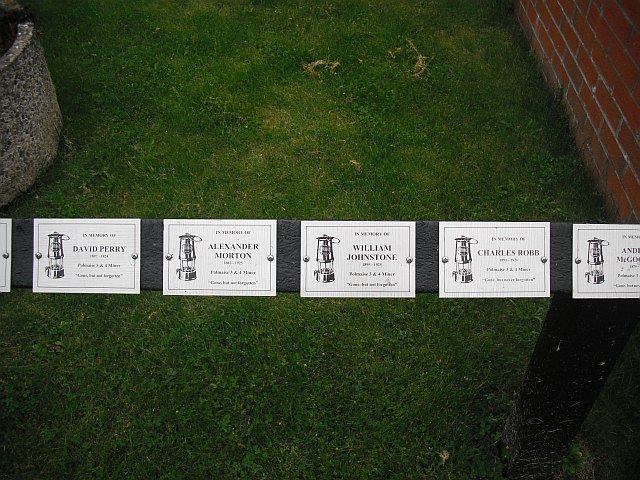
The site is now home to the Polmaise Murray Mining Museum, an open-air museum opened in 1994 displaying machinery used at the former Polmaise collieries, alongside a memorial naming individual miners killed working the Polmaise pits.
Related mines
- Dechmont Colliery — Both Archibald Russell Ltd collieries.
- Ferniegair Colliery — Both worked by Archibald Russell Ltd.
Nearby mines
- Pirnhall Colliery — 2.4 miles (3.9 km) SW
- Bannockburn Colliery — 3.0 miles (4.8 km) SE
- Glenochil Colliery — 3.7 miles (5.9 km) NE, Clackmannanshire
- Plean Colliery — 4.4 miles (7.1 km) S
- Forthbank Colliery — 4.5 miles (7.3 km) E, Clackmannanshire
Straight-line distance, within 9 miles (15 km). Show on the map.
Disasters & major incidents
-
Polmaise Colliery explosion, 1906
28 January 1906 · Explosion · 2 fatalities
Two men were killed in Polmaise No. 2 Pit on Sunday 28 January 1906 when gas left by a slowed weekend fan fired at their naked lights; they had gone in uninspected workings on the under-manager's orders.
Recorded claims
Individual factual claims, each attached to the source(s) that support it below. Where sources disagree, both are kept.
- Polmaise Colliery was developed by Archibald Russell Ltd, with the village of Fallin created to house its workforce; shafts Nos. 1 and 2 were sunk in January 1904, Nos. 3 and 4 from August 1904, in production by April 1906. 1,2
- The NCB announced its proposal to close Polmaise on 13 December 1983 and in January 1984 cited 'geological faults' and a lack of market for its coal, despite £15.8 million recently spent on redevelopment; the workforce and union publicly disputed the geological justification. 2
- Polmaise became the first colliery in Britain to strike over its closure, beginning the 56-week national miners' strike of 1984-85; Fallin's miners were first out and the last to return when the strike ended. 2
- The colliery survived the strike's end and continued working for a further two years before British Coal finally closed it on 15 July 1987, with 112 workers made redundant. 1
- The site is now home to the Polmaise Murray Mining Museum, an open-air museum opened in September 1994 displaying machinery used at the former Polmaise collieries, and a memorial naming individual miners killed working the Polmaise pits. 3
Photographs & further reading
The Stirling Smith Art Gallery and Museum's retrospective on the closure and the 1984-85 strike.
View sourceThe Polmaise Project's detailed mining-heritage history of the colliery and village.
View sourceSources
- (secondary) 30th Anniversary of the Polmaise Colliery Closure — The Stirling Smith Art Gallery and Museum
- (secondary) 01. Polmaise, a village pit — Polmaise: the fight for a pit
- (observational) Polmaise - Murray Mining Museum — Geograph
Record created: 27 August 2026 · Last researched: 15 September 2026