 MineArchive
Plean Colliery
| Also known as | East Plean Colliery |
|---|---|
| Location | East Plean, near Bannockburn, Stirling — 56.0551, -3.8662 (approximate) |
| Commodity | Coal |
| Type | Coal |
| Worked | By 1901–1962 (abandoned 1963) |
| Maximum depth | 402 m (No. 5 shaft, sunk 1931) |
| Operators | Plean Colliery Company |
Overview
A Stirlingshire coking-coal pit south of Bannockburn, worked from the turn of the twentieth century until 1962 and remembered chiefly for the explosion of 1922 that killed twelve men. Its site and the grounds of Plean House together form Plean Country Park.
History
Plean was one of the deep pits sunk into the Stirlingshire coalfield as the industry pushed below the older shallow workings, with production under way by 1901 under the Plean Colliery Company. Three shafts were worked — Nos. 3, 4 and 5 — and coke ovens were built at Plean 3, the colliery producing coking, steam and house coals. The deepest shaft, No. 5, was sunk in 1931 to 402 m; No. 4, at 165 m, served only for ventilation and pumping.
On 13 July 1922 an explosion in the Torwood Levels killed twelve men (see Disasters, below). The pit worked on for another forty years afterwards, employing 461 people in 1948 and reaching its greatest workforce of 528 in 1958, but demand for coke was shrinking by the end of that decade.
Geology
The colliery worked coking, steam and house coals in the Stirlingshire coalfield, the deepest of its shafts reaching 402 m.
Workings
Three shafts: No. 5, sunk in 1931, at 402 m; No. 4 at 165 m, used only for ventilation and pumping; and No. 3 nearby, where the coke ovens stood. In 1948 output was 400 tons a day, 114,406 tons in the year, with 461 employees, a Baum feldspar washer, and baths of 1932 and a canteen at the No. 5 pit.
Closure
Demand for coke was falling away by 1959, and the colliery closed in 1962; it was formally abandoned the following year.
What remains
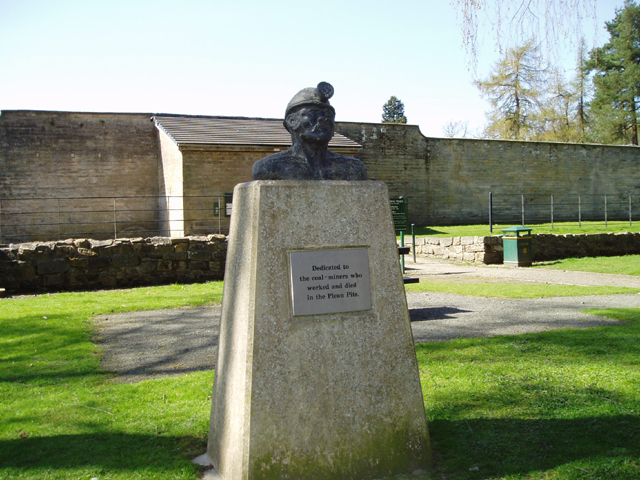
The colliery site and the grounds of the neighbouring Plean House are now Plean Country Park, run by Stirling Council. A mining memorial stands in the park.
The colliery buildings have gone; what survives is the reshaped ground of the country park, together with a memorial to the men who worked and died at the pit.
Redevelopment
The site was taken into Plean Country Park, which combines the former colliery ground with the policies of Plean House as public open space.
Nearby mines
- Bannockburn Colliery — 1.6 miles (2.6 km) N
- Herbertshire Colliery — 2.8 miles (4.5 km) SW, Falkirk
- Pirnhall Colliery — 3.0 miles (4.9 km) NW
- Carmuir Colliery — 3.5 miles (5.6 km) SE, Falkirk
- Carronhall Colliery — 3.8 miles (6.1 km) SE, Falkirk
Straight-line distance, within 9 miles (15 km). Show on the map.
Disasters & major incidents
-
East Plean Colliery explosion, 1922
13 July 1922 · Explosion · 12 fatalities
A shot fired in the Torwood Levels blew out instead of breaking the coal, igniting coal dust and killing twelve men; four more were overcome by carbon monoxide, and the officials who led the recovery were poisoned in their turn.
Recorded claims
Individual factual claims, each attached to the source(s) that support it below. Where sources disagree, both are kept.
- Plean worked three shafts — No. 5, sunk in 1931 to 402 m; No. 4 at 165 m, used only for ventilation and pumping; and No. 3, where the coke ovens stood. 1
- In 1948 the colliery produced 400 tons a day and 114,406 tons in the year with 461 employees, a Baum feldspar washer, and baths dating from 1932. 1
- The average workforce was 441, peaking at 528 in 1958. 1
- Demand for coke was shrinking by 1959; the colliery closed in 1962 and was formally abandoned in 1963. 1
- An explosion at East Plean on 13 July 1922 killed twelve men (see Disasters). 1,2
Sources
- (primary) Plean Colliery — Canmore/Trove — Historic Environment Scotland
- (secondary) East Plean Colliery Explosion, Bannockburn, 1922 — Northern Mine Research Society — Northern Mine Research Society
Record created: 27 August 2026 · Last researched: 28 August 2026