 MineArchive
East Plean Colliery explosion, 1922
A shot fired in the Torwood Levels blew out instead of breaking the coal, igniting coal dust and killing twelve men; four more were overcome by carbon monoxide, and the officials who led the recovery were poisoned in their turn.
| Date | 13 July 1922 |
|---|---|
| Mine | Plean Colliery |
| Region | Stirling |
| Type | Explosion |
| Fatalities | 12 |
| Injuries | 5 |
| Context | During active mining |
Cause
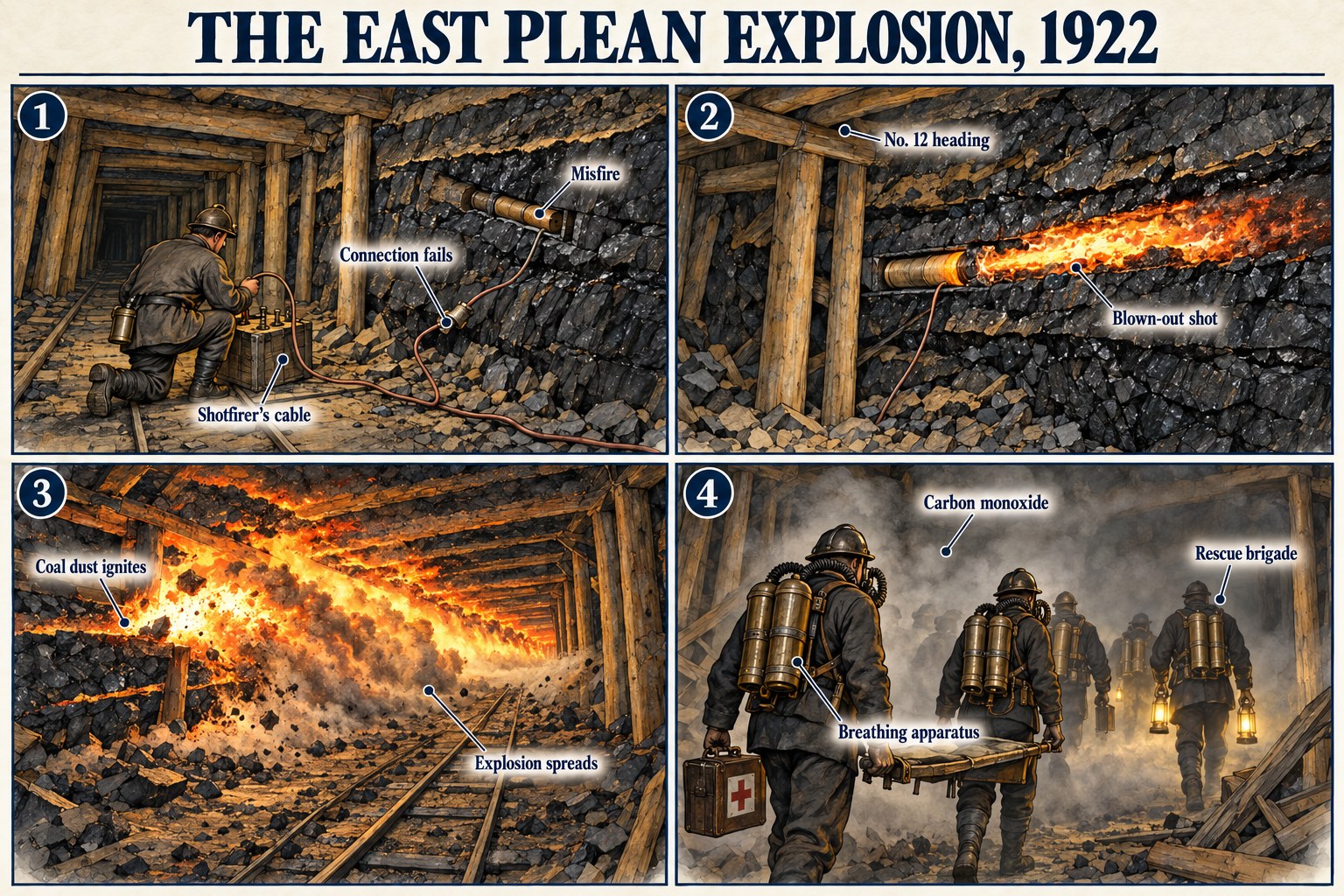
A shotfirer's cable had come away from its battery connection, causing a misfire in the upper coal seam. The shot that was then fired in No. 12 heading blew out — venting its force along the hole rather than breaking the coal — and the flame ignited coal dust in the workings, possibly with some contribution from firedamp.
What happened
The explosion happened on 13 July 1922 in No. 12 heading of the Torwood Levels at East Plean, about four and a half miles south-south-east of Stirling. Twelve men were killed. Four others were brought out suffering from carbon monoxide poisoning and shock, and one man was injured about the head during the rescue. That the toll was not higher owed something to timing: the explosion caught the pit between shifts. Colliery officials reached five men who had been overcome and got them out, and were themselves poisoned by carbon monoxide in doing it. A Rescue Brigade from Larbert arrived with breathing apparatus by three in the afternoon to recover the bodies.
The dead were Bernard McCann (30), William Minnock (35), David Minnock (21), James McEwan (35), John Barlow (29), Thomas Bryden (50), William Robertson Lennie (50), Daniel Forsyth (17), John Hunter (31), Alexander Henderson (20) and James Murdoch Jarvie (19).
Investigation & inquiry
A formal inquiry sat from 17 to 21 October 1922 under Thomas H. Mottram, Chief Inspector of Mines, and reported on 6 January 1923. It concluded that the blown-out shot had ignited coal dust.
Legal & regulatory aftermath
The inquiry was one of a series in the early 1920s that established coal dust, rather than firedamp alone, as an explosion hazard in its own right — an expert at the inquiry noting plainly that this was a coal dust explosion and demonstrated the inflammation of coal dust underground.
Recorded claims
Individual factual claims, each attached to the source(s) that support it below. Where sources disagree, both are kept.
- Twelve men were killed in the explosion of 13 July 1922; four more were brought out with carbon monoxide poisoning and shock, and colliery officials who led the recovery were themselves poisoned. 1
- The official inquiry, held 17-21 October 1922 under Chief Inspector of Mines Thomas H. Mottram and reported on 6 January 1923, concluded that a blown-out shot in No. 12 heading of the Torwood Levels had ignited coal dust. 1
- A Rescue Brigade from Larbert reached the pit with breathing apparatus by three in the afternoon to recover the bodies. 1
Related terminology
Mining terms this disaster is structurally linked to, with the nature of the relationship.
- Breathing Apparatus (contextual relationship)
Named in this record’s narrative: “…monoxide in doing it. A Rescue Brigade from Larbert arrived with breathing apparatus by three in the afternoon to recover the bodies. The dead were…” - Coal (contextual relationship)
Named 7 times in this record, first in the summary: “…the Torwood Levels blew out instead of breaking the coal, igniting coal dust and killing twelve men; four more were overcome by carbon…” - HM Chief Inspector of Mines (contextual relationship)
Named in this record’s investigation: “…inquiry sat from 17 to 21 October 1922 under Thomas H. Mottram, Chief Inspector of Mines, and reported on 6 January 1923. It concluded that the blown-out…” - Level (contextual relationship)
Named twice in this record, first in the summary: “A shot fired in the Torwood Levels blew out instead of breaking the coal, igniting coal dust and…” - Shot-firing (contextual relationship)
Named in this record’s cause: “A shotfirer's cable had come away from its battery connection, causing a misfire…”
Photographs & further reading
This page doesn't try to reproduce everything — these are the best original sources found for this disaster.
The Northern Mine Research Society's account, with the named dead, the rescue, and the findings of the October 1922 inquiry.
View sourceSources
- (secondary) East Plean Colliery Explosion, Bannockburn, 1922 — Northern Mine Research Society — Northern Mine Research Society
- (primary) Plean Colliery — Canmore/Trove — Historic Environment Scotland
Record created: 28 August 2026 · Last researched: 28 August 2026