 MineArchive
Plumbley Colliery
| Also known as | Seldom Seen Colliery |
|---|---|
| Location | Plumbley, Mosborough, South Yorkshire — 53.3148, -1.3698 (approximate) |
| Commodity | Coal |
| Type | Coal |
| Worked | By 1875–By 1914 |
| Maximum depth | Unknown. The engine in the Seldom Seen house wound and pumped the shaft. |
Overview
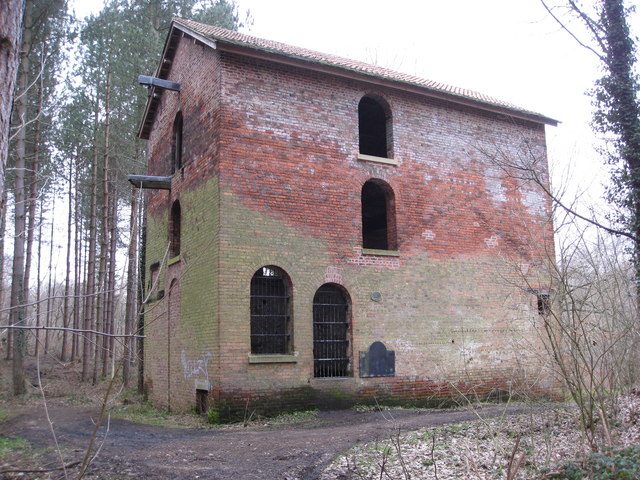
A colliery in the woods above the Moss Brook north-west of Eckington, at work by 1875 and disused by 1914. Its winding and pumping engine house, known as Seldom Seen, still stands twelve to fifteen metres high among the trees, with the ruins of a Guibal fan house, coke-oven earthworks and conical spoil heaps around it.
History
Plumbley Colliery was operating by 1875 and had reached its full extent by 1897; it was disused by 1914, though small-scale independent working may have gone on for a little while afterwards. It was one of two collieries in the hamlet of Plumbley, the other being Westwell, sunk in 1876 and disused by 1901. Plumbley had its own branch railway, locally called the Penny Engine railway, running east and west along the top of the slope; its line is now a broad footpath, with the remains of the railway expected to survive beneath it. The hamlet was in the Derbyshire parish of Eckington until boundary changes in 1967 moved it into Sheffield. On 16 March 1895 a colliery worker and several children drowned in a pond at the colliery, the worker having gone in after the children who had fallen in; the Sheffield Independent of 18 March reported four people dead (see Disasters, below). The engine house takes its odd name, Seldom Seen, from its position in the valley.
Geology
The colliery worked the coal of the Sheffield and North Derbyshire field, on the edge of the Moss Valley, which is now a Site of Special Scientific Interest.
Workings
The Seldom Seen engine house stands on rising ground in the northern part of the site, looking over the small valley of the Moss Brook. It is unusually large for its kind, built of brick and standing twelve to fifteen metres high, its walls pierced by round-arched and square openings; some roof and floor timbers survive, and two timbers protrude from the south wall, one moulded and one still carrying a pulley. Inside, the thick bearing walls for an indoor beam engine remain; the engine is thought to have done both the winding and the pumping in the shaft, and its boiler stood in a brick chamber against the west wall, whose ruined walls survive. East of the engine house are earthworks believed to be coke ovens, and immediately north a range of spoil heaps, at least two of them the characteristic conical shape. A brick-built adit is cut into the slope to the south, partly buried under later deposits, and west of it are the ruins of a Guibal fan house with part of the stone opening for the steam-driven fan still visible. South of the former railway, further earthworks and ruins stand in the woods: a second engine house with its engine bed intact, well-preserved earthwork reservoirs shown on the 1897 Ordnance Survey map, and several shafts, some large and collapsed.
Closure
The colliery was at its largest by 1897 and disused by 1914, although the scheduling allows that small-scale independent working may have continued for a little while afterwards. The reason for the closure is not known.
What remains
The ruined buildings, earthworks and buried remains are a scheduled monument in woodland. The Seldom Seen engine house stands to its full height but is roofless and open; the fan house and the second engine house are low ruins, and several of the shafts are collapsed. The surfaces of the tracks and footpaths and all fence posts are excluded from the scheduling, though the ground beneath them is included.
The Seldom Seen engine house with its internal bearing walls and boiler chamber; the Guibal fan house; a brick-built adit; coke-oven earthworks; conical spoil heaps; the line of the branch railway; a second engine house with an intact engine bed; earthwork reservoirs; several shafts.
Redevelopment
None. The site is woodland crossed by footpaths in the Moss Valley.
Nearby mines
- Eckington Mine — 1.8 km E, Derbyshire
- Renishaw Park Colliery — 3.0 km SE, Derbyshire
- Westthorpe Colliery — 3.3 km E, Derbyshire
- Birley Collieries — 4.2 km N
- Hartington Colliery — 4.7 km S, Derbyshire
Straight-line distance, within 15 km. Show on the map.
Recorded claims
Individual factual claims, each attached to the source(s) that support it below. Where sources disagree, both are kept.
- Plumbley Colliery was operating by 1875, had reached its full extent by 1897 and was disused by 1914, though small-scale independent mining may have continued for a little while thereafter. 1,2
- The brick-built Seldom Seen engine house stands twelve to fifteen metres high and retains the thick bearing walls for an indoor beam engine thought to have both wound and pumped the shaft. 1
- The remains include a Guibal fan house with part of the stone opening for its steam-powered fan, earthworks believed to be coke ovens, conical spoil heaps, a brick adit, a second engine house with an intact engine bed and earthwork reservoirs shown on the 1897 Ordnance Survey map. 1
- Plumbley had its own branch railway, known locally as the Penny Engine railway, and a second colliery, Westwell, stood nearby, sunk in 1876 and disused by 1901. 2
Photographs & further reading
The hamlet article, which dates both of its collieries, names the Penny Engine railway branch and records the drowning of four people at the colliery pond in March 1895.
View sourceSources
- (primary) Plumbley Colliery, including Seldom Seen engine house, Eckington (List entry 1017746) — Historic England
- (secondary) Plumbley — Wikipedia
Record created: 22 September 2026 · Last researched: 22 September 2026