 MineArchive
Penhale and Wheal Golden
| Also known as | Penhale Mine, Wheal Golden, Wheal Golden Consols, Penhale and Lomax |
|---|---|
| Location | Penhale Point, between Holywell and Perranporth, Cornwall — 50.3884, -5.1544 (approximate) |
| Commodities | Lead, Iron, Silver |
| Type | Metal |
| Worked | By 1777–1873 |
| Maximum depth | 100 fathoms (183 m) at Engine and Whim shafts |
| Operators | Wheal Golden Consols (1848–1855), Penhale and Lomax Company (1866–?) |
Overview
Two lead and silver mines on one north-south lode at Penhale Point, north of Perranporth, at work by 1777 and last tried in 1871-73; Wheal Golden had its own smelting house.
History
Penhale and Wheal Golden worked the same north-south lead lode, which runs from the tip of Penhale Point about 500 metres south into the Penhale sett. They were worked sometimes as separate companies and sometimes together with their neighbours. Penhale was at work by 1777, when it raised 41 tons of lead ore, and is probably much older. An engine was put up at Penhale in 1820, and two years later Wheal Golden set a smelting house to work; its ore was rich in silver, and 60.5 pounds of silver came out that year. A fall in the price of lead closed Wheal Golden in 1824, and Penhale soon after; Penhale reopened briefly around 1830.
In 1848 Wheal Golden Consols was formed with Wheal Golden and East Wheal Golden, and between 1849 and 1855 Wheal Golden raised 2,560 tons of lead and 24,200 ounces of silver. Flooding in the Penhale section in 1851 ate the profits, the group closed in 1855, and Penhale's 60-inch engine was advertised and taken down that year. Wheal Golden was tried again in 1866-67, and Penhale was reopened by the Penhale and Lomax Company, whose costly new engines, count house and buildings bankrupted one of its main shareholders. Further workings in 1867-71 and 1871-73 were the last. Besides lead and silver, Penhale raised copper and brown haematite from the Perran Iron Lode.
The engine houses of Wheal Golden, Penhale and the neighbouring Phoenix mine were demolished after a daylight air raid on the adjoining Penhale army camp in the Second World War. Ligger House on Penhale Point, Penhale's count house, where pitches were auctioned to the miners, is a listed building on Ministry of Defence land.
Geology
A north-south lead lode with comb-textured quartz, rich in silver; Penhale also reached the Perran Iron Lode.
Workings
Young's, Maxwell's, Engine, Whim, Hall's and Leggo's shafts, 70 to 100 fathoms deep; shallow stopes open in the cliffs.
Closure
Last worked in 1871-73.
What remains
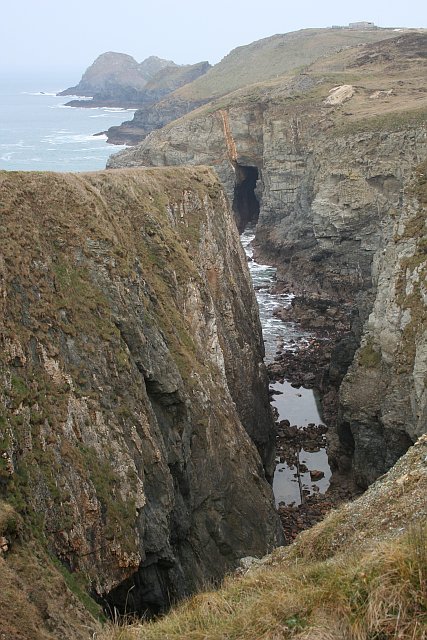
The lode's course and shallow workings show in the cliffs; the engine houses are gone, and Wheal Golden's Engine Shaft, under a compound on Penhale Point, has been plugged after a collapse.
Fenced shafts, cliff stopes and Ligger House, the former Penhale count house.
Redevelopment
Part of the Penhale military training area.
Related mines
- Gravel Hill Mine — Both at the north end of Perran Sands; Penhale also worked the Perran Iron Lode, which Gravel Hill worked.
Nearby mines
- Gravel Hill Mine — 1.0 miles (1.6 km) SE
- Trebisken and Trebellan Mines — 2.1 miles (3.4 km) SE
- Wheal Vlow — 2.1 miles (3.4 km) S
- Treamble Mine — 2.6 miles (4.2 km) SE
- Wheal Leisure — 3.0 miles (4.8 km) S
Straight-line distance, within 9 miles (15 km). Show on the map.
What's uncertain
Points where sources disagree or the record could not be settled; both accounts are kept. All open questions in the archive.
- Penhale was at work until about 1826. (disputed) 1
Recorded claims
Individual factual claims, each attached to the source(s) that support it below. Where sources disagree, both are kept.
- Penhale was at work in 1777, when it produced 41 tons of lead ore. 1,2
- Wheal Golden put a smelting house to work in 1822; 60.5 lb of silver was removed that year. 3,2
- A drop in lead prices closed Wheal Golden in 1824, with Penhale following. 2
- Penhale was at work until about 1826. (disputed) 1
- Wheal Golden Consols was formed in 1848; Wheal Golden produced 2,560 tons of lead and 24,200 oz of silver in 1849-55. 1,2
- Penhale was reopened by the Penhale and Lomax Company, whose expensive refit led to a shareholder's bankruptcy and liquidation. 2
- The engine houses of Wheal Golden, Penhale and Phoenix were demolished after a daylight air raid on the Penhale army camp in the Second World War. 3
- Ligger House on Penhale Point is the former Penhale count house, listed and on MOD land. 1
Sources
- (secondary) Penhale Mine (Penhale & Lomax), Perranporth — Cornwall Calling
- (secondary) Penhale and Wheal Golden — Explore Cornwall
- (secondary) Mining in our Area — Goonhavern & District History
Record created: 18 October 2026 · Last researched: 18 October 2026