 MineArchive
Oakbank No. 1 and 2 Pits
| Also known as | Oakbank Pit, Midcalder Pit |
|---|---|
| Location | Beside the Linhouse Water, about 200 m east of the bridge at Mid Calder, West Lothian — 55.8915, -3.4756 (approximate) |
| Commodity | Oil Shale |
| Type | Mineral |
| Worked | c. 1865–1909 |
| Maximum depth | 43 fathoms (about 79 m) in 1876. |
| Operators | Mid-Calder Mineral Oil Company (1865–?, founder) — Sank the pit about 1865 (Scotsman, 13 June 1865, quoted by Scottish Shale) Oakbank Oil Company (?–1909, owner) — Owner and operator of the pits for its Oakbank Paraffin Oil Works (Scottish Shale; DMM o219) |
Overview
Twin shale shafts sunk about 1865 beside the Linhouse Water at Mid Calder, which supplied most of the shale for Oakbank Paraffin Oil Works through the nineteenth century until the Oakbank Oil Company closed them in 1909.
History
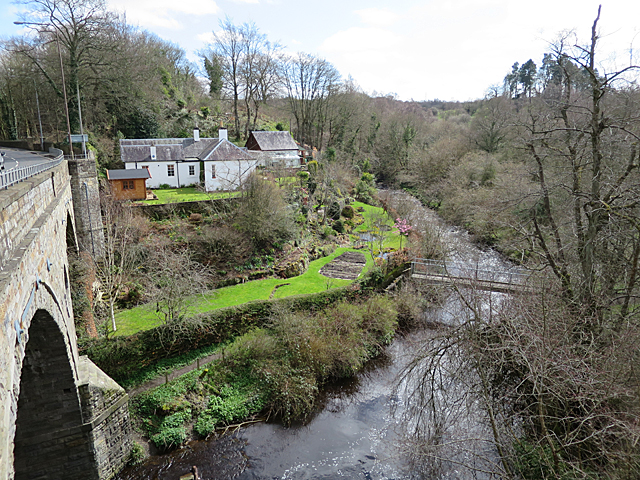
Oakbank Pit, sometimes called Midcalder Pit, was sunk about 1865 on the bank of the Linhouse Water some 200 metres east of the Mid Calder bridge; in June 1865 the Edinburgh Geological Society inspected a shale pit lately sunk there by the Mid-Calder Mineral Oil Company. Its two adjacent shafts, No. 1 and No. 2, reached both the Dunnet Shale and the Broxburn Shale, known locally as the Big Shale, and supplied most of the shale used at Oakbank Paraffin Oil Works in the nineteenth century. The Calder Hall estate lay between the pit and the railhead at Hoghill, and its owner, though a director of the oil company, would not have shale trains crossing his parkland, so the shale was at first carried along an inclined mine beneath the estate. The railway was not carried through to the pit until the mid-1880s; in August 1886 the tenant of Calder Hall, Peter M'Lagan MP, won an interim interdict against a line the company had staked out through the shrubberies and across the tennis court.
The shaft was 43 fathoms deep in 1876, when the company began working its lowest seam, four and a half feet thick, and put in a beam pumping engine by A. Barclay and Son of Kilmarnock, with a 62-inch cylinder and a 27-inch plunger pump able to lift 1,500 gallons a minute; a young lady christened it 'Maggie' by breaking a bottle of champagne over the beam. The Oakbank shale workings employed 334 people in 1894 and 369 in 1899, and in 1905 worked the New and Wild shales. Working of the Big Shale ended in 1900 and of the Lower Big and McLean shales in 1908. In April 1909 the company closed the workings that had fed its works since the beginning and opened a new field on the Calder House estate; the Dunnet Shale workings were abandoned that year. A private house, Bridge House, now stands on the site.
Geology
The Broxburn Shale (the local Big Shale, with the Lower Big, Curly, McLean and Wild shales) and the Dunnet Shale (the Lower or Dunnet, New and Under shales) of the Mid Calder shale-field.
Workings
Two adjacent vertical shafts, No. 1 and No. 2. Shale went first along an inclined mine beneath the Calder Hall estate to the railhead at Hoghill, and from the mid-1880s by private railway to Oakbank Oil Works. A beam pumping engine and a 20-ton steam crane stood at the pithead.
Closure
The Big Shale was finished in 1900 and the Lower Big and McLean shales in 1908; the Dunnet Shale workings were abandoned in 1909, when the company moved to a new field on the Calder House estate.
What remains
A private house, Bridge House, stands on the site.
Nearby mines
- Pumpherston Oil Works — 0.7 miles (1.2 km) NW
- Pumpherston No. 5 Mine — 1.1 miles (1.7 km) N
- Pumpherston No. 1 Mine — 1.4 miles (2.2 km) N
- Pumpherston No. 4 Mine — 1.6 miles (2.6 km) NW
- Roman Camp No. 1 Mine — 1.6 miles (2.6 km) N
Straight-line distance, within 9 miles (15 km). Show on the map.
Recorded claims
Individual factual claims, each attached to the source(s) that support it below. Where sources disagree, both are kept.
- The pit was sunk about 1865 near the bridge at Mid Calder; in June 1865 a shale pit recently sunk there by the Mid-Calder Mineral Oil Company was visited by the Edinburgh Geological Society. 1,2
- Shale was at first carried along an inclined mine beneath the Calder Hall estate, and the railway was extended to the pit only in the mid-1880s. 1,2
- In 1876 the 43-fathom shaft was fitted with a Barclay beam pumping engine, christened 'Maggie', able to lift 1,500 gallons a minute. 1
- The Oakbank shale workings employed 334 in 1894 and 369 in 1899. 3
- The Big Shale workings were abandoned in 1900 and the Dunnet Shale workings in 1909, when the company closed the pits. 1,4,5
Photographs & further reading
The Museum of the Scottish Shale Oil Industry's page for this mine, with maps, plans, site photographs and newspaper extracts.
View sourceSources
- (secondary) Oakbank No.1 & 2 pits (Scottish Shale, Museum of the Scottish Shale Oil Industry) — Almond Valley Heritage Trust
- (secondary) Explosion at Oakbank (Scottish Shale story F18030) — Almond Valley Heritage Trust
- (primary) Oakbank (Oil Shale) (Durham Mining Museum) — Durham Mining Museum
- (primary) BGS mine plan: OAKBANK NOS.1 2, Big seam, abandoned 1900 — British Geological Survey / Mining Remediation Authority
- (primary) BGS mine plan: OAKBANK NOS.1 2, Lower or Dunnet seam, abandoned 1909 — British Geological Survey / Mining Remediation Authority
Record created: 26 October 2026 · Last researched: 26 October 2026