 MineArchive
Norbury Colliery
| Location | Hazel Grove, Stockport, Greater Manchester — 53.3668, -2.0939 (approximate) |
|---|---|
| Commodity | Coal |
| Type | Coal |
| Worked | By 1704–1927 |
| Maximum depth | Unknown. |
| Operators | Nathaniel Wright (1795–1826), Clayton and Brooke (1826–1895), Joseph Wright (1895–1917) |
Overview
The Hazel Grove colliery of the Leghs of Lyme, on record from 1704, where Nathaniel Wright put up a pumping engine in 1795 that pirated James Watt's separate condenser. Under the Clayton family from 1826 it was a substantial business of three collieries with its own canal arm and railway, raising 60,000 to 80,000 tons a year, until the Clayton companies gave up in 1895; a former clerk worked it on a small scale until 1917, and the last miners left in 1927. The 1795 engine house still stands.
History
Norbury lies at the southern end of Hazel Grove, on land that the Leghs of Lyme bought from the de Hydes in 1670. The first record of coal mining there dates from 1704, and in its early days the Leghs worked the pits directly, close to their seat at Lyme Hall, so that Norbury often served for trials of new ideas. In 1707 a waterwheel was installed to pump the workings, a joint venture with Edward Warren, who owned the Poynton mines on the other side of Norbury Brook. Flooding was a constant problem: an early steam pump was installed in 1749 and a more powerful one a few years later.
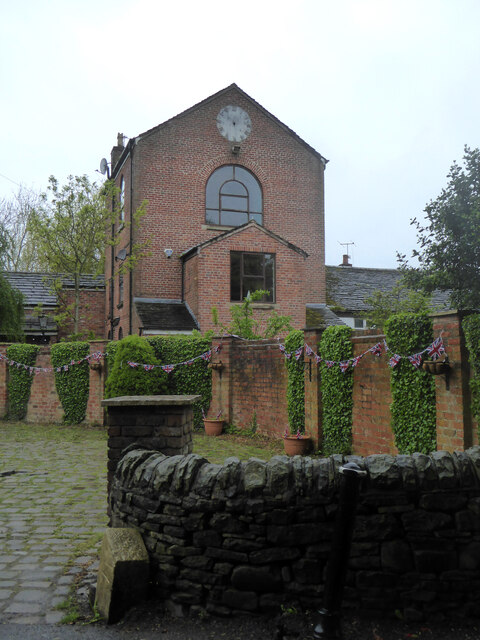
In 1793 Nathaniel Wright, from a mining family at Crich in Derbyshire, took a lease on one of the Warren family's mines in partnership with Matthew Pickford, the Poynton wagoner, and in 1795 he was brought in to run the Legh mines as well. The pumping engine house he built at Norbury in 1795 housed an engine by Bateman and Sherratt of Salford with a hidden condensing plant that pirated Boulton and Watt's separate condenser patent; Boulton and Watt sent a spy, found out the design, and Wright had to settle on their terms. He brought in John Clayton as a partner when he needed capital and explored a dedicated canal to Stockport that came to nothing. The engine had been removed before 1851, but the engine house survives, converted, by Jackson's Lane.
Nathaniel's son John sold his share to John Clayton in 1826, and until the end of the century the Clayton family controlled the colliery in combination with the Brook and Shaw families, all of whom intermarried; the Durham Mining Museum records the owners as Clayton and Brooke. In its prime the concern was three separate collieries: Norbury itself, a second beside the old High Lane station, and a third at Middlewood, and Clayton and Brook financed a short arm of the Macclesfield Canal to the Middlewood pits and a rail link from the King and Queen pits at High Lane. Plans survive of the Norbury, Brook, Canal, Deep, Engine, King, Middlewood, Queen, Resolution and Speedwell pits in the Four Feet, Five Feet, Silver, Waterloo and New seams. For most of the nineteenth century the collieries produced 60,000 to 80,000 tons a year and employed upwards of 250 men; John Clayton left £1.7 million when he died in 1861. The Norbury corn mill took a steam engine in the mid-nineteenth century fuelled by coal from the Norbury Hollow pit. The mines inspectors' reports list twenty-one deaths at the colliery between 1851 and 1883 (see Disasters, below).
Competition from the Yorkshire coalfield and the exhaustion of the seams told: the Middlewood pits had closed by 1870 and in 1895 the Clayton companies ceased operations, their lease from Lord Newton having expired. Pumping stopped, and by June 1896 water stood 543 feet deep in Norbury Pit; the neighbouring Poynton Collieries drove levels in the Gees seam to tap it, and late in 1909 the Norbury water at last broke through the old workings into Poynton's, when by luck nobody was underground. Mining at Norbury did not quite end in 1895: Joseph Wright, one of the company's clerks, took over the operation and worked it on a much reduced scale, a coal merchant in 1901 and a colliery proprietor in 1911, giving up in 1917 at the age of 78 when it produced about 700 tons a year. Other miners carried on until 1927, when working finally ceased.
Geology
The Four Feet, Five Feet, Silver (Gees), Waterloo and New seams of the Poynton coalfield, worked on the Legh land north of Norbury Brook, with the upper seams in communication with the Poynton workings.
Workings
Three collieries at their height: Norbury itself around what is now Jackson's Dairies, a second beside the old High Lane station and a third at Middlewood, with the King, Queen, Canal, Deep, Engine, Resolution and Speedwell pits among them, served by a short arm of the Macclesfield Canal and a rail link to the Great Central.
Closure
The Clayton companies ceased work in 1895 at the expiry of the lease from Lord Newton; a former clerk worked the pit on a small scale until 1917 and other miners until 1927.
What remains
The former pumping engine house of 1795 survives, converted and unlisted, by Jackson's Lane.
The 1795 engine house, a tall brick building with an arched window and a clock in its gable.
Redevelopment
Unknown.
Related mines
- Poynton Collieries — Neighbours across Norbury Brook, worked together for a time by Wright and Clayton; Norbury's water drained into Poynton's workings after 1895.
Nearby mines
- Anson Colliery — 1.3 miles (2.1 km) S, Cheshire
- Poynton Collieries — 1.4 miles (2.2 km) S, Cheshire
- Hough Hole Colliery — 5.7 miles (9.2 km) S, Cheshire
- Hyde Colliery — 5.9 miles (9.5 km) N
- Wood Mine — 6.8 miles (10.9 km) SW, Cheshire
Straight-line distance, within 9 miles (15 km). Show on the map.
What's uncertain
Points where sources disagree or the record could not be settled; both accounts are kept. All open questions in the archive.
- The colliery is listed as working from 1855 to 1890. (uncertain) 3
Recorded claims
Individual factual claims, each attached to the source(s) that support it below. Where sources disagree, both are kept.
- Coal mining at Norbury is first recorded in 1704, on Legh of Lyme land worked directly by the family. 1
- A waterwheel was installed in 1707 to pump the workings, jointly with Edward Warren of Poynton; an early steam pump followed in 1749. 1
- The pumping engine house was built for Nathaniel Wright in 1795 to house a Bateman and Sherratt engine with a hidden condenser that pirated Boulton and Watt's patent; the engine was removed before 1851. 1,2
- John Wright sold his share in the colliery to John Clayton in 1826, and the Clayton family controlled it until the end of the century. 1
- The owners are recorded as Clayton and Brooke. 3
- For most of the nineteenth century the collieries produced 60,000 to 80,000 tons a year and employed upwards of 250 men. 1
- Clayton and Brook financed a short arm of the Macclesfield Canal to the Middlewood pits and a rail link from the King and Queen pits at High Lane. 1
- Abandonment plans survive of the Norbury, Brook, Canal, Deep, Engine, King, Middlewood, Queen, Resolution and Speedwell pits in the Four Feet, Five Feet, Silver, Waterloo and New seams. 4,5
- The Middlewood pits had closed by 1870; the Clayton companies ceased operations in 1895, Joseph Wright worked the pit until 1917, and mining ended in 1927. 1
- The Norbury collieries closed at the expiry of their lease from Lord Newton, and the water rising in their workings threatened Poynton. 6
- By June 1896 water stood 543 feet deep in Norbury Pit, and late in 1909 it broke through into the Poynton workings while nobody was underground. 6
- The colliery is listed as working from 1855 to 1890. (uncertain) 3
- The colliery appears in the mines inspectors' reports and Lists of Mines from 1851 to 1888. 3,7
Photographs & further reading
The fullest account of the colliery from 1704 to 1927: the Leghs, Nathaniel Wright's pirate engine, the Clayton years, canal arm, railway and decline.
View sourceLocation, owners and the names of those killed at the colliery from the inspectors' reports, 1851 to 1883.
View sourceThe Poynton history on the water that rose in Norbury's abandoned workings after 1895 and broke into Poynton's in 1909.
View sourceSources
- (secondary) February 2022: Norbury Colliery (talk by David Kitching, reported by Neil Mullineux) — Marple Local History Society
- (observational) Former engine house, Norbury (photograph and description) — Geograph
- (primary) Norbury Colliery — Durham Mining Museum
- (primary) NORBURY, BROOK, CANAL, DEEP, ENGINE, KING, MIDDLEWOOD, QUEEN pits: abandonment plan catalogue entry (Four Feet, Five Feet, Silver, Waterloo, New seams) — British Geological Survey / Mining Remediation Authority
- (primary) NORBURY, CANAL, KING, MIDDLEWOOD, QUEEN pits: abandonment plan catalogue entry (Four Feet, Five Feet, Silver, Water and New seams) — British Geological Survey / Mining Remediation Authority
- (secondary) Poynton Collieries: 1890–1935, the final years — David Kitching
- (secondary) Norbury Colliery (source list) — Northern Mine Research Society
- (secondary) Norbury, Hazel Grove — Marple Local History Society
Record created: 8 October 2026 · Last researched: 8 October 2026