 MineArchive
Morlais Colliery
| Location | Llangennech, east of Llanelli, Carmarthenshire — 51.7018, -4.0671 (exact) |
|---|---|
| Commodity | Coal |
| Type | Coal |
| Worked | 1882–1981 |
| Maximum depth | 322 feet (the two 1947 pits, each 12 feet in diameter) |
| Operators | Thomas Williams and Sons (Llangennech) Ltd (1894–1947), National Coal Board (1947–1981) |
Overview
A Carmarthenshire colliery begun as a slant in 1882 and first listed the year after, sunk as a pit in 1894 by Thomas Williams and Sons of Llangennech — one of the few middle-sized companies to survive the combines and last until nationalisation. It worked the steam coals under the Loughor river, the last pit in the non-anthracite part of the Llanelli area to do so. In 1976 a roadway was driven under the Llwchwr estuary to join it to Brynlliw on the far side, after which the two were one unit and Morlais wound only men and materials. It was the last pit in the coalfield winding with steam engines, and the Morlais section closed in 1981.
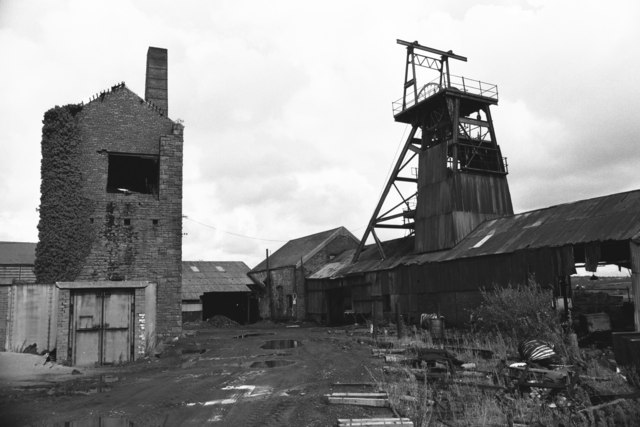
History
Morlais was first listed in 1883, a slant having been driven the year before. By 1891 it was described as a slant to the Six Feet seam with a 96-foot upcast, and a level to the Four Feet seam with a 30-foot upcast. In 1895 it was reported that Thomas Williams and Sons had struck the Four Feet vein by borehole and begun a new level to the Six Feet.
The Inspector of Mines list for 1896 gives 194 men employed producing manufacturing coal. The workforce grew to 430 by 1908, 447 in 1918 and 569 in 1923, working the Six Feet and Four Feet seams, before falling to 352 by 1945. In 1947 the colliery was two pits 322 feet deep and 12 feet in diameter — No. 1 to the east, No. 2 to the west — with a slant north-west beside No. 2.
In 1976 a roadway was driven under the Llwchwr estuary to link Morlais with Brynlliw on the opposite side, and the two collieries became a single unit, all the coal drawn through the Brynlliw shafts while the Morlais shaft carried men and material only. Through the late 1970s the combined unit produced an average of 6,000 tons a week with 840 men.
Geology
The western end of the South Wales coalfield, working the Six Feet and Four Feet seams. Morlais was the last pit to work in the non-anthracite part of the Llanelli area, taking steam coal from beneath the Loughor river.
Workings
A slant and a level at first, then two pits of 322 feet, 12 feet in diameter, with the slant retained alongside. From 1976 the workings ran under the Llwchwr estuary to meet Brynlliw. Morlais was the last pit in the coalfield to wind using steam-powered engines.
Closure
The Morlais section closed in 1981, ending with it the working of coal beneath the Loughor river. It was the last colliery to close in the area.
What remains
No structure is known to survive.
Related mines
- Brynlliw Colliery — One company and then one mine: both were sunk by Thomas Williams and Sons of Llangennech, and in 1976 a roadway was driven under the Llwchwr estuary to join them, after which all the coal came up through the Brynlliw shafts and Morlais wound only men and materials.
- Talyclyn Colliery — Thomas Williams and Sons (Llangennech) collieries.
Nearby mines
- Bolgoed Colliery — 1.5 miles (2.4 km) E, Swansea
- Grovesend Colliery — 1.5 miles (2.4 km) SE, Swansea
- Acorn Colliery — 1.6 miles (2.6 km) W
- Brynlliw Colliery — 1.7 miles (2.8 km) SE, Swansea
- Porthdafen Colliery — 1.9 miles (3.1 km) W
Straight-line distance, within 9 miles (15 km). Show on the map.
Recorded claims
Individual factual claims, each attached to the source(s) that support it below. Where sources disagree, both are kept.
- Morlais was first listed in 1883 and a slant was driven in 1882. By 1891 it was described as a slant to the Six Feet seam with a 96-foot upcast and a level to the Four Feet seam with a 30-foot upcast. 1
- The pit was sunk in 1894 by Thomas Williams and Sons (Llangennech) Ltd, one of the few middle-sized companies to survive a takeover from the large combines and last until nationalisation in 1947. 2
- The Inspector of Mines list for 1896 records 194 men employed producing manufacturing coal; the workforce was 430 by 1908, 447 in 1918, 569 in 1923 and 352 in 1945. 1
- In 1947 Morlais was described as two pits 322 feet deep and 12 feet in diameter, No. 1 to the east and No. 2 to the west, with a slant to the north-west adjacent to No. 2. 1
- In 1976 a roadway was driven under the Llwchwr estuary to link up with Brynlliw on the opposite side. The two collieries then formed a single unit with all coal brought to the surface through the Brynlliw shafts, the Morlais shaft being used for men and material only. Through the late 1970s the unit produced an average of 6,000 tons a week with 840 men. 1
- Morlais was the last pit in the coalfield to wind using steam-powered engines. 1
Photographs & further reading
The colliery’s working record: the 1882 slant, the 1894 sinking, the workforce and seams decade by decade, the 1976 link under the estuary to Brynlliw and the steam winder.
View sourceSources
- (secondary) Morlais Colliery — Welsh Coal Mines
- (secondary) Llangennech, Carmarthenshire — GENUKI
Record created: 8 September 2026 · Last researched: 8 September 2026