 MineArchive
Kirkby Slate Quarries
| Location | Kirkby-in-Furness, Cumbria — 54.2467, -3.1539 (exact) |
|---|---|
| Commodity | Slate |
| Type | Slate |
| Worked | By the 16th century–Still active |
| Maximum depth | Several hundred feet -- an enormous single pit rather than a system of galleries |
| Operators | Cavendish family (1820–?), Burlington Slate Works (1920–?) |
Overview
Also known as Burlington Slate Quarries, this is the largest slate quarry in England -- a single enormous pit at Kirkby-in-Furness, worked for over 450 years and still owned by the Cavendish family (as Holker Estates) who organised it into an industrial-scale operation in the 1820s.
History
Slate has been worked at Kirkby-in-Furness for over 450 years, but large-scale, organised production began only in the early 19th century, when William Cavendish -- the 2nd Earl of Burlington, later 7th Duke of Devonshire -- brought together the small-scale workings of local farmers into a single larger group of quarries from the early 1820s. This drove real population growth in Kirkby: the arrival of the railway in 1846 brought further prosperity, and houses at Marshside and Incline Foot were built specifically for quarry workers, alongside non-conformist chapels, a Reading Room, and community organisations including a Temperance League, Girls' Friendly Society, Male Voice Choir and Brass Band. The quarry has traded under several names -- historic Durham Mining Museum records list it as Burlington Slate Works by the 1920s, working numerous named pits including Fisher's, Hospital, Hunter's, Lord's, Town's and Winnow End quarries -- and trades today as Burlington Stone, still owned by the Cavendish family.
Geology
The characteristic even blue-grey Kirkby slate is sedimentary in origin, with slaty cleavage imposed on Ordovician and Silurian mudstone successions.
Workings
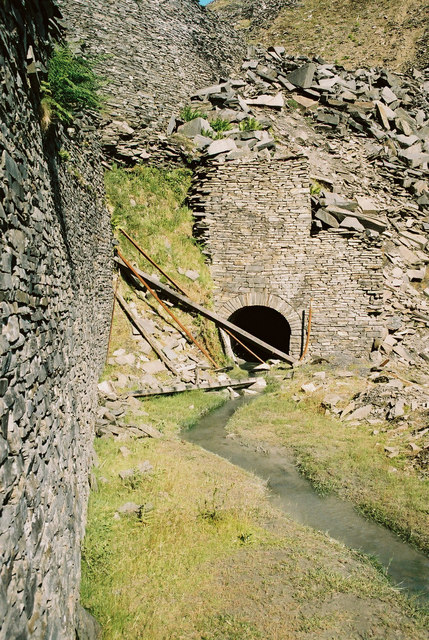
Unlike many slate quarries, Kirkby has no system of underground galleries -- it is worked as a single enormous open pit several hundred feet deep, spreading across and under Kirkby Moor. Inclined trackways and water-balance lifts moved slate out of the pit, and the Sandside trackway once connected the quarry to Sandside port on the Duddon Estuary and the main railway line.
Closure
Unknown.
What remains
An active, working quarry -- Burlington Stone's largest -- still producing slate today; Burlington invested £5 million in the site as of 2024.
Related mines
- Elterwater Quarry — Both are Burlington quarries: Elterwater passed to Burlington in 1976, and Kirkby-in-Furness is the company's original working and the source of the darker Burlington slate against which Elterwater's Westmorland Green is sold.
Nearby mines
- Margaret Mine — 5.0 miles (8.1 km) S
- Park Mines — 5.9 miles (9.6 km) S
- Roanhead Iron Mine — 6.7 miles (10.7 km) SW
- Hodbarrow Mine — 6.7 miles (10.8 km) SW
- Lindal Moor — 7.0 miles (11.3 km) S
Straight-line distance, within 9 miles (15 km). Show on the map.
Recorded claims
Individual factual claims, each attached to the source(s) that support it below. Where sources disagree, both are kept.
- William Cavendish, 2nd Earl of Burlington, brought together small-scale local quarrying at Kirkby into a single larger operation from the early 1820s. 1
- By the 1920s the quarry traded as Burlington Slate Works, working numerous named pits including Fisher's, Hospital, Hunter's, Lord's, Town's and Winnow End quarries. 2
- The 1846 arrival of the railway brought further prosperity to Kirkby; houses at Marshside and Incline Foot were built for quarry workers, and the growing community saw non-conformist chapels, a Reading Room, a Temperance League, Girls' Friendly Society, Male Voice Choir and Brass Band all formed. 3
- Durham Mining Museum's own fatality index records several individual deaths at the quarry, including Thomas Butterworth (1888, fell down a shaft), James Casson (1855, a child killed when the incline wagon he was riding derailed), Thomas Edward Cooper (1926) and John Thomas Dawson (1889, aged 17), none as part of a single multi-fatality incident. 2
Photographs & further reading
Sources
- (secondary) Kirkby Slate Quarries — Wikipedia
- (primary) Burlington Quarry (Slate) — Durham Mining Museum
- (secondary) A Brief History of Kirkby-in-Furness — History of Kirkby Group
Record created: 29 August 2026 · Last researched: 29 August 2026