 MineArchive
Park Mines
| Location | Park, between Askam-in-Furness and Dalton-in-Furness, Cumbria — 54.1665, -3.2069 (approximate) |
|---|---|
| Commodity | Iron |
| Type | Metal |
| Worked | 1850–1921 |
| Maximum depth | No reliable depth figure has yet been located. |
| Operators | Schneider, Hannay and Co (1853–?) |
Overview
A Furness haematite mine at Park, north of Dalton-in-Furness, where Henry Schneider's last trial pit struck a huge ore body in 1850. Park Sop and its neighbouring deposits were worked by Schneider, Hannay and Co until the men were laid off in 1921, and the find underpinned the iron and steel industry at Barrow.
History
Park lay on the Earl of Burlington's Park Farm, between Askam and Dalton-in-Furness, where old workings were already visible when Henry William Schneider, a London iron dealer touring Furness, was shown them in 1839. He took a lease early in 1840, but two years of trials found only small, unworkable pockets, and he turned to Whitriggs and Mouzell instead. In 1850 the Earl's agent told him to surrender the lease or try again, and Schneider sank a pit on a spot he had chosen ten years earlier: for an outlay of about £50 it struck the Park deposit, found close to Park Farm in October 1850 by the Oxford Archaeology account, though the Dock Museum and Co-Curate date the find to 1851. It proved to be the second largest haematite deposit found in Britain. To finance it Schneider took Robert Hannay of Kirkcudbright into partnership, and Schneider, Hannay and Co was formed on 1 January 1853. In 1856 Park raised 120,000 tons of the Dalton field's 464,000, and by the 1880s about 1,000 tons a day; Schneider's obituary in 1887 put the average over 34 years at 250,000 tons a year, eight and a half million tons in all, with £535,000 paid in royalties by 1886. The ore went out over a mineral branch of the Furness Railway to Barrow, and it was this find, his obituary says, that led to Schneider and Hannay blowing in blast furnaces at Barrow in 1859 and to the growth of the town. The mines weathered wage cuts in the slump before the First World War, but after the 1921 national coal strike shut the county's blast furnaces there was no market for the ore, and the 500 men still employed were given notice in March 1921. The Cumbria County History Trust gives the closure as 1921 in one account and 1922 in another. The surface buildings were demolished during the Second World War.
Geology
Haematite iron ore in 'sops', large irregular pockets in the Carboniferous limestone lying under boulder clay, together with the north-south California Vein. Park Sop, the largest orebody of its type, measured about 450 m east-west by 240 m north-south; four smaller sops to the south-west (Garden, California No 1, Plewner and California No 3) ran parallel to the vein, with more sand and less ore in their filling towards the south.
Workings
Richardson counted five pits at Park in the later nineteenth century, among them the Burlington Pit, and a California Pit No 4 appears on the 1913 Ordnance Survey map. The California Vein was worked conventionally, but the irregular sops were taken by top slicing from shafts sunk in the limestone clear of the ore: a 2.75 m slice was cut directly under the boulder clay beneath a heavily timbered roof, and each lower slice was removed as the timber mat and ground above settled onto it, leaving conical depressions at the surface. Ore was cut with hand tools and pushed in small bogies to the shaft, with no pit ponies, then raised by steam. The 1890 map shows open pits, engine and pumping houses, reservoirs and two explosives magazines, linked by a mineral branch of the Furness Railway.
Closure
A national coal strike in 1921 closed the blast furnaces across the county, leaving no market for the ore, and the 500 men employed at Park were given notice in March 1921. One Cumbria County History Trust account gives the closure as 1922.
What remains
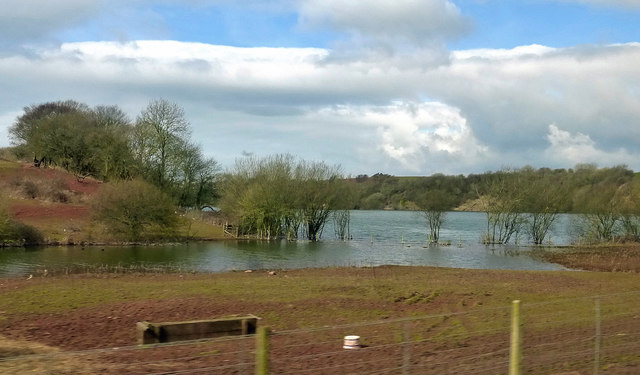
The flooded subsidence craters left by Park mines are managed as fishing ponds by the Furness Fishing Association. Part of the site lies within the Bennett Bank landfill.
Flooded subsidence ponds. The mine buildings were demolished during the Second World War, and a 2003 archaeological assessment found no above-ground remains of the mining complex within the Bennett Bank landfill extension area.
Redevelopment
Part of the former Park Mines ground, around Bennett Bank, is a landfill site; an extension was assessed archaeologically in 2003.
Related mines
- Roanhead Iron Mine — The Burlington deposit crossed the boundary between Park and Roanhead, so the two mines worked the same orebody.
Nearby mines
- Margaret Mine — 2.0 km NE
- Lindal Moor — 2.4 km SE
- Hodbarrow Mine — 5.7 km NW
- Kirkby Slate Quarries — 9.6 km N
Straight-line distance, within 15 km. Show on the map.
People
- Earl of Burlington · landowner — Owned Park Farm and held the royalty under which Schneider leased and worked the mines.
- Robert Hannay · proprietor, from 1853 — via the operator record Schneider, Hannay and Co
- Henry William Schneider (1817–1887) · lessee, from 1840 — Took the lease of the Earl of Burlington's Park property in 1840 and sank the pit that found the deposit in 1850.
- Henry William Schneider (1817–1887) · proprietor, from 1853 — via the operator record Schneider, Hannay and Co
What's uncertain
Points where sources disagree or the record could not be settled; both accounts are kept. All open questions in the archive.
- Schneider's trial pit struck the Park deposit close to Park Farm in October 1850, at a cost of about £50. (disputed) 1,2
- The Park deposit was opened in about 1851. (disputed) 3,4
- Park Sop measured about 450 m by 240 m and is thought to have yielded between 12 and 17 million tonnes of high-quality ore. (uncertain) 1
- The 500 men employed at Park Mines were given notice in March 1921, and the mine closed in 1921. (disputed) 1,6
- Park mine closed in 1922. (disputed) 7
- The Burlington deposit crossed the boundary between Park and Roanhead. (uncertain) 9
Recorded claims
Individual factual claims, each attached to the source(s) that support it below. Where sources disagree, both are kept.
- Schneider's trial pit struck the Park deposit close to Park Farm in October 1850, at a cost of about £50. (disputed) 1,2
- The Park deposit was opened in about 1851. (disputed) 3,4
- Schneider took a lease of the Earl of Burlington's Park property in early 1840 after being shown the ancient workings at the north end of Park Farm. 1,2
- Schneider, Hannay and Co was formed on 1 January 1853 when Schneider took Robert Hannay into partnership to work the mines. 1,2
- In 1856 Park Mines produced 120,000 tons of ore out of 464,000 tons for the whole Dalton field, and about 1,000 tons a day in the 1880s. 1
- Over 34 years to 1886 the mine averaged 250,000 tons of ore a year, eight and a half million tons in all, with £535,000 paid in royalties. 2
- Park Sop measured about 450 m by 240 m and is thought to have yielded between 12 and 17 million tonnes of high-quality ore. (uncertain) 1
- The sop orebodies at Park were worked by top slicing. 5,1
- The 500 men employed at Park Mines were given notice in March 1921, and the mine closed in 1921. (disputed) 1,6
- Park mine closed in 1922. (disputed) 7
- The ponds left by Park mines are managed as fishing ponds by the Furness Fishing Association. 8
- The Burlington deposit crossed the boundary between Park and Roanhead. (uncertain) 9
Photographs & further reading
A 2013 visit to the neighbouring Roanhead workings, noting the Burlington deposit that ran across the Park and Roanhead boundary.
View sourceThe fullest account read of Park Mines: the 1850 discovery, the sops and California Vein, top slicing, output figures and the 1921 closure, with historic maps.
View sourceSchneider's 1887 obituary, telling how the last trial pit at Park found the deposit and giving output and royalty totals to 1886.
View sourceThe museum's account of how the Park ore find and the Furness Railway led to the ironworks at Barrow.
View sourceSources
- (primary) Bennett Bank Landfill Site, Dalton-in-Furness, Cumbria: Archaeological Desk-Based Assessment (2003) — Oxford Archaeology North
- (secondary) Henry William Schneider — Grace's Guide to British Industrial History
- (secondary) Iron and Steelworks — The Dock Museum, Barrow-in-Furness
- (secondary) Henry Schneider (1817-1887) — Co-Curate, Newcastle University
- (secondary) Iron mining — Industrial History of Cumbria
- (secondary) Dalton Since 1914: Gazetteer, Dalton — Cumbria County History Trust
- (secondary) Dalton in Furness (township) — Cumbria County History Trust
- (secondary) Roanhead — Wikipedia
- (observational) Roanhead mines Nr Askam in Furness, June 2013 — 28DaysLater
Record created: 21 September 2026 · Last researched: 21 September 2026