 MineArchive
Roanhead Iron Mine
| Location | Roanhead, between Barrow and Ulverston, Cumbria — 54.1648, -3.2415 (approximate) |
|---|---|
| Commodity | Iron |
| Type | Iron |
| Worked | 1852–1942 |
| Operators | Kennedy Brothers (1857–1928) |
Overview
One of the major haematite deposits of the Furness iron field, between Barrow and Ulverston, worked by top slicing and controlled for three generations by the Kennedy family.
History
Roanhead was one of the principal ore bodies of the Furness haematite field, worked using top slicing -- removing ore in successive slices and allowing the roof to crush down onto the void left behind, a method also used at the neighbouring Park, Mouzell, Elliscales and Lindal Moor mines. Mineral leases at Roanhead were held by the Kennedy family from before 1857, inherited by Myles Burton Kennedy from his grandfather Charles Storr Kennedy; the firm of Kennedy Brothers, which Myles Burton went on to control, described Roanhead as consistently profitable ('a winner'). Myles Burton Kennedy joined the board of the North Lonsdale Ironworks Company in 1889 -- a firm his own father had helped launch as vice-chairman in 1873 -- later becoming its chairman, a position he held until his death in 1928, when the Roanhead leases passed to his son Nigel. The mine's own plans survive in part: a multi-layer plan of the Wilfred pits, from the Cumbria Amenity Trust Mining History Society's collection, is held by the British Geological Survey.
Geology
One of the principal haematite ore bodies of the Furness field, worked by top slicing — taking the ore in successive slices from the top down.
Workings
An engine bed for the mine's No. 16 Pit, originally catalogued as a magazine, was modified around 1945.
Closure
Unknown.
What remains
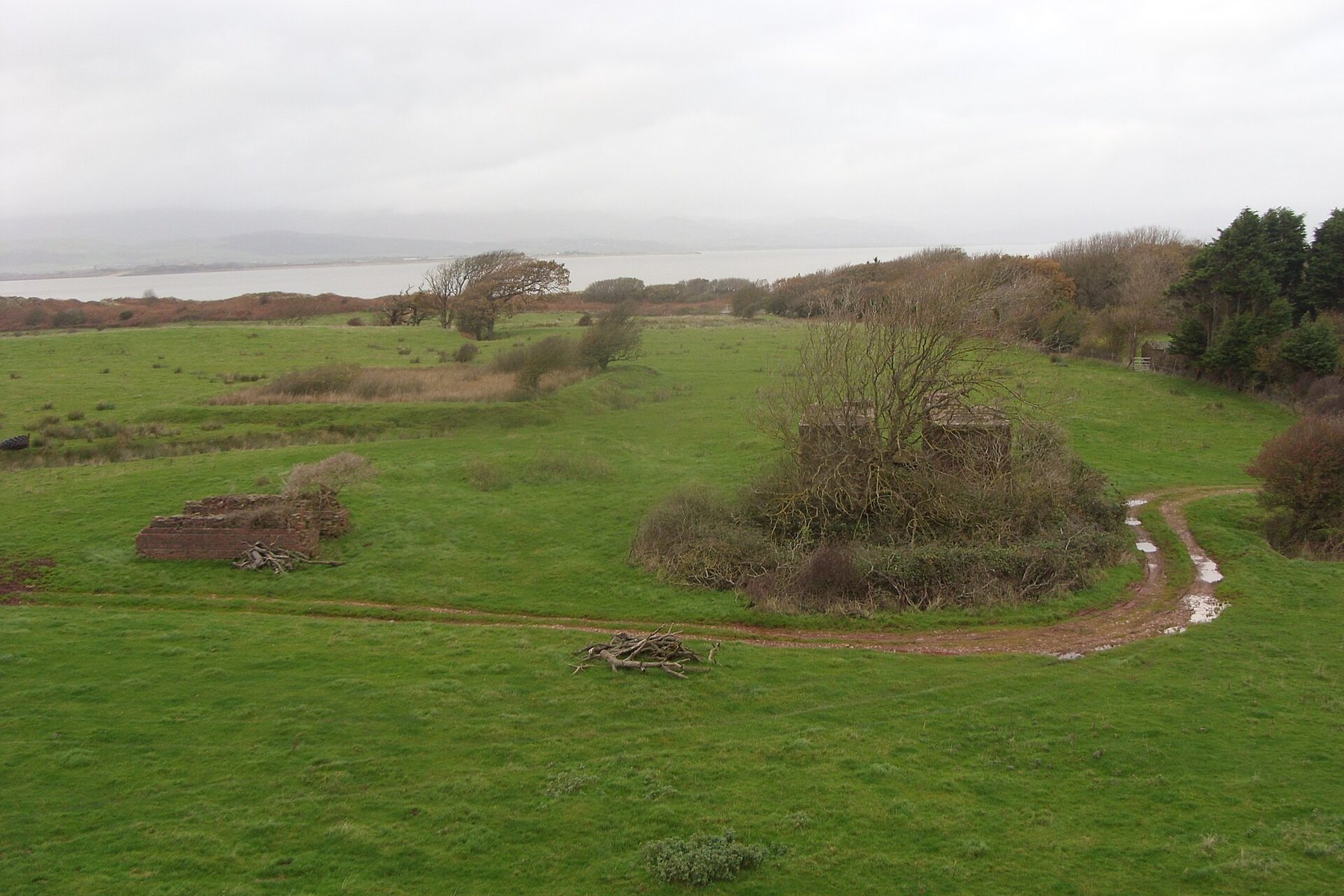
A 2013 report found the site heavily overgrown. Surviving remains include concrete bases of the pumping and winding engines at Violet Pit, a small pond marking the site of No. 16 Pit, the No. 16 winding engine bed (converted to an air raid shelter, matching the arched roof already noted from Cumbria industrial-history sources), and Kathleen Pit's changehouse, still standing after 70 years of abandonment.
Related mines
- Lindal Moor — Roanhead was worked by the same top-slicing method used at the neighbouring Lindal Moor mines.
- Park Mines — The Burlington deposit crossed the boundary between Park and Roanhead, so the two mines worked the same orebody.
Nearby mines
- Park Mines — 1.4 miles (2.3 km) E
- Lindal Moor — 2.4 miles (3.9 km) SE
- Margaret Mine — 2.5 miles (4.1 km) E
- Hodbarrow Mine — 3.0 miles (4.9 km) NW
- Yarlside Mine — 3.4 miles (5.5 km) SE
Straight-line distance, within 9 miles (15 km). Show on the map.
Recorded claims
Individual factual claims, each attached to the source(s) that support it below. Where sources disagree, both are kept.
- Roanhead was worked using top slicing -- removing ore in successive slices and letting the roof crush down on the void -- a method also used at the neighbouring Park, Mouzell, Elliscales and Lindal Moor mines. 1
- Mineral leases at Roanhead were held by the Kennedy family from before 1857, passing from Charles Storr Kennedy to his grandson Myles Burton Kennedy and then to Myles Burton's son Nigel on his death in 1928. 2
- Violet Pit, Roanhead Mine is listed as a site of clear national importance in the Cumbria industrial heritage sites table. 1
- Myles Kennedy leased the mineral rights at Roanhead in 1852; the mine worked a series of named pits including Violet, Rita, Nigel, Kathleen, Betty, Wilfred and Plunger, with the pumping engine moved to Violet Pit in 1901 and operated there from 1912 to 1942. 3
- Roanhead worked until 1942, when the last deposit was exhausted; the mines are said to have produced around 11 million tons of ore in total. 3
- A multi-layer plan of the Roanhead mines' Wilfred pits, from the Cumbria Amenity Trust Mining History Society's collection, is held by the British Geological Survey and can be viewed online. 4
Photographs & further reading
The scanned Cumbria Amenity Trust plan of the Wilfred pits at Roanhead, viewable online in the British Geological Survey's collection.
View sourceAn explorer's report and photographs of the overgrown Roanhead site, its engine bases and the pits.
View sourceSources
- (secondary) Iron mining — Industrial History of Cumbria
- (secondary) Myles Burton Kennedy — Wikipedia
- (observational) Roanhead mines Nr Askam in Furness, June 2013 — 28DaysLater
- (primary) MULTI-LAYER PLAN OF ROANHEAD MINES. WILFRED PITS (Cumbrian Amenity Trust Historical Mining Society mine plans CT, BGS mine plans catalogue) — British Geological Survey / Mining Remediation Authority
Record created: 29 August 2026 · Last researched: 24 September 2026