 MineArchive
Yarlside Mine
| Also known as | Yarlside Mines, Yarlside Iron Mines |
|---|---|
| Location | Yarlside, near Barrow-in-Furness, Cumbria — 54.1289, -3.1831 (approximate) |
| Commodity | Iron |
| Type | Iron |
| Worked | from 1868 |
| Maximum depth | Unknown. |
| Operators | Yarlside Mining Company (1868–1892), Barrow-in-Furness Hematite Steel Co. (1892–?) |
Overview
A Furness haematite mine opened in 1868 by Thomas Storey and William Boulton, served by John Fell's experimental monorail and later his Parkhouse tramway, and undone by running sand, pumping costs and royalties.
History
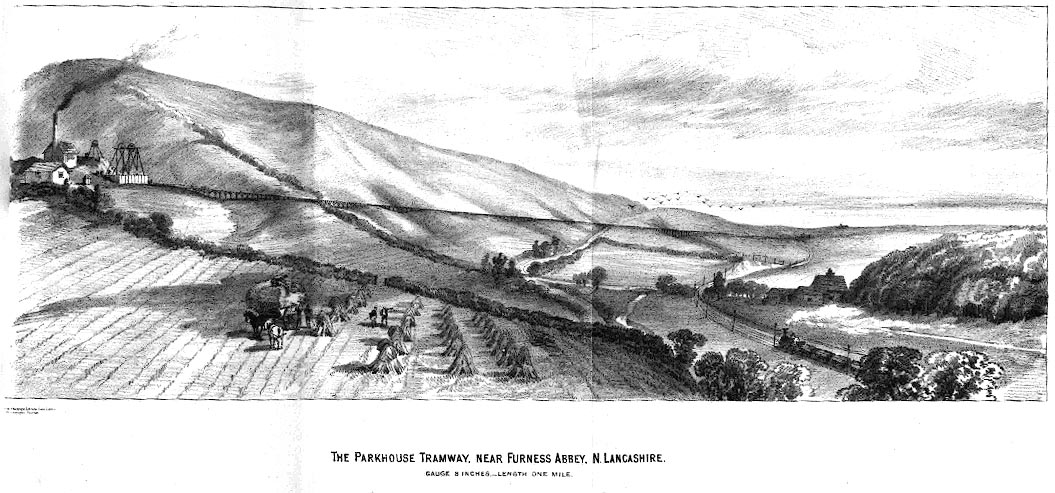
Thomas Storey and his brother-in-law William Boulton formed the Yarlside mining company in 1868, against the advice of experts. In the same year John Barraclough Fell built a horse-drawn monorail from an exchange siding on the Furness Railway to the Yarlside Iron Mines; in 1870 he replaced it with the 8-inch-gauge Parkhouse Tramway, driven by a stationary engine and endless wire rope and able to carry up to 100,000 tons a year, and it became a standard-gauge railway in 1873.
Yarlside was prone to inrushes of running sand, and to deal with the sand and the water two large Hathorn Davey pumping engines were installed at Nos. 8 and 11 pits. High pumping costs, ore with a high phosphorus content and royalties payable to two dukes made the mine unprofitable, and Storey wrote to the Duke of Buccleuch's agent that the mine already owed him £70,000. The Barrow Haematite Steel Company took over the mines in 1892, had removed the last of the ore by 1898 and kept the pumps running until its neighbouring Stank mine was exhausted in March 1901. The Durham Mining Museum lists six men killed between 1880 and 1885.
The mine was worked again in the 20th century. The Durham Mining Museum records 25 people employed in 1910, 86 in 1915 and 162 in 1921, lists iron ore from Yarlside in 1910, 1915, 1921 to 1925 and 1945, and moulding sand from 1927.
Geology
Red haematite worked in a district subject to inrushes of running sand; the ore was high in phosphorus. Limestone and moulding sand appear among the later outputs.
Workings
Pits numbered at least 3, 4, 6, 7, 8, 10 and 11 were sunk. A compound pumping engine with 30-inch and 60-inch cylinders stood at No. 8 pit and an engine with 38-inch and 60-inch cylinders at No. 11. The tramway carried ore to the Furness Railway.
Closure
The last ore had been removed by 1898 and the pumps ran on until 1901. The Durham Mining Museum nevertheless lists iron ore from Yarlside in 1910, 1915, 1921 to 1925 and 1945, with moulding sand from 1927.
What remains
A 2014 exploration report shows the engine bed at No. 8 pit and the flooded shaft of No. 11 in the foreground, with the square holes for hold-down bolts and a cooling pond nearby.
An engine bed at No. 8 pit and the flooded shaft of No. 11 pit.
Redevelopment
Unknown.
Related mines
- Stank Mine — The Barrow Haematite Steel Company worked both; after taking over Yarlside in 1892 it kept Yarlside's pumps running until Stank was exhausted in 1901.
Nearby mines
- Stank Mine — 0.3 miles (0.5 km) SE
- Lindal Moor — 1.3 miles (2.1 km) N
- Park Mines — 2.8 miles (4.5 km) N
- Margaret Mine — 3.3 miles (5.2 km) N
- Roanhead Iron Mine — 3.4 miles (5.5 km) NW
Straight-line distance, within 9 miles (15 km). Show on the map.
Recorded claims
Individual factual claims, each attached to the source(s) that support it below. Where sources disagree, both are kept.
- Thomas Storey and William Boulton formed the Yarlside mining company in 1868. 1
- John Barraclough Fell built a horse-drawn monorail to the Yarlside Iron Mines in 1868, replaced in 1870 by the Parkhouse Tramway, which became standard gauge in 1873. 2
- Two Hathorn Davey pumping engines dealt with running sand and water at Nos. 8 and 11 pits. 1
- The Barrow Haematite Steel Company took over the Yarlside mines in 1892 and removed the last ore by 1898. 1
- The Durham Mining Museum lists the Yarlside Mining Co. as owner in the 1880s and the Barrow Haematite Steel Co. Ltd in the 1920s. 3
- Employment was 25 in 1910, 86 in 1915 and 162 in 1921. 3
- The Durham Mining Museum lists six men killed at Yarlside between November 1880 and July 1885. 3
Photographs & further reading
Photographic report on both mines' pumping-engine sites, with a short history including the Storey letter on royalties.
View sourceOwners, output 1882-1945, employment 1910-1924 and a list of six men killed.
View sourceArticle on Fell's monorail and the Parkhouse mineral railway that served the mines.
View sourceSources
- (observational) Report - Stank and Yarlside mines near Barrow in Furness, Jan 2014 — 28DaysLater
- (secondary) Yarlside Iron Mines tramway - Wikipedia — Wikipedia
- (primary) Durham Mining Museum - Yarlside (Iron Ore) — Durham Mining Museum
Record created: 29 September 2026 · Last researched: 29 September 2026