 MineArchive
Stank Mine
| Also known as | Stank Mines |
|---|---|
| Location | Stank, Barrow-in-Furness, Cumbria — 54.1267, -3.1764 (approximate) |
| Commodity | Iron |
| Type | Iron |
| Worked | 1871 (first shaft)–March 1901 |
| Maximum depth | At least 720 feet (the 120 fathom level) |
| Operators | Barrow-in-Furness Hematite Steel Co. (1871–1901) |
Overview
A Furness haematite mine east of Barrow, sunk in 1871 by the Barrow Haematite Steel Company; nine pits, Cornish beam pumping engines and around two and a half million tonnes of ore by 1885, worked until it was exhausted in March 1901.
History
The Stank mine lies two miles east of Barrow-in-Furness in the Furness haematite orefield. The Barrow Haematite Steel Company sank a borehole looking for coal on this side of the hill and found a vein of haematite; its lease dates from 1871, when the first shaft was sunk. Nine pits were eventually sunk, and by 1885 the mine had yielded around two and a half million tonnes of ore. Pumping was by Cornish beam engines, one of them brought from Wheal Mary Ann near Menheniot in Cornwall; an engine house at No. 1 pit held a 40-inch engine, No. 2 pit was drained by a 72-inch engine and No. 5 pit had a 70-inch engine. In 1896 the mine employed 505 people, 355 below ground and 150 on the surface, raising red haematite, and the cages ran to at least the 105 and 120 fathom levels.
Across the hill the neighbouring Yarlside mines, formed as a company by Thomas Storey and William Boulton in 1868, were beset by running sand, pumping costs and royalties. The Barrow Haematite Steel Company took Yarlside over in 1892, had removed the last of its ore by 1898 and kept the pumps running until the Stank mine was exhausted in March 1901. The Durham Mining Museum lists 23 men and boys killed at Stank between 1870 and 1900, most by falls of rock or in the shafts.
Geology
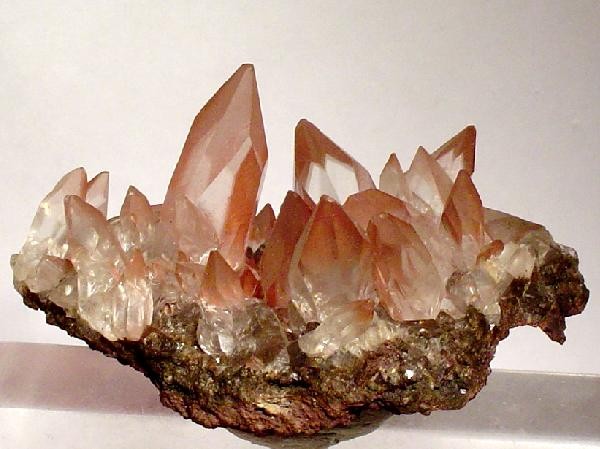
Red haematite was worked from vein deposits in the limestone; one working in 1900 was a vein about 7 feet wide bounded by limestone sides. The mine is known to mineral collectors for scalenohedral calcite crystals in red, yellow and brown tints with haematite inclusions, and for haematite pseudomorphs after fluorite.
Workings
Nine shafts were sunk. Ore was won by shot-firing from drifts and forebreasts on levels served by cages, including the 105 and 120 fathom levels, and the workings were timbered with larch head-trees. Boys picked the ore at the surface. Pumping engines stood at Nos. 1, 2 and 5 pits.
Closure
The mine was exhausted and closed in March 1901, after the ore was removed and the pumps kept running until that date.
What remains
A 2014 exploration report records the No. 1 pit building still standing and listed, the No. 2 pit demolished and the No. 5 pit site further up the hill.
A former mine ancillary block of about 1875, probably used by workmen or as a workshop, survives as a farm outbuilding and is listed Grade II; it formed part of the group serving No. 2 pit.
Redevelopment
The listed mine building is now a farm outbuilding.
Related mines
- Wheal Mary Ann — A Cornish beam engine that had worked at Wheal Mary Ann near Menheniot was moved to Stank to pump the mine.
- Yarlside Mine — The Barrow Haematite Steel Company worked both; after taking over Yarlside in 1892 it kept Yarlside's pumps running until Stank was exhausted in 1901.
Nearby mines
- Yarlside Mine — 0.3 miles (0.5 km) NW
- Lindal Moor — 1.5 miles (2.4 km) N
- Park Mines — 3.0 miles (4.9 km) NW
- Margaret Mine — 3.4 miles (5.5 km) N
- Roanhead Iron Mine — 3.7 miles (6.0 km) NW
Straight-line distance, within 9 miles (15 km). Show on the map.
Recorded claims
Individual factual claims, each attached to the source(s) that support it below. Where sources disagree, both are kept.
- The Barrow Haematite Steel Company's lease of the Stank ground dates from 1871, the year the first shaft was sunk. 1,2
- The first shaft was sunk in 1871 and nine pits were sunk; the mine had yielded around two and a half million tonnes of iron ore by 1885. 1
- A Cornish beam engine from Wheal Mary Ann near Menheniot pumped the mine; No. 1 pit had a 40-inch engine, No. 2 a 72-inch and No. 5 a 70-inch. 1,2
- In 1896 the mine employed 505 people, 355 below ground and 150 on the surface, producing red haematite. 3
- The mine was exhausted in March 1901, after the last ore was removed by 1898 and the pumps were kept running. 1,2
- A mine ancillary block of about 1875 north of Glenfield House, built to serve No. 2 pit, has been listed Grade II since 6 May 1976. 4
- The Durham Mining Museum records 23 deaths at Stank between 1870 and 1900. 3
- The British Geological Survey holds a longitudinal section and other plans of Stank Mine from the Cumbrian Amenity Trust Historical Mining Society collection. 5
Photographs & further reading
Photographic report on the Stank and Yarlside pumping-engine sites with a short history of both mines.
View sourceThe 1896 return of employment and output, the Buccleuch Pit, and a list of the men and boys killed at Stank.
View sourceDates, ownership by year, pits, mineral specimens and a list of publications on the mine.
View sourceGrade II listing text for the surviving mine ancillary block built to serve Stank No. 2 pit.
View sourceSources
- (secondary) Stank Mine - Buddlepit Mine Database — Buddlepit Mine Database
- (observational) Report - Stank and Yarlside mines near Barrow in Furness, Jan 2014 — 28DaysLater
- (primary) Durham Mining Museum - Stank (Iron Ore) — Durham Mining Museum
- (primary) Former Mine Building Immediately to North of Glenfield House, Stank (Grade II, Historic England 1197902) — Historic England (listing text via British Listed Buildings)
- (primary) BGS mine plan: Longitudinal section of Stank Mine (Cumbrian Amenity Trust Historical Mining Society collection) — British Geological Survey
- (secondary) Iron mining — Industrial History of Cumbria
Record created: 29 September 2026 · Last researched: 29 September 2026