 MineArchive
Hyddgen Mine
| Also known as | Llechweddmawr Mine, Hyddgen Lead Works |
|---|---|
| Location | Valley of the Afon Hyddgen, Cadfarch, Powys — 52.5008, -3.7954 (exact) |
| Commodity | Lead |
| Type | Metal |
| Worked | 1873–by 1885 |
Hyddgen was a lead mine in the remote valley of the Afon Hyddgen, on what was taken to be the south-westward run of the Dylife lode. It seems to have been opened about 1873 as the Llechweddmawr mine, had a 40-foot waterwheel by 1876, changed hands after 1879 and was disused by 1885. Shafts lie on the west bank and the wheelpits, office and tramway on the east.
Location
Recorded location. The large pin is this mine; the small round markers are the nearest mines on record. Click one for its page. View on full map
History
It is not certain what the mine was first called. The Ordnance Survey marked it Hyddgen Lead Works, but there is strong evidence that it was opened about 1873 as the Llechweddmawr mine. Llechwedd Mawr was at work for a few years from that date, with a Mr Williams as its chief agent in 1874 and its manager in 1875 and 1876. He may have been the Captain Williams of Dylife who is named as the first manager at Hyddgen, and the hope behind the venture was plainly that the rich lodes of Dylife would turn up again here.
Money was spent on it. By 1876 a 40-foot waterwheel had been installed for pumping, winding and crushing, fed by a leat from the north, and a tramway a hundred metres long was laid out to a tip on the valley floor, as if a great deal of rock were expected. The lodes did not oblige. The mine seems to have changed hands some time after 1879, a second venture left no records at all, and when the surveyors came in 1885 the works were disused. Nothing has been done there since.
Geology
The vein strikes north-east and south-west through Ordovician shales and sandstones, as a continuation of the Dylife lode, and carries lead with some copper. The spoil tips on the west side held good specimens of sulphide ores.
Geological setting: Veins and Lodes (historical documentary reference)
Workings
West of the river the remains are all of extraction: at least two water-filled shafts, among four recorded there, with a level or drainage adit, an infilled level or opencut and prospecting trenches, each with its tip, and more distant trials on Llechwedd Mawr. East of the river, by the mine building, are the main level, now run in, and a probable shaft. Nothing shows how ore from the west bank was brought across to the dressing floor on the east.
Closure
The works are marked disused on the Ordnance Survey map surveyed in 1885.
What remains
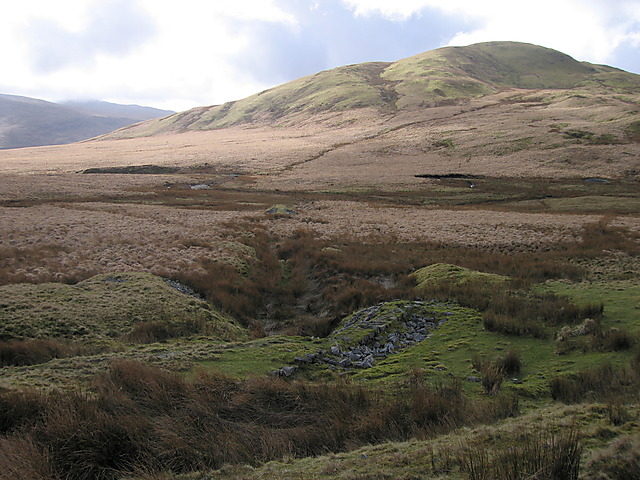
When the site was surveyed in 2005 thick vegetation hid much of it. Low mossy walls in rough moorland were all that showed in a photograph of 2009.
Two wheelpits, the larger for the 40-foot wheel; the fragment of what was probably the crusher house; a ruined mine building about 24 metres long, taken to be the office; a tramway bed running south-east to a large tip; some rails; and a cast-iron pump pipe still in one of the western shafts.
Nearby mines
- Cwmbyr Mine — 2.5 miles (4.0 km) N
- Camdwrmawr Mine — 2.7 miles (4.3 km) SW, Ceredigion
- Brynyrafr Mine — 2.9 miles (4.7 km) SW, Ceredigion
- Cwmrhaiadr Mine — 2.9 miles (4.7 km) NW
- Rhyd Fach Mine — 2.9 miles (4.7 km) SW, Ceredigion
Straight-line distance, within 9 miles (15 km). Show on the map.
Further reading
The archaeological trust's field survey of 1992-93, with a 2004 note on the shafts, levels, office and wheel.
View sourceThe Royal Commission's site record, with a field description of 2005 and a discussion of the mine's earlier name.
View sourceSources
- (primary) Hyddgen Lead Mine (NPRN 306328) — Coflein, Royal Commission on the Ancient and Historical Monuments of Wales
- (secondary) Powys Metal Mines Survey: Hyddgen (HER 6158) — Clwyd-Powys Archaeological Trust, Powys Metal Mines Survey
- (observational) Hyddgen Lead Mine (Geograph photograph 1189875, 2009) — Geograph
Record created: 18 November 2026 · Last researched: 18 November 2026