 MineArchive
Hendreddu Quarry
| Also known as | Hendre-ddu Quarry, Hendre Ddu Slate Quarry |
|---|---|
| Location | head of the Angell Valley, Dyfi Forest, near Aberangell, Gwynedd — 52.6962, -3.7750 (exact) |
| Commodity | Slate |
| Type | Slate |
| Worked | 1856–1941 |
| Maximum depth | Unknown. |
| Operators | Hendreddu Slate Quarry Company (1868–1876) |
Overview
A slate quarry worked intermittently between 1868 and 1941 at the head of the Angell Valley near Aberangell, whose fine-grained Narrow Vein slate was prized for slab products like billiard-table beds rather than roofing, and whose fortunes rose and fell across at least six changes of ownership -- including one outright fraud.
History
An exploration permit for slate at Hendreddu, on the slopes of Mynydd Hendre-ddu at the head of the Angell Valley, was granted to David Hughes in 1856, but it was Sir Edmund Buckley who developed the site from 1864. The Hendreddu Slate Quarry Company was formally established in August 1868 under manager Edward Davies, and underground mining of the Narrow Vein -- the highest-quality slate vein in the wider Abercorris group -- began in 1873 after a long incline was laid from the pit level down to the valley bottom in 1870 and a tunnel driven northwest to meet the vein, completed in April 1873. The quarry specialised in slab slate rather than roofing slate, valued for uses such as billiard-table beds and, later, electrical switchboard panels. Buckley's ownership ran until 1876, when the quarry passed to Dennis and Jacob Bradwell, whose tenure saw significant labour conflict during the 1880s but also the quarry's main boom; Jacob Bradwell's death in 1908 brought that period to a close. Edward Hurst Davies, previously the quarry's second manager, reopened it under his own ownership from 1908 to 1914. After a wartime closure, the site passed in 1919 to the National Welsh Slate Quarries Ltd, an outright fraudulent venture that collapsed at the end of 1921; Hendre-ddu Slate Quarries Ltd took over from 1922 to 1932, specialising in electrical-installation slate slabs, and T. Glyn Williams made one final, only partially successful attempt to work the quarry from 1937 until wartime labour shortages forced its closure in 1941. A terrace of cottages for married quarrymen and a barracks for single men housed the workforce on site; a serious underground collapse in 1925 damaged several chambers but did not end operations at the time. Slate left the quarry via the narrow-gauge Hendre-Ddu Tramway, built in 1874 to connect the site to Aberangell station on the Mawddwy Railway and typically run as a single enterprise with the quarry itself. The mill, built with machinery brought in via Aberangell station, was demolished in 1946.
Geology
Fine-grained Narrow Vein slate on the slopes of Mynydd Hendre-ddu at the head of the Angell Valley.
Workings
Slate worked underground from the Narrow Vein via a long incline (laid 1870) down to the valley floor and a tunnel driven northwest to the vein, completed in 1873; a substantial mill processed the slate into slab products, with output carried out on the quarry's own 1 ft 11 in narrow-gauge Hendre-Ddu Tramway to Aberangell station on the Mawddwy Railway -- a gauge forced on the line by a landowner's refusal to allow a standard-gauge route across his property.
Closure
Closed for the final time in 1941 amid wartime labour shortages under owner T. Glyn Williams; the mill itself was demolished in 1946. The Royal Commission's record gives 1946, the year the mill was demolished, as the quarry's end.
What remains
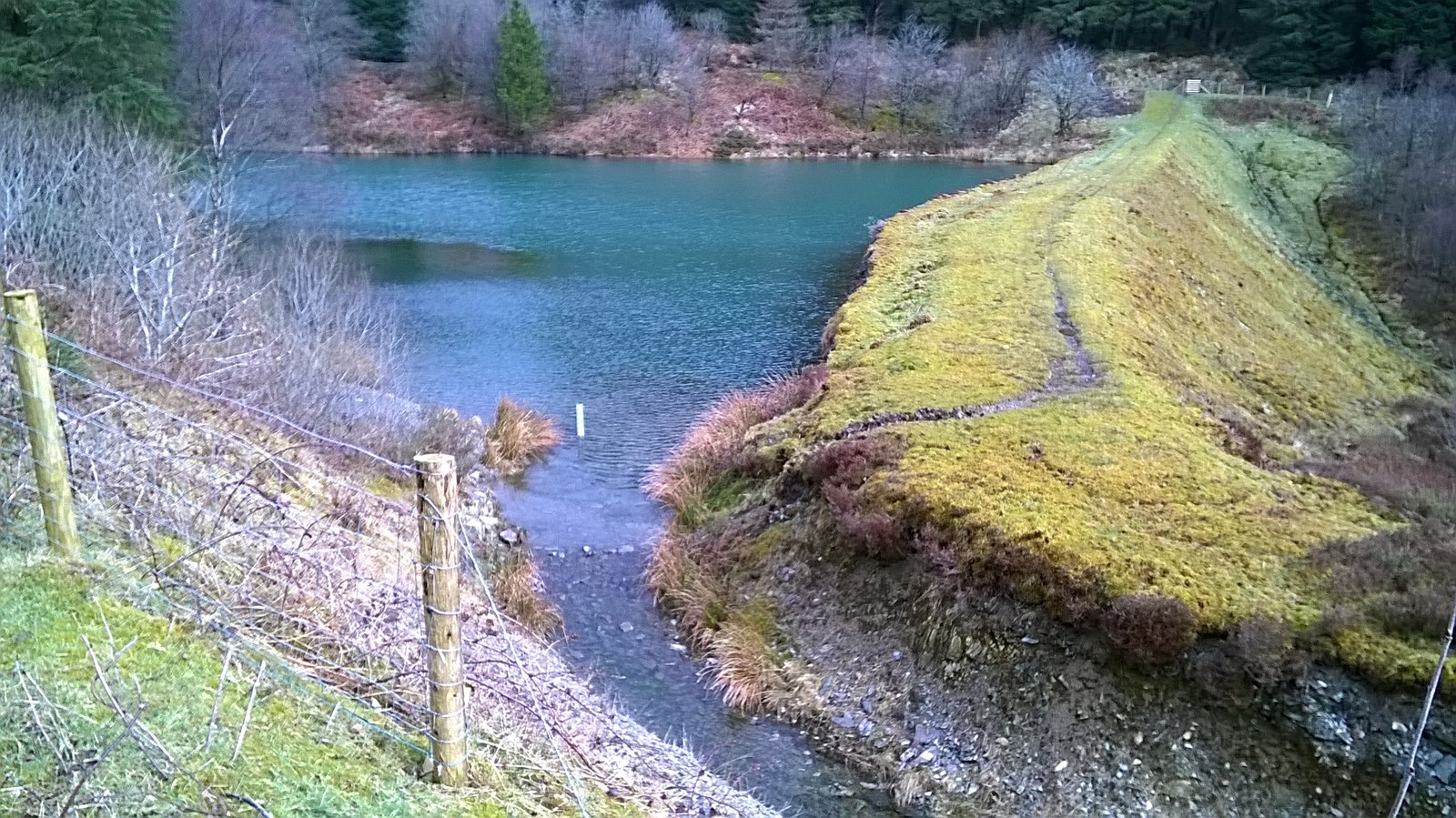
Quarry remains, including former mill foundations and workers' housing (a terrace of married quarters and a single men's barracks), survive at the head of the Angell Valley. The workings, on four levels, are now mostly enveloped in forestry, and the reservoir at the top survives well.
Former quarry buildings, mill foundations, and workers' housing.
Related mines
- Gartheiniog Quarry — Edward Hurst Davies served as mine agent at Gartheiniog before becoming notable at the neighbouring Hendreddu quarry.
- Maesygamfa Quarry — Edward Hurst Davies, formerly Maesygamfa's manager, went on to purchase Hendreddu outright after Jacob Bradwell's 1908 death.
- Minllyn Slate Quarry — Edward Davies, Edmund Buckley’s quarry supervisor, re-opened Minllyn in the 1860s and then oversaw the opening of Hendreddu near Aberangell, managing the new quarry from Minllyn — the same man and the same estate behind both.
Nearby mines
- Ratgoed Quarry — 1.1 miles (1.8 km) SW
- Maesygamfa Quarry — 1.3 miles (2.0 km) NE
- Gartheiniog Quarry — 1.4 miles (2.3 km) SE
- Cymerau Quarry — 1.8 miles (2.9 km) SW
- Aberllefenni Slate Quarry — 2.4 miles (3.9 km) SW
Straight-line distance, within 9 miles (15 km). Show on the map.
Recorded claims
Individual factual claims, each attached to the source(s) that support it below. Where sources disagree, both are kept.
- Hendreddu worked the Narrow Vein, reckoned the highest-quality slate vein in the Abercorris group, and specialised in slab products such as billiard-table beds and, later, electrical switchboard panels rather than roofing slate. 1
- The quarry passed through at least six distinct ownerships between 1864 and 1941, including a fraudulent venture, the National Welsh Slate Quarries Ltd, which collapsed at the end of 1921. 1
- The quarry was active in four separate spells -- 1868-1908, 1914-1916, 1920-1932 and 1937-1941 -- closing for the last time in 1941 amid wartime labour shortages, with its mill demolished in 1946. 1
- The quarry's own 1 ft 11 in narrow-gauge Hendre-Ddu Tramway, built in 1874 to Aberangell station on the Mawddwy Railway, was forced to that unusual gauge when landowner James Walton refused a standard-gauge route across his property; rail traffic ceased in 1938 in favour of road lorries, and the trackbed itself was converted into a road in 1941 for wartime munitions transport. 2
- Output in 1883 was 878 tons of slate from 31 men, and the quarry's yearly output is unlikely ever to have exceeded 1,000 tons; it employed 25 men in 1898. 3
- In 1991 the remains comprised workings on four levels, a compact mill area, adits with massive spoil heaps containing sizeable blocks, traceable tramroad formations and inclines, and a well-preserved reservoir at the top, the whole now mostly enveloped in forestry; the quarry had a ward for injured workers attached to it. 3
Sources
- (secondary) Hendreddu quarry — Wikipedia
- (secondary) Hendre-Ddu Tramway — Wikipedia
- (primary) Hendre-ddu Quarry (Slate), NPRN 400824 (Coflein) — Royal Commission on the Ancient and Historical Monuments of Wales
Record created: 30 August 2026 · Last researched: 24 September 2026