 MineArchive
Ratgoed Quarry
| Location | one mile north of Aberllefenni, on Mynydd Llwydiarth, Gwynedd — 52.6898, -3.8003 (exact) |
|---|---|
| Commodity | Slate |
| Type | Slate |
| Worked | Before 1844–1946 |
| Maximum depth | Unknown. |
| Operators | Alltgoed Consols (1851–1860), Hall Harber & Thomas Ltd (1924–1930) |
Overview
The northernmost and remotest of the slate quarries served by the Corris Railway network, worked under the name Alltgoed from before 1844 and as Ratgoed from the 1870s, reached only by its own long, horse-worked tramway which outlived the passenger railway it connected to.
History
The original workings on this site, known as Alltgoed Quarry, date from before 1844, when proprietor William Hughes went bankrupt; the quarry reopened in 1851 under the Alltgoed Consols partnership, managed by John Rowlands under proprietor Horatio Nelson Hughes, selling roofing slate and slab products including washstands, chimney pieces and headstones. Shareholder disputes forced Rowlands out of management in the early 1860s, though he remained resident at Ratgoed Hall and went on to chair the Corris Railway; the site became known as Ratgoed from around the mid-1870s. The quarry's fortunes were transformed in 1864 by the opening of the Ratgoed Tramway, a 2 ft 3 in gauge horse-worked line running 1¾ miles from the quarry to join the Corris, Machynlleth & River Dovey Tramroad (later the Corris Railway) at Aberllefenni, which the Corris had reached in 1860. The tramway's arrival prompted significant expansion at the quarry, working both the Narrow Vein and, to a lesser extent, the Broad Vein, and enabled profitable operation until 1878; but slate prices collapsed across the industry in 1879, and a small, remote concern like Ratgoed suffered badly in the downturn. Trading recovered somewhat in the 1890s, but by the century's end the more profitable, accessible roofing-slate reserves at Ratgoed were running dry, and the workforce faced dismissal by 1900. The quarry reopened briefly from 1901 to 1903, and again with fluctuating employment (from over 30 workers down to just 6) between 1907 and 1918; Hall Harber & Thomas Ltd acquired it in 1924, and the Lewis family reclaimed ownership in 1930. The quarry struggled on through further ownership changes during the Depression and the Second World War before closing for good in 1946. Remarkably, the isolated Ratgoed Tramway itself continued to operate as a horse-drawn line under British Railways ownership even after the passenger-carrying Corris Railway it connected to had closed in August 1948.
Geology
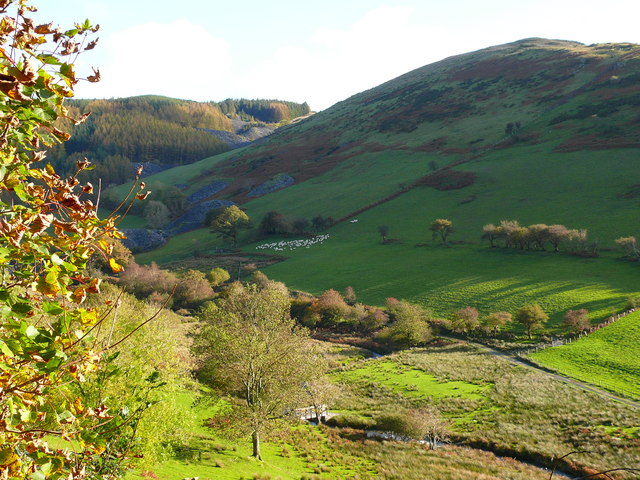
Slate at the head of Cwm Ratgoed, the northernmost of the quarries served by the Corris Railway network.
Workings
Slate worked chiefly from the Narrow Vein, with some Broad Vein production, hauled out via the quarry's own 2 ft 3 in gauge, horse-worked Ratgoed Tramway to a junction with the Corris Railway at Aberllefenni.
Closure
Closed for good in 1946 after struggling through successive ownership changes during the Depression and Second World War; its own tramway nonetheless kept running under British Railways even after the Corris Railway itself closed in 1948.
What remains
Old quarry workings survive on the hillside above Cwm Ratgoed, visible alongside the valley's footbridge over the Nant Ceiswyn.
Disused quarry workings on the hillside, together with the former Ratgoed Tramway trackbed down to Aberllefenni.
Related mines
- Cymerau Quarry — The two quarries shared the remote Ratgoed Tramway and closed simultaneously in October 1946.
Nearby mines
- Cymerau Quarry — 0.7 miles (1.1 km) SW
- Hendreddu Quarry — 1.1 miles (1.8 km) NE
- Aberllefenni Slate Quarry — 1.3 miles (2.1 km) SW
- Cambergi Quarry — 1.4 miles (2.2 km) SW
- Maesygamfa Quarry — 2.3 miles (3.7 km) NE
Straight-line distance, within 9 miles (15 km). Show on the map.
Recorded claims
Individual factual claims, each attached to the source(s) that support it below. Where sources disagree, both are kept.
- The 1864 opening of the 2 ft 3 in gauge, horse-worked Ratgoed Tramway to Aberllefenni prompted significant expansion at the quarry and enabled profitable operation until the industry-wide slate price collapse of 1879. 1
- By 1900 the more accessible, profitable roofing-slate reserves at Ratgoed were exhausted and the workforce faced dismissal; the quarry struggled on through repeated brief reopenings and ownership changes before closing for good in 1946. 1
- The Ratgoed Tramway continued running as a horse-drawn line under British Railways ownership even after the passenger-carrying Corris Railway it connected to closed in August 1948. 2
Sources
- (secondary) Ratgoed quarry — Wikipedia
- (secondary) Ratgoed Tramway — Wikipedia
- (observational) Cwm Ratgoed — Geograph Britain and Ireland (Ian Medcalf)

Record created: 30 August 2026 · Last researched: 30 August 2026