 MineArchive
Cymerau Quarry
| Location | half a mile north of Aberllefenni, Gwynedd — 52.6850, -3.8140 (exact) |
|---|---|
| Commodity | Slate |
| Type | Slate |
| Worked | Around 1860–October 1946 |
| Maximum depth | Unknown. |
| Operators | Inigo Jones and Company (1918–?) |
Overview
A slate quarry half a mile north of Aberllefenni, worked from around 1860 to 1946, whose original underground chambers lay below the water table and required continuous pumping, sharing the remote Ratgoed Tramway with its better-known neighbour Ratgoed quarry.
History
Cymerau quarry began operating around 1860, following the earlier success of the neighbouring Ratgoed quarry to the north. Slate was extracted from five underground chambers working the Narrow Vein -- the highest-quality slate in the Abercorris Group -- which lay below the water table and required continuous pumping by waterwheel. In 1864 the Ratgoed Tramway opened, a 2 ft 3 in gauge horse-worked line connecting both Cymerau and Ratgoed to the newly built Corris Railway at Aberllefenni; the tramway's arrival prompted significant expansion at the quarry, with finished slate travelling downhill to the tramway by gravity while ponies hauled the empty wagons back up. By 1878 the quarry was owned by H. R. Hughes and his nephew. A second quarry opened around 1880, between the original workings and Ratgoed, consisting of surface pits linked by incline, with slate transported down to a southern mill for processing; at its height the combined workings employed over 100 men, whose slate travelled via the quarry's own private wagons along the Ratgoed Tramway and onward on the Corris Railway toward Machynlleth. The quarry closed during the First World War and was reopened at greatly reduced scale by the Inigo Jones company of Groeslon, producing just three tons of finished slab in 1921 with only three employees; a modest recovery took employment to 14 workers by 1927, before falling again to six by the outbreak of the Second World War. Limited wartime production continued until the quarry finally closed in October 1946, at the same time as Ratgoed.
Geology
The Narrow Vein, the highest-quality slate in the Abercorris Group, worked in five underground chambers that lay below the water table and needed continuous pumping.
Workings
Slate worked from underground chambers below the water table (pumped by waterwheel) and, from around 1880, a second surface-pit working linked by incline to a southern mill; finished slate ran by gravity to the quarry's own private wagons on the horse-worked Ratgoed Tramway.
Closure
Closed in October 1946, at the same time as the neighbouring Ratgoed quarry, after a long decline from over 100 workers at its Victorian peak to just six by the start of the Second World War.
What remains
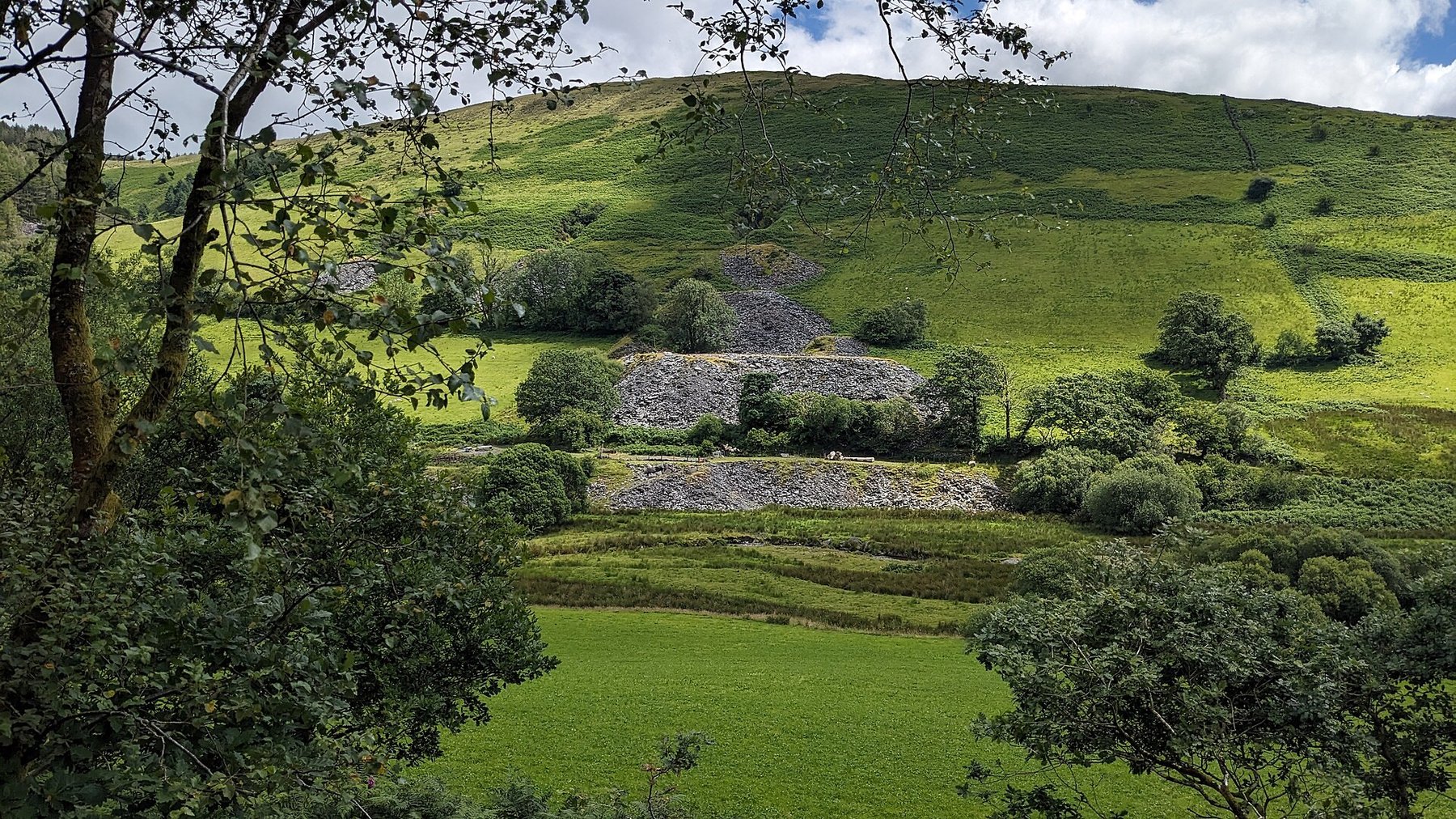
The slate waste tips along the Nant Ceiswyn are the first thing seen; a row of four quarrymen's cottages and remnants of the mill stand among the farm buildings, the adit entrance is flooded, an angle bob, pulley and rising main survive at the incline foot with the leat that fed the waterwheel pump, and the dam of the Pelton wheel stands breached with its spillway and buried penstock sluice.
Related mines
- Ratgoed Quarry — The two quarries shared the remote Ratgoed Tramway and closed simultaneously in October 1946.
Nearby mines
- Aberllefenni Slate Quarry — 0.7 miles (1.1 km) SW
- Cambergi Quarry — 0.7 miles (1.1 km) SW
- Ratgoed Quarry — 0.7 miles (1.1 km) NE
- Hendreddu Quarry — 1.8 miles (2.9 km) NE
- Abercorris Slate Quarry — 2.0 miles (3.3 km) SW
Straight-line distance, within 9 miles (15 km). Show on the map.
Recorded claims
Individual factual claims, each attached to the source(s) that support it below. Where sources disagree, both are kept.
- The 1864 opening of the Ratgoed Tramway, connecting Cymerau and Ratgoed to the Corris Railway at Aberllefenni, prompted significant expansion at Cymerau; by 1878 it was owned by H. R. Hughes and his nephew, and at its height employed over 100 men. 1
- Reopened by the Inigo Jones company after its First World War closure, the quarry produced just three tons of finished slab with three employees in 1921, recovering modestly to 14 workers by 1927 before falling to six by the start of the Second World War; it finally closed in October 1946. 1
- Construction of the quarry began in 1863, though production is not recorded until 1869; it stayed under the same ownership as its larger neighbour Ratgoed for most of its life. 2
- The mill was driven by a Pelton wheel until 1936, after which most of the slate was processed at Groeslon, whose company had acquired the quarry; Cymerau kept its own wagons and ponies on the Ratgoed Tramway, separate from Ratgoed's. 2
- The slate waste tips along the Nant Ceiswyn, a row of four quarrymen's cottages, remnants of the mill among the farm buildings, the flooded adit, an angle bob, pulley and rising main at the incline foot, the leat that fed the waterwheel pump and the breached dam of the Pelton wheel all survive. 2
- Located at about 52.685 N, 3.814 W. 1
Photographs & further reading
The Buddlepit database entry, from Alun John Richards, describing the quarry's history and what survives on the ground.
View sourceSources
- (secondary) Cymerau quarry — Wikipedia
- (secondary) Cymerau (Buddlepit Mine Database, from Alun John Richards) — Buddlepit Mine Database
- (secondary) Ratgoed Tramway — Wikipedia
Record created: 30 August 2026 · Last researched: 24 September 2026