 MineArchive
Aberllefenni Slate Quarry
| Also known as | Foel Grochan, Hen Gloddfa, Ceunant Ddu |
|---|---|
| Location | Cwm Hengae, near Aberllefenni, Gwynedd — 52.6759, -3.8221 (exact) |
| Commodity | Slate |
| Type | Slate |
| Worked | By 1500–2003 |
| Operators | Aberllefenni Slate Quarries (1850–?), Wincilate Ltd (1956–2003) |
Overview
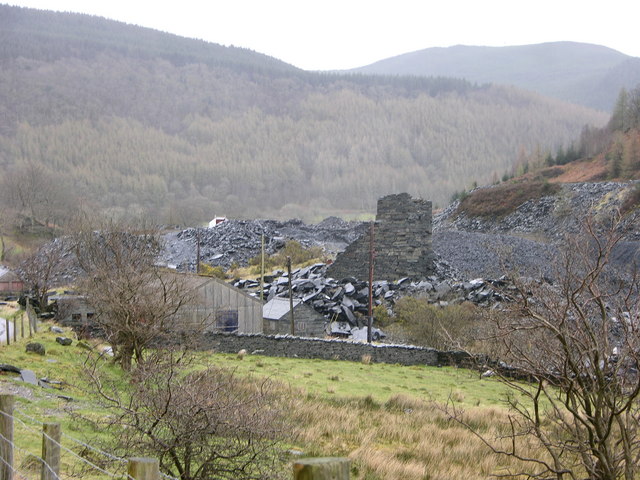
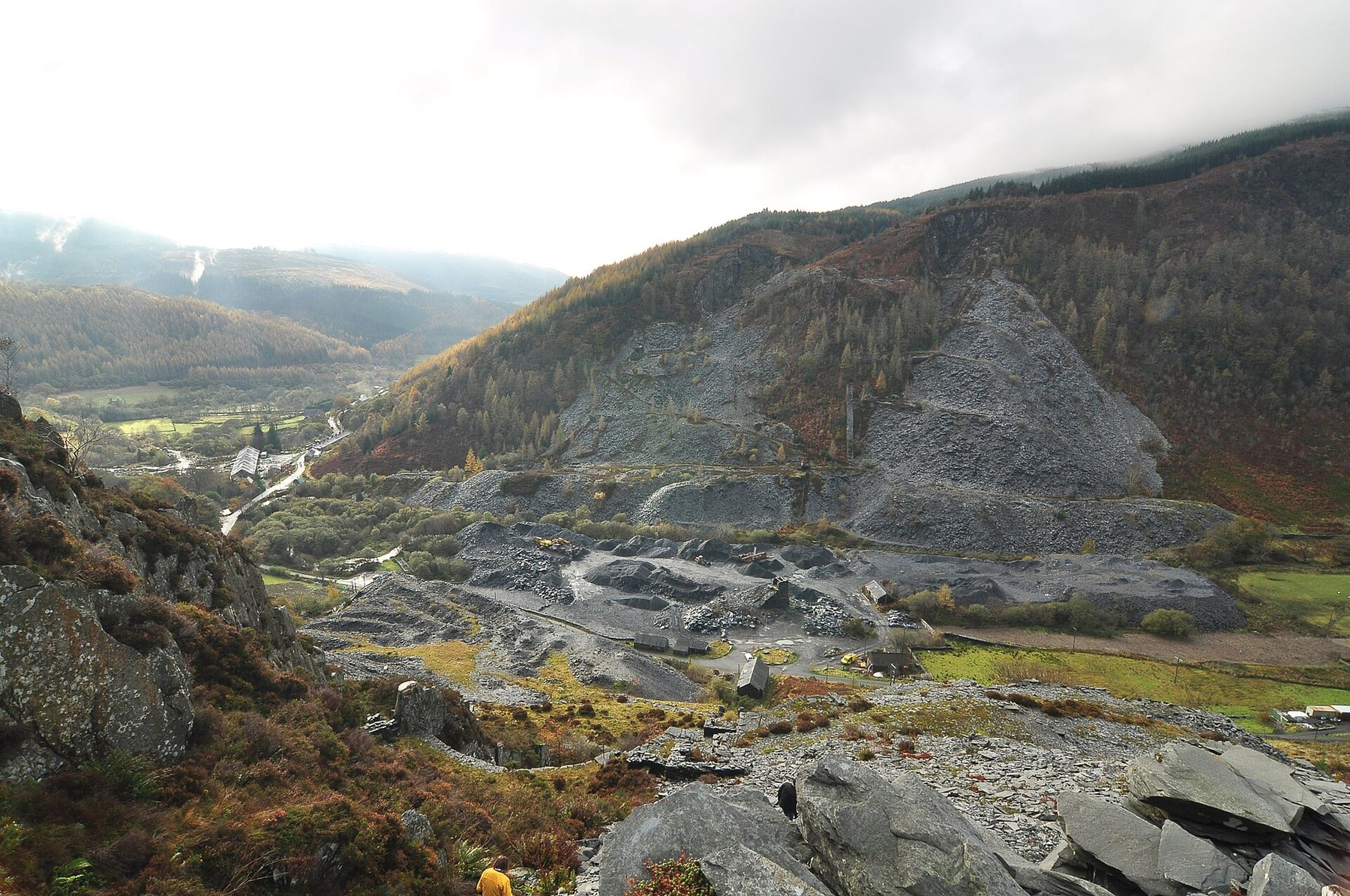
A group of three connected slate workings — Foel Grochan, Hen Gloddfa and Ceunant Ddu — in Cwm Hengae, Gwynedd, worked with only brief interruption from at least the 16th century until 2003, making it the longest continually operated slate mine in the world.
History
Slate from the Aberllefenni workings is recorded roofing the local house Plas Aberllefenni as early as 1500, and the quarry may have been working since the fourteenth century. The Lloyd family owned it in the seventeenth century; it passed to the Campbells in 1725 and in 1806 to John Davies, who first organised commercial quarrying around 1810, and then to his executor Pryce Jones in 1824. Only three men were employed in 1825, but by 1854 output was substantial and the great 'Alma' open chamber at the top of Foel Grochan was named that year after the battle. By 1850 the concern belonged to Colonel Robert Davies Jones, trading as Aberllefenni Slate Quarries; the opening of the Corris Railway in 1859 gave it an efficient route to Machynlleth and beyond, and Robert Hughes, appointed manager in 1873, extended the mill and drove its new machinery with a large waterwheel. The quarry employed 180 men that year, 169 in 1879 when it made nearly 4,700 tons of finished slate and slab, and a peak of 190 in 1890, after which numbers fell below 100 in 1908 and to 71 by 1910. Between the wars the owner A. Hamilton Pryce leased it, in 1935, to Sir Henry Haydn Jones of the Bryn Eglwys quarry and the Talyllyn Railway; 140 men were at work in 1940, 40 by 1944, and a strike closed the quarry for part of 1947. In 1956 the brothers Gwilym and Dewi Lloyd took it over as Wincilate Ltd, mechanised it, and kept it producing into the 1990s as the last working slate mine south of Blaenau Ffestiniog.
Geology
Slate of the Narrow Vein of the Corris district, deep blue, extremely hard and dense, which resists fine splitting and so went mostly as large cut slabs rather than roofing slates; the poorer Broad Vein runs parallel to it. Worked as underground mines rather than open pits for most of its history across three linked workings in Cwm Hengae.
Workings
The name covers three linked underground and open workings in Cwm Hengae — Foel Grochan, Hen Gloddfa (also called Hen Chwarel) and Ceunant Ddu — worked as slate mines rather than open pits for most of their history.
Closure
Employment fell steadily through the 20th century, to around 40 men by 1950 despite post-war modernisation and new machinery at Foel Grochan; the quarry finally closed in 2003, extraction no longer being economical, with only three men still employed at the end.
What remains
A 2025 exploration report of the Foel Grochan section describes extensive intact underground chambers and equipment left in place since closure.
Nearby mines
- Cambergi Quarry — 0.4 miles (0.6 km) NW
- Cymerau Quarry — 0.7 miles (1.1 km) NE
- Abercorris Slate Quarry — 1.3 miles (2.1 km) SW
- Ratgoed Quarry — 1.3 miles (2.1 km) NE
- Abercwmeiddaw Slate Quarry — 1.7 miles (2.7 km) SW
Straight-line distance, within 9 miles (15 km). Show on the map.
What's uncertain
Points where sources disagree or the record could not be settled; both accounts are kept. All open questions in the archive.
- Aberllefenni is reputed to be the longest continually operated slate mine in the world, closing in 2003. (uncertain) 1
- The quarry employed around 190 men at its peak around 1890, falling to around 40 by 1950 and just 3 at closure in 2003. (uncertain) 1
Recorded claims
Individual factual claims, each attached to the source(s) that support it below. Where sources disagree, both are kept.
- Aberllefenni is reputed to be the longest continually operated slate mine in the world, closing in 2003. (uncertain) 1
- The quarry employed around 190 men at its peak around 1890, falling to around 40 by 1950 and just 3 at closure in 2003. (uncertain) 1
- The Lloyd family owned the quarry in the seventeenth century; it passed to the Campbells in 1725, to John Davies in 1806, who organised commercial working around 1810, to his executor Pryce Jones in 1824, and by 1850 to Colonel Robert Davies Jones, trading as Aberllefenni Slate Quarries. 1
- A. Hamilton Pryce leased the quarry in 1935 to Sir Henry Haydn Jones of Bryn Eglwys and the Talyllyn Railway; in 1956 the brothers Gwilym and Dewi Lloyd took it over as Wincilate Ltd and mechanised it, and it closed in 2003, the mill continuing on slate brought in from Blaenau Ffestiniog, Penrhyn and China. 1
- Foel Grochan was worked from eight near-horizontal levels about 60 feet apart, each opening into a chamber 100 to 187 feet long with 24 to 30 feet of rock left between one chamber and the next below. 1
Photographs & further reading
An explorer's photographs of the chambers and levels of Foel Grochan after closure.
View sourceSources
- (secondary) Aberllefenni quarries — Wikipedia
- (observational) Foel Grochan / Aberllefeni Slate mine, July 2025 — 28DaysLater.co.uk
- (primary) Mine plan: ABERLLEFENNI — BGS / Mining Remediation Authority mine plans catalogue
Record created: 25 August 2026 · Last researched: 24 September 2026