 MineArchive
Glyncastle Colliery
| Location | Cwm Clydach, above Resolven, Vale of Neath, Neath Port Talbot — 51.7048, -3.6714 (approximate) |
|---|---|
| Commodity | Coal |
| Type | Coal |
| Worked | Levels from 1837; shafts sunk from 1879–3 April 1965 |
| Maximum depth | 669 yards (No. 2 shaft); No. 1 shaft 543 yards |
| Operators | Cardiff and Swansea Smokeless Steam Coal Company (1873–1891), Cory Brothers and Company Ltd (1893–1947), National Coal Board (1947–1965) |
Overview
A Cory Brothers colliery above Resolven in the Vale of Neath, sunk from 1879 after the company's levels failed on soft, friable coal. Dogged by bad seams, strikes and liquidation before 1894, it later became a showpiece for anthracite sizing, employed 800 men with Ffaldydre in 1934, and closed with Rheola on 3 April 1965.
History
J. W. Lyon opened levels at Resolven in 1837, and after several owners the Cory and Yeo interests bought the Resolven collieries in 1871, becoming the Cardiff and Swansea Smokeless Steam Coal Company in 1873-74. Their levels were producing soft, friable coal, so they sank two 15-foot shafts: No. 1 from September 1879, eventually to 543 yards, and No. 2, for ventilation, from June 1880 to 669 yards. In 1881 all but two levels were closed for poor quality, a strike lasted six months, and the No. 2 and No. 3 Rhondda seams proved just as soft. The mine closed in 1886, was sunk deeper in 1887, and in 1889 opened the Six-Feet seam, only to find a thick clod above it that fouled the coal. The company went into liquidation in 1891; Cory Brothers took over directly in 1893 and raised 110,656 tons in 1894. Cory Brothers equipped Glyncastle with the most modern surface plant of its day, and their general manager W. D. Wight read a paper on its anthracite breaking and sizing plant, built to make 'nuts' for domestic stoves, to the Federated Institution of Mining Engineers. After the strikes of 1921, 1925 and 1926 it closed from April 1928 to May 1929 for want of markets. Worked with the Ffaldydre level from 1914, it employed 801 men in 1934. On nationalisation in 1947 it had 311 men in the Six-Feet seam. In 1950 a brewing industry delegation came to inspect its anthracite, used in malting, and in 1952 nearly a third of the underground men were foreign workers from Poland, Italy, Yugoslavia, Ukraine, Lithuania and Estonia. The shafts stood on the mountainside above the surface plant, with men carried up by bus and spake and coal brought down by rope haulage. Power loading failed, losses replaced profits after 1959, and only 121 of 263 men transferred there since 1962 stayed. The NCB closed Glyncastle and Rheola on 3 April 1965 as uneconomic, citing disturbed ground.
Geology
Steam and anthracite coals of the Middle and Lower Coal Measures: the No. 2 and No. 3 Rhondda seams proved too soft, and the colliery worked the Six-Feet, Four-Feet, Nine-Feet and Yard seams, with the Six-Feet alone from 1947 to closure. Remaining reserves in 1964 included the dirty White Four-Feet, the faulted Lower Four-Feet and the gassy Peacock seams.
Geological setting: Sedimentary Beds and Seams (well documented example)
Workings
Two 15-foot shafts on the mountainside, No. 1 (downcast and winding, 543 yards) and No. 2 (ventilation, 669 yards), with the surface plant, washery and baths in the valley below, linked by bus, spake and an endless rope haulage. A reorganisation of the 1950s planned slants nearer the surface plant to replace the shafts.
Closure
Closed by the NCB with Rheola on 3 April 1965 as uneconomic. The Board cited disturbed ground and the difficulty of keeping men; power loading had failed, and the colliery went from a profit of up to £1.50 a ton in 1953-59 to a loss of £2 a ton in 1960. Earlier closures ran from 1886-87 and April 1928 to May 1929.
What remains
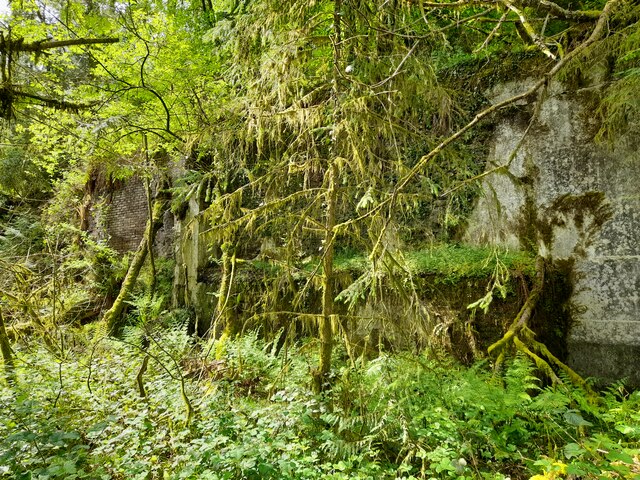
A 2022 photograph shows moss-covered masonry and brick walls of the colliery overgrown by woodland.
Overgrown walls of colliery buildings survive in woodland (Geograph, 2022).
Redevelopment
Unknown.
Related mines
- Ffaldydre Colliery — Worked in conjunction with Glyncastle from the 1930s under the same manager, and closed in 1963 so its men could be transferred to Glyncastle.
Nearby mines
- Ffaldydre Colliery — 0.5 km W
- Ynysarwed Colliery — 1.2 km SW
- Cwmgwrach Colliery — 3.6 km NE
- Glyncorrwg Colliery — 4.6 km SE
- Graig y Fforest No.2 Colliery (Pinetrees) — 4.9 km N
Straight-line distance, within 15 km. Show on the map.
Recorded claims
Individual factual claims, each attached to the source(s) that support it below. Where sources disagree, both are kept.
- No. 1 pit was started in September 1879 and No. 2 in June 1880, both 15 feet in diameter; No. 1 reached 543 yards and No. 2 669 yards. 1
- Levels in Cwm Clydach passed through several owners to John, Cory and Yeo, becoming the Cardiff Merthyr Steam Coal Company by 1873 and the Cardiff and Swansea Smokeless Steam Coal Company by 1874; the collieries were renamed Glyncastle and Rheola in 1896. 2
- The Cardiff & Swansea company went into liquidation in 1891; the Cory Brothers owned it directly from 1893 and raised 110,656 tons in 1894. 1
- Welsh Coal Mines gives 252 men in 1896, 209 in 1908, 158 in 1918 and 84 in 1923; in 1938, 655 at Glyncastle and 52 underground at Ffaldydre plus 151 surface; 352 at Glyncastle in 1945. 3
- In 1935, 750 men worked in 'the Pit'; with Ty'n-y-Cwm and the Tyra levels the collieries employed over 700 men in 1896. (uncertain) 2
- W. D. Wight read a paper on the anthracite coal breaking and sizing plant at Glyncastle to the Federated Institution of Mining Engineers. 1
- In 1952, 30% of the underground men were foreign workers from Poland, Italy, Yugoslavia, Ukraine, Lithuania and Estonia. 1
- Glyncastle and Rheola were closed on 3 April 1965 as uneconomic. 1
- Glyncastle closed in 1965. 3
- Walls of the colliery survive, overgrown, in woodland at SN 8452 0205 (photographed 2022). 4
- Mining Remediation Authority abandonment plan SWR702, 'Glyncastle Resolven', is dated to abandonment in 1965. 5
Photographs & further reading
Full history from Ray Lawrence: the soft-coal troubles, Cory Brothers' sizing plant, a surface worker's memoir, seams by year and closure.
View sourceGlyncastle with its Ffaldydre and Rheola workings, seams worked and historic photographs.
View sourceLocal history of the Resolven collieries and the village that grew around Glyncastle.
View sourceSources
- (secondary) Glyncastle Colliery — Northern Mine Research Society (Ray Lawrence)
- (secondary) Cymdeithas Hanes Resolfen History Society: Coal in Resolven — Cymdeithas Hanes Resolfen (Resolven History Society)
- (secondary) Glyn Castle (Glyncastle, Ffaldydre and Rheola collieries) — Welsh Coal Mines
- (observational) Remains of Glyncastle Colliery (photograph, 2022) — Geograph (Adrian Dust)
- (primary) BGS / Mining Remediation Authority mine plans: GLYNCASTLE RESOLVEN — British Geological Survey / Mining Remediation Authority
Record created: 16 September 2026 · Last researched: 16 September 2026