 MineArchive
Pentreclwydau Colliery
| Also known as | Pentreclwydau Drifts, Unity Mine |
|---|---|
| Location | Pentreclwydau, west of Glynneath, Vale of Neath, Neath Port Talbot — 51.7329, -3.6690 (approximate) |
| Commodity | Coal |
| Type | Coal |
| Worked | Drifts begun 1955; production from 1958–27 May 1967 (NCB); later reopened |
| Maximum depth | Unknown; the main drifts were 790 and 900 yards long, driven at about one in three. |
| Operators | National Coal Board (1947–1967), Ryan Mining Ltd (1991–1995), NSM Mining (South Wales) Ltd (1995–1997), Pentreclwydau Mining Company (1997–1998), Unity Mine Ltd (1999–?) |
Overview
A pair of drift mines near Glynneath in the Vale of Neath, driven by the National Coal Board from 1955 to open up a large western take of Aberpergwm Colliery. Planned for 2,000 tons a day and 1,000 men, it was held back by washouts and faults, never passed about 500 men, and closed in May 1967. Its concrete and brick surface buildings are a scheduled monument, and later drifts on the site were reopened by private companies from about 1990, becoming Unity Mine.
History
The ground west of Aberpergwm had been tried before: two drifts from Aberpergwm attempted it in 1940 but were withdrawn because of ventilation and haulage problems. After nationalisation the NCB planned a new mine to work 1,500 acres of coal in seven seams between Aberpergwm and Ynysarwed, some 50 million tonnes, which would allow both Rock and Aberpergwm collieries to close. The Neath Trough left no suitable rock bed, and choosing a site proved very difficult. NMRS records thirteen men developing the ground under the manager E.J.H. Nicholas in 1947; Welsh Coal Mines dates the start of work on site to July 1954. The No. 2 drift was begun in February 1955 and No. 1 in March, both 14 feet high and 40 yards apart, driven with compressed-air shovels that had to be chained to a haulage on the one-in-three gradient. They were finished in July 1956 at 790 and 900 yards. By 1957 they had reached the Nine Feet seam and production began in 1958, the coal going 2,200 yards by surface railway to the Aberpergwm washery. A continuous miner bought for £150,000, said to be the only one of its type in the UK, did not bring the planned output: in January 1960 the Nine Feet was reported disturbed and the project three or four years late, and by August 1963 two of its four faces had been stopped by washouts, the other two were working at one in four, and a face had been opened in the Peacock seam instead. NMRS gives 352 men and 45,000 tons in 1960 and 513 men and 85,490 tons in 1961. The Peacock (Bute) seam was mainly worked at about a metre thick. In 1966 the mine lost £163,634 between April and October, £0.75 on every ton, and the NCB called closure inevitable, citing heavy losses, low productivity and absenteeism; the union won repeated extensions, but Pentreclwydau closed on 27 May 1967. Drifts on the site were listed from 1991 under Ryans Mining, then worked by NSM Mining (South Wales) from 1995 until it went into liquidation in 1997 with the loss of about 100 jobs, and by a management and workforce buy-out, Pentreclwydau Mining Company, from October 1997 until July 1998. Horizon Mining took over in 1999 and was renamed Unity Mine Ltd in 2006. The NCB-era surface buildings were scheduled as an ancient monument in 2003.
Geology
Worked the Nine Feet seam from 1958, which met washouts and faults, and mainly the Bute or Peacock (Brass) seam at about a metre; abandonment plans also cover the Red Vein (Caerau Cornish). The site lies on the disturbed ground of the Neath Trough.
Geological setting: Sedimentary Beds and Seams (historical documentary reference)
Workings
Two parallel drifts 14 feet high and 40 yards apart: No. 1 the intake, driven at one in three for about 790 yards, and No. 2 the return, about 900 yards. Coal was hauled by 150 h.p. haulages and taken by surface railway to the Aberpergwm washery. Pillar and stall working in the Nine Feet was abandoned by 1963. Separate South drifts were worked after 1990.
Closure
Closed by the NCB on 27 May 1967 after heavy losses on the Peacock seam and two deferred closure dates. Drifts on the site were reopened by private operators from about 1990; the South drifts were worked intermittently to 1998 and passed to Horizon Mining in 1999, renamed Unity Mine Ltd in 2006.
What remains
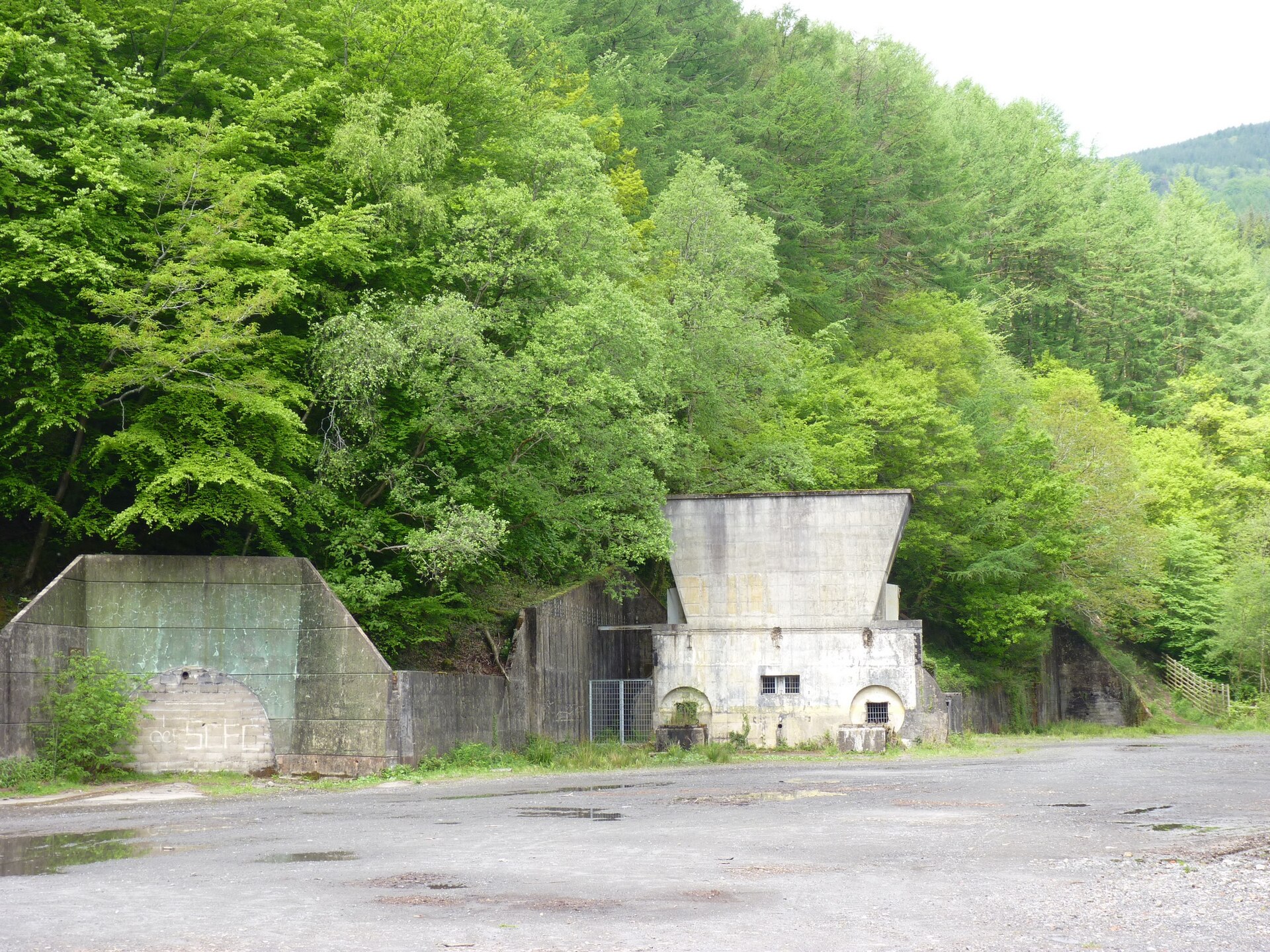
The NCB-era surface remains were scheduled by Cadw on 12 February 2003: haulage engine houses, drift entrances, rail tracks and a fan drift with a concrete fanhouse and evasée.
Haulage engine houses, drift entrances, rail tracks, and a fan drift with a concrete fanhouse and evasée, built of reinforced concrete and brick.
Redevelopment
Unknown for the NCB drifts; the later South drifts became Unity Mine.
Related mines
- Aberpergwm Colliery — Pentreclwydau was driven to work Aberpergwm's western take, and its coal went to the Aberpergwm washery.
- Ynysarwed Colliery — Pentreclwydau's planned take lay between Aberpergwm and Ynysarwed.
Nearby mines
- Graig y Fforest No.2 Colliery (Pinetrees) — 2.1 km NE
- Blaenant Colliery — 2.5 km NW
- Ffaldydre Colliery — 3.1 km S
- Glyncastle Colliery — 3.1 km S
- Nant Hir Colliery — 3.2 km N
Straight-line distance, within 15 km. Show on the map.
People
- E.J.H. Nicholas · manager, 1947 — Manager while the ground was being developed in 1947.
- Emrys Glyn Williams (d. 1967) · worker, to 1967 — A 58-year-old miner from Glynneath recorded as dying at work at Pentreclwydau in May 1967; no details given.
What's uncertain
Points where sources disagree or the record could not be settled; both accounts are kept. All open questions in the archive.
- NMRS records the ground being developed by thirteen men under manager E.J.H. Nicholas in 1947. (disputed) 1
- Welsh Coal Mines says work on site began in July 1954. (disputed) 2
- NMRS: 352 men and 45,000 tons in 1960; 513 men and 85,490 tons in 1961. (disputed) 1
- Welsh Coal Mines: 221 underground and 52 surface each year 1960-65, and 354/76 in 1966. (disputed) 2
Recorded claims
Individual factual claims, each attached to the source(s) that support it below. Where sources disagree, both are kept.
- The NCB began the No. 2 drift in February 1955 and the No. 1 drift in March 1955. 1,2
- NMRS records the ground being developed by thirteen men under manager E.J.H. Nicholas in 1947. (disputed) 1
- Welsh Coal Mines says work on site began in July 1954. (disputed) 2
- The drifting was completed in July 1956 at 790 yards in No. 1 and 900 yards in No. 2. 2
- Production began in 1958 after the drifts reached the Nine Feet seam; the NCB bought a £150,000 continuous miner for the colliery. 1
- By August 1963 two of four Nine Feet faces had been stopped by washouts, the others worked at one in four, and a face had been established in the Peacock seam. 2
- NMRS: 352 men and 45,000 tons in 1960; 513 men and 85,490 tons in 1961. (disputed) 1
- Welsh Coal Mines: 221 underground and 52 surface each year 1960-65, and 354/76 in 1966. (disputed) 2
- The NCB closed Pentreclwydau on 27 May 1967. 1,2
- Drifts on the site were worked by Ryans Mining from about 1990-91, NSM Mining (South Wales) 1995-97, Pentreclwydau Mining Co. 1997-98, and from 1999 Horizon Mining, renamed Unity Mine Ltd in 2006. 1,2
- The colliery remains were scheduled as a monument (GM537) on 12 February 2003. 3
- A Mining Remediation Authority abandonment plan of Pentreclwydau's Cornish (Red) seam is dated 8 January 1966; another covers the methane drainage, intake and return fan drifts in the Red Vein, Nine Feet and Bute (Peacock) seams. 4,5
Photographs & further reading
The NCB's plans, the driving of the drifts, manpower and output, the 1966-67 closure talks and the later private operators.
View sourceManpower by year, contemporary reports of washouts in the Nine Feet, and dates of each post-1990 operator.
View sourceCadw's scheduling description of the surviving engine houses, drift entrances and fanhouse.
View sourceSources
- (secondary) Pentreclwydau Colliery — Northern Mine Research Society (Ray Lawrence)
- (secondary) Pentreclwydau Drifts — Welsh Coal Mines
- (secondary) Pentreclwydau Colliery, Glynneath (scheduled monument GM537) — AncientMonuments.uk, from Cadw data
- (primary) BGS / Mining Remediation Authority mine plans: PENTRECLWYDAU (Cornish (Red), 1966) — British Geological Survey / Mining Remediation Authority
- (primary) BGS / Mining Remediation Authority mine plans: PENTRECLWYDAU (METHANE DRAINAGE)/ INTAKE /RETURN FAN DRIFTS — British Geological Survey / Mining Remediation Authority
Record created: 17 September 2026 · Last researched: 17 September 2026