 MineArchive
Darran Colliery
| Also known as | Darren Colliery |
|---|---|
| Location | Deri, Darran valley, Caerphilly — 51.6903, -3.2447 (approximate) |
| Commodity | Coal |
| Type | Coal |
| Worked | 1868–1919 |
| Maximum depth | Two shafts, each reaching the Brithdir seam at 120 yards. |
| Operators | Rhymney Iron Company (1868–1919) |
Overview
A house-coal colliery in the Darran valley near Deri, sunk in 1868 by the Rhymney Iron Company with two shafts to the Brithdir seam at 120 yards. It was reckoned a safe pit and was worked with naked lights throughout its life — until an explosion on a Friday morning in October 1909 killed twenty-seven, five of them rescuers. It closed in 1919.
History
The colliery was sunk in 1868 by the Rhymney Iron Company near Deri in the Darran valley, with two shafts reaching the Brithdir house-coal seam at 120 yards. In 1908 it employed 272 men.
At about four o'clock on the morning of Friday 29 October 1909, with fifty night-shift men underground, an explosion vented up the upcast shaft and shattered the pit-head casing on which two men were standing, badly injuring both. Twenty-seven died, five of them members of a rescue party (see Disasters, below). Until that morning the mine had been considered safe, and had been worked with naked lights throughout its history.
By 1918 only seventy-three men were employed, and the colliery closed the following year. The Brithdir seam's abandonment plan, shared with the Groesfaen and Pen-y-garreg pits, is held by the Mining Remediation Authority.
Geology
The colliery worked the Brithdir seam, one of the house-coal seams of the upper Coal Measures on the eastern side of the South Wales Coalfield, at a shallow 120 yards. House-coal districts of this kind were widely reckoned less gassy than the steam-coal measures below them, which is why naked lights were tolerated here for forty years — an assumption the 1909 explosion destroyed.
Workings
Two shafts, each 120 yards to the Brithdir house-coal seam, with a separate ventilation pit that had a ladder fixed to the side of the shaft. The colliery was connected underground to the neighbouring Gilfach colliery, which is how survivors of the 1909 explosion got out and how the rescue party got in. Naked lights were used throughout the colliery's working life.
Closure
Employment had fallen to seventy-three by 1918 and the colliery closed in 1919.
What remains
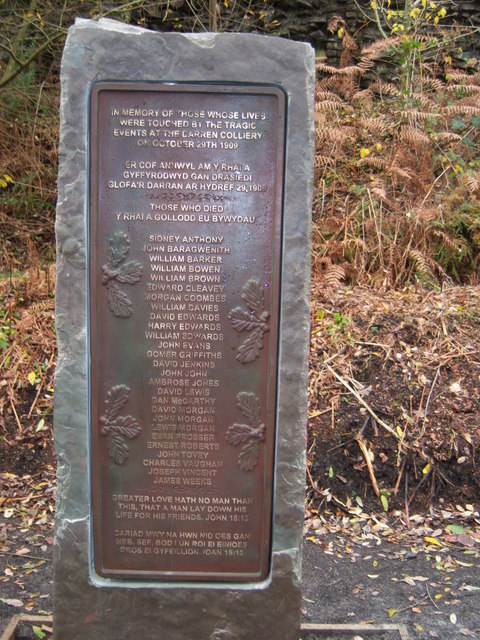
The colliery site has been cleared. A memorial at Darran House in Deri commemorates those who died on 29 October 1909, many of them in their attempts to rescue others.
No colliery structures; a colliery memorial at Darran House, Deri.
Related mines
- Gilfach Colliery — Gilfach Colliery was connected underground to the Darran Colliery at Deri.
Nearby mines
- Wingfield Colliery — 0.6 miles (0.9 km) W
- Groesfaen Colliery — 0.6 miles (1.0 km) NW
- Bargoed Colliery — 0.8 miles (1.2 km) E
- Gilfach Colliery — 1.0 miles (1.6 km) SE
- Gwaelod-y-Waun Colliery — 1.2 miles (2.0 km) E
Straight-line distance, within 9 miles (15 km). Show on the map.
Disasters & major incidents
-
Darran Colliery Explosion, 1909
29 October 1909 · Explosion · 27 fatalities
At about four on the morning of Friday 29 October 1909, with fifty night-shift men underground, Darran Colliery exploded. The blast vented up the upcast shaft and shattered the pit-head casing, and it disabled the winding shaft. Twenty-seven died — five of them rescuers whose breathing apparatus did not hold enough oxygen to get them out again.
What's uncertain
Points where sources disagree or the record could not be settled; both accounts are kept. All open questions in the archive.
- The colliery was sunk in 1868 by the Rhymney Iron Company, with two shafts each reaching the Brithdir house-coal seam at 120 yards. (uncertain) 1
- Until the explosion of 29 October 1909 the mine was considered safe, and throughout its history it had been worked with naked lights. (uncertain) 1
- The colliery employed 272 men in 1908 and only seventy-three by 1918. (uncertain) 1
- The Darran was connected underground to Gilfach colliery; survivors of the 1909 explosion made their way out through the Gilfach shaft, and the rescue party went in that way. (uncertain) 1
- The colliery closed in 1919. (uncertain) 2,1
Recorded claims
Individual factual claims, each attached to the source(s) that support it below. Where sources disagree, both are kept.
- The colliery was sunk in 1868 by the Rhymney Iron Company, with two shafts each reaching the Brithdir house-coal seam at 120 yards. (uncertain) 1
- Until the explosion of 29 October 1909 the mine was considered safe, and throughout its history it had been worked with naked lights. (uncertain) 1
- The colliery employed 272 men in 1908 and only seventy-three by 1918. (uncertain) 1
- The Darran was connected underground to Gilfach colliery; survivors of the 1909 explosion made their way out through the Gilfach shaft, and the rescue party went in that way. (uncertain) 1
- The colliery closed in 1919. (uncertain) 2,1
- The Mining Remediation Authority holds abandonment plan SWR1715 for the Brithdir seam of the Darran, Groesfaen and Pen-y-garreg pits, with three further sheets beside it. 3
Photographs & further reading
The colliery's sinking by the Rhymney Iron Company, its shafts and seam, and a detailed account of the 1909 explosion — the carpenter who went down the ventilation shaft by ladder, and the rescue party whose oxygen ran out.
View sourceSources
- (secondary) Darran Colliery, Deri — Welsh Coal Mines
- (secondary) Welsh mining disasters: list of accidents with five or more fatalities — Welsh Coal Mines
- (primary) DARRAN/ GROESFAEN/ PEN-Y-GARREG (Mine Remediation Authority abandonment plan SWR1715, BGS mine plans catalogue) — British Geological Survey / Mining Remediation Authority
Record created: 3 September 2026 · Last researched: 24 September 2026