 MineArchive
Crynant Colliery
| Location | Crynant, Dulais valley, Neath Port Talbot — 51.7303, -3.7440 (exact) |
|---|---|
| Commodities | Anthracite, Coal |
| Type | Coal |
| Worked | 1880–3 March 1956 |
| Maximum depth | Unknown. |
| Operators | Crynant Colliery Co. Ltd (1880–?), Evans and Bevan (?–1947), National Coal Board (1947–1956) |
Overview
Crynant Colliery was opened in 1880 in the Dulais valley north-east of Neath by the Crynant Colliery Co. of Jebb and Dickinson, and worked as a Lower Level with an Upper Level alongside it between 1890 and 1895. It raised anthracite, with steam coal in its earliest and latest returns. It was a small pit — 79 people in 1894, 191 by 1915 — and passed to Evans and Bevan, the family firm that dominated coal in the Dulais valley and by 1935 controlled six mines and 2,631 workers. The National Coal Board closed it on 3 March 1956.
History
The Crynant Colliery Co., in the hands of Jebb and Dickinson, opened the colliery in 1880 as a level rather than a shaft, and an Upper Level was worked from 1890 to 1895 alongside the Lower. The Lists of Mines record 79 people in 1894 raising anthracite and steam coal, 60 in 1896 and 72 in 1900, by which time anthracite alone was returned; employment then grew to 92 in 1905, 151 in 1910 and 191 in 1915. Ownership passed to the Crynant Colliery Co. Ltd and then to Evans and Bevan Ltd. From the 1870s the Evans-Bevan family had begun exploiting the Dulais valley's coal and opened numerous collieries there; by 1935 the firm controlled six mines employing 2,631 people and producing half a million tons a year. At nationalisation in 1947 Crynant raised 27,000 tons of anthracite and steam coal.
Geology
Crynant worked the anthracite of the Dulais valley on the northern outcrop of the South Wales coalfield, where the coal reaches the highest rank in Britain; steam coal is returned alongside the anthracite in the earliest and the last of the Lists of Mines entries.
Geological setting: Sedimentary Beds and Seams (well documented example)
Workings
A Lower Level, worked from 1880, with an Upper Level a little to the north worked from 1890 to 1895 — levels driven into the valley side rather than shafts, the usual form in the narrow Dulais valley.
Closure
Crynant was closed on 3 March 1956 after being transferred to the National Coal Board's No. 9 (Neath) Area. Reviewing the Board's decision, the Area Executive Council of the National Union of Mineworkers decided that, given the conditions prevailing at the colliery, they could not oppose the closure.
What remains
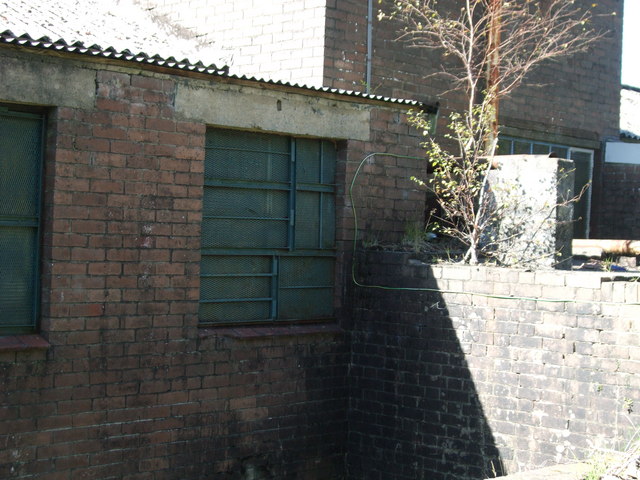
A former colliery building survives at Brynawel in Crynant, now part of a farm. The village keeps its railway bridges and the derelict Crynant Miners Welfare Club.
A former colliery building survives at Brynawel, now part of a farm.
Related mines
- Brynteg Colliery — Evans and Bevan collieries in the Dulais Valley.
Nearby mines
- Blaenant Colliery — 0.0 miles (0.1 km) W
- Treforgan Colliery — 0.5 miles (0.8 km) NW
- Cefn Coed Colliery — 1.2 miles (1.9 km) SW
- Danygraig Colliery — 1.2 miles (1.9 km) NW
- Darrell Colliery — 1.2 miles (1.9 km) NE
Straight-line distance, within 9 miles (15 km). Show on the map.
What's uncertain
Points where sources disagree or the record could not be settled; both accounts are kept. All open questions in the archive.
- The BGS mine-plans catalogue holds a Mining Remediation Authority abandonment plan titled 'Crynant' (catalogue SWR3772, No2 Rhondda (Ynisarwed), undated in the catalogue); the catalogue gives no location and the plan's details do not clearly tie it to this working, so it may belong to another of the same name. (uncertain) 3
Recorded claims
Individual factual claims, each attached to the source(s) that support it below. Where sources disagree, both are kept.
- The colliery was opened in 1880 and closed in March 1956; an Upper Level was opened in 1890 and closed in 1895. 1
- The colliery was worked by the Crynant Colliery Co. under Jebb and Dickinson, then the Crynant Colliery Co. Ltd, then Evans and Bevan Ltd, and by the National Coal Board from 1947. 1
- Employment ran from 79 people in 1894 to 191 in 1915; in 1947 the colliery raised 27,000 tons of anthracite and steam coal. 1
- From the 1870s the Evans-Bevan family exploited the coal of the Dulais valley and opened numerous collieries there, dominating mining in the valley. 2
- The BGS mine-plans catalogue holds a Mining Remediation Authority abandonment plan titled 'Crynant' (catalogue SWR3772, No2 Rhondda (Ynisarwed), undated in the catalogue); the catalogue gives no location and the plan's details do not clearly tie it to this working, so it may belong to another of the same name. (uncertain) 3
Photographs & further reading
Opening and closing dates for both levels, owners, output and employment for each Lists of Mines year, with the names of those killed at the colliery.
View sourceThe valley Crynant belonged to and the Evans-Bevan family who came to dominate its coal from the 1870s.
View sourceSources
- (primary) Durham Mining Museum: Crynant Colliery — Durham Mining Museum, from the Lists of Mines
- (secondary) Dulais Valley Heritage Trail — Dulais Valley Heritage Trail
- (primary) BGS / Mining Remediation Authority mine plans: CRYNANT — British Geological Survey / Mining Remediation Authority
- (observational) Former colliery building at Brynawel, Crynant (photographed 2009) — Geograph Britain and Ireland, Kevin Griffiths
Record created: 10 September 2026 · Last researched: 10 September 2026