 MineArchive
Caprington Colliery
| Location | Riccarton, near Kilmarnock, East Ayrshire — 55.5851, -4.5151 (approximate) |
|---|---|
| Commodity | Coal |
| Type | Coal |
| Worked | by 1781 |
| Maximum depth | 28 fathoms (168 feet) at No. 41 pit, to the Blind coal |
| Operators | Caprington & Auchlochan Collieries Ltd, Cuninghames of Caprington Castle |
Overview
Caprington Colliery was the Cuninghames' pit on their own estate south-west of Kilmarnock, a scatter of numbered shafts working the Ell and Blind coals on low ground beside the River Irvine. It is remembered for two things. Its Newcomen atmospheric pumping engine, secondhand when installed in 1806, worked for ninety-five years and now stands nine and a half metres high in the National Library of Scotland; the 1781 engine house that preceded it survives on the golf course disguised as a mock tower house. And on the night of 10 December 1909 the roof of abandoned workings seventeen feet below a flooded field gave way, and ten men and boys drowned in No. 41 pit.
History
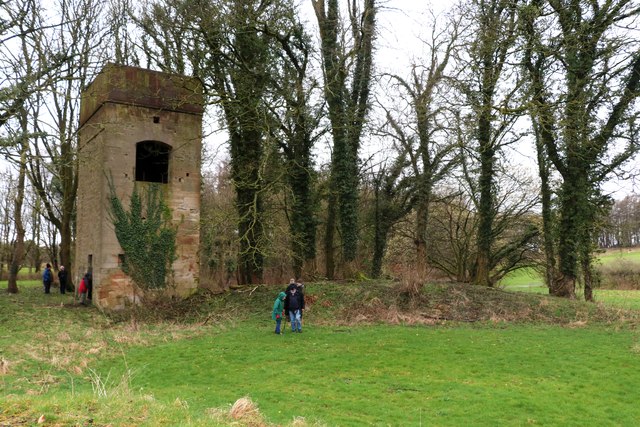
The Cuninghames of Caprington Castle worked coal on their estate in the parish of Riccarton from the eighteenth century. A Newcomen atmospheric pumping engine was installed at Blacksyke in 1781 to lift water out of this low, flood-prone ground, and the Carron Iron Works supplied it at a time when the more efficient Boulton and Watt engines were available — coal was plentiful on site and a Newcomen carried no annual patent payment. Its engine house was camouflaged as a mock Gothic tower house on the castle estate and is now called Blacksyke Tower. A second Newcomen engine, already secondhand, was installed at Earlston in 1806 and pumped for ninety-five years. Sir William Cuninghame opened a two-and-a-half-mile horse-drawn mineral branch off the Kilmarnock and Troon Railway in 1818, which grew into a network serving at least nine pits. By the Lists of Mines the colliery was modest: 98 people in 1894, 76 in 1896, 141 in 1905 and 125 in 1910, raising household, manufacturing and steam coal, and working the McNaught and Parrot seams in 1910. W. C. S. Cunninghame is the owner named there; by 1909 the pits were worked by the Caprington and Auchlochan Collieries, with Hugh Shaw Dunn as managing partner and John Gibson as certified manager. The Ell coal, three feet six inches thick, was opened from No. 41 pit about 1894 and worked by stoop and room until 1906, when it was abandoned because the stoops were thought too small to remove without letting the surface down. Work then concentrated on the Blind coal, three feet thick and fifteen fathoms below. On 10 December 1909 the cover over those abandoned Ell workings collapsed under a flooded field and ten of the sixteen people underground were drowned (see Disasters, below).
Geology
Caprington worked the Ell coal, three feet six inches thick, and the Blind coal, three feet thick and fifteen fathoms below it, on flat ground beside the River Irvine subject to occasional flooding. The cover over the Ell coal was as little as eighteen feet in places, which is what made the 1909 inrush possible: the seam's roof formed part of that cover, and it deteriorated over time until it collapsed with the gravel and sand above.
Geological setting: Sedimentary Beds and Seams (well documented example)
Workings
A scatter of numbered pits, at least nine of them served by the estate's mineral railway. No. 41 was the winding pit, 28 fathoms deep to the Blind coal with the Ell coal fifteen fathoms above; an air pit twenty yards away and a shallower new air pit 330 yards east ventilated the west and east sections, the east by a furnace or 'cube' at the foot of a cross-cut mine. Both seams were worked by stoop and room, the Ell with stoops five yards square against the three yards left by a neighbouring colliery sixty years before. Pumping was by Newcomen atmospheric beam engine, the Earlston engine having a thirty-inch bore and a stroke of 54 to 60 inches, its wooden beam replaced in cast iron in 1837.
Closure
The closure date is not known for the colliery as a whole. The local pits had closed by 1908 according to the Ordnance Survey evidence for the Blacksyke school, and the Earlston engine was given to the town of Kilmarnock in 1901 after ninety-five years' work, but No. 41 pit was still winding men daily in December 1909.
What remains
Blacksyke Tower stands on Caprington golf course, a roofless scheduled monument of rubble with dressed quoins, crow-stepped gables, a corbelled parapet and a turret that was once the chimney, with a lower lean-to on the west that probably held the boiler. The trackbed of the waggonway and several sidings can still be made out, and the twin lime kilns beside it keep their kiln eyes and the iron box and grate bars. The Earlston engine is on display in Edinburgh.
Blacksyke Tower, the scheduled engine house on Caprington golf course, with the trackbed of the waggonway, several sidings and the twin lime kilns beside it.
Related mines
- Auchlochan Colliery — Both were worked by Caprington & Auchlochan Collieries Ltd, the firm whose managing partner Hugh Shaw Dunn gave evidence at the inquiry into the 1909 Caprington inrush.
- Fairlie Colliery — Both pits were served by the Fairlie branch railway, and Fairlie later passed to Caprington and Auchlochan Collieries.
Nearby mines
- Fairlie Colliery — 1.2 miles (2.0 km) W
- Newfield Colliery — 1.5 miles (2.4 km) W, South Ayrshire
- Fortacres Colliery — 1.6 miles (2.6 km) SW, South Ayrshire
- Annandale Colliery — 1.7 miles (2.7 km) NW
- Busbiehead Colliery — 2.8 miles (4.5 km) N
Straight-line distance, within 9 miles (15 km). Show on the map.
Disasters & major incidents
-
Caprington Colliery inrush, 1855
19 September 1855 · Flooding / Inundation · 3 fatalities
Three men at Caprington Colliery, near Kilmarnock, were drowned on 19 September 1855 when their working holed into an old waste full of water. -
Caprington Colliery Inrush
10 December 1909 · Flooding / Inundation · 10 fatalities
At 11.45 on the night of 10 December 1909 the roof of abandoned stoop-and-room workings in the Ell coal at Caprington Colliery, near Kilmarnock, gave way under a field that had flooded from the River Irvine. Water and gravel poured into the old workings, found their way to No. 41 pit and ran down the shaft, driving accumulated black damp in front of them. Of the sixteen people below ground, five escaped through the new air pit after raking out the ventilation furnace that blocked their way, and one was carried by the flood into the winding shaft and came out on top of the cage. The other ten drowned. The surface cover over the abandoned seam was about eighteen feet.
What's uncertain
Points where sources disagree or the record could not be settled; both accounts are kept. All open questions in the archive.
- The BGS mine-plans catalogue holds a Mining Remediation Authority abandonment plan titled 'Caprington' (catalogue S1500, Splint, Turf And Wee, dated 1915); the catalogue gives no location and the plan's details do not clearly tie it to this working, so it may belong to another of the same name. (uncertain) 4
Recorded claims
Individual factual claims, each attached to the source(s) that support it below. Where sources disagree, both are kept.
- A Newcomen atmospheric pumping engine was installed at Blacksyke in 1781 to remove water from the workings in this low-lying area, supplied by the Carron Iron Works at a time when Boulton and Watt engines were available, because coal was plentiful on site and a Newcomen required no annual patent payment. 1
- The engine house was camouflaged as a mock Scottish tower house on the Caprington Castle estate; it is a scheduled monument and would be one of the oldest surviving engine houses in the United Kingdom. 1
- The Newcomen engine at Earlston was secondhand when installed in 1806, worked for ninety-five years, was given by Colonel Cuninghame to Kilmarnock in 1901, went to the National Museum of Scotland in 1958 and is now displayed in Edinburgh; its wooden beam was replaced in cast iron in 1837 and its cylinder had a thirty-inch bore. 1
- The Lists of Mines record 98 people in 1894, 141 in 1905 and 125 in 1910, working the McNaught and Parrot seams, under W. C. S. Cunninghame. 2
- No. 41 pit was 28 fathoms deep to the Blind coal, three feet thick, with the Ell coal, three feet six inches thick, fifteen fathoms above; both were worked by stoop and room. 3
- Where the surface subsided on the night of the 1909 disaster the cover over the Ell coal was about eighteen feet thick. 3
- Sir William Cuninghame of Caprington Castle opened a horse-drawn mineral branch two and a half miles long off the Kilmarnock and Troon Railway in 1818, which grew into a network serving at least nine coal pits. 1
- The BGS mine-plans catalogue holds a Mining Remediation Authority abandonment plan titled 'Caprington' (catalogue S1500, Splint, Turf And Wee, dated 1915); the catalogue gives no location and the plan's details do not clearly tie it to this working, so it may belong to another of the same name. (uncertain) 4
Photographs & further reading
The Inspector of Mines report on the disaster in full: the names of the ten drowned, the description of the colliery and its two seams, the narrative of the night and the inspector’s conclusions on working coal under eighteen feet of cover.
View sourceThe colliery’s 1781 engine house, disguised as a tower house, with the story of the Earlston Newcomen engine now in Edinburgh and of the estate waggonway and lime kilns.
View sourceSources
- (secondary) Blacksyke Tower — Wikipedia
- (primary) Durham Mining Museum: Caprington Colliery — Durham Mining Museum, from the Lists of Mines
- (primary) Caprington, 10 December 1909: report by Thomas H. Mottram, Inspector of Mines — Scottish Mining Website, reproducing the Inspector of Mines report
- (primary) BGS / Mining Remediation Authority mine plans: CAPRINGTON — British Geological Survey / Mining Remediation Authority
- (observational) Caprington golf course: the beam engine house (photographed 2024) — Geograph Britain and Ireland, Chris Allen
Record created: 10 September 2026 · Last researched: 10 September 2026