 MineArchive
Bwlch Glas Mine
| Location | Tal-y-bont, Ceredigion — 52.4864, -3.9142 (approximate) |
|---|---|
| Commodities | Lead, Silver, Zinc |
| Type | Metal |
| Worked | 1880s–1923 |
| Maximum depth | 35 metres below the deep adit |
| Operators | Scottish Cardigan Lead Mining Company (1909–1923) |
Overview
A lead, zinc and silver mine above Tal-y-bont, at its Edwardian peak one of Ceredigion's larger producers before closing in 1923.
History
Trials at Bwlch Glas, in the Cyneiniog valley east of Tal-y-bont, date back to the 1880s, carried out by Edward Evans of Talybont, who also ran the Leri Store in the village and worked the nearby Allt-y-crib mine. By 1889 a mine report published by Edmund Spargo recorded that a cross-cut — what became No. 1 adit — had been driven to intercept two parallel lodes exposed on the hillside, though working at this stage remained modest.
In 1890 Captain John Davis and the industrialist Thomas Molyneux formed a partnership to develop the mineral rights and quarries of the district, and in 1896-97 built the Plynlimon and Hafan Tramway specifically to serve Bwlch Glas and the stone quarries around Hafan, connecting them down to the main line. The tramway opened for mineral traffic in August 1897 and formally to passengers in March 1898, but the venture failed quickly: the line closed in the summer of 1899 and the operating company was wound up that December, after barely two years' service.
Real production at Bwlch Glas did not begin until a decade later, once the Scottish Cardigan Lead Mining Company took over in 1909 and built a new processing mill and further levels — built, as it happened, directly over the abandoned trackbed of the Plynlimon and Hafan Tramway, which had already closed and so could not be used to serve the mine's new period of real output. That output proved rich for several years: 1910, the mine's peak year, saw 154 tons of lead and 1,250 ounces of silver raised, with 135 men working underground and up to 169 on the surface. By 1916 the mine had returned a cumulative total of around 1,240 tons of ore since working began. The Scottish Cardigan Lead Mining Company continued working the mine, intermittently, until it finally closed in 1923.
Geology
Bwlch Glas was developed on two parallel lodes, exposed at outcrop and intercepted by No. 1 adit's cross-cut, associated with the Hafan Lode system that also gave its name to the Plynlimon and Hafan Tramway's destination. The mine is well known among mineral collectors for pyromorphite — itself a secondary lead mineral — found in a vertical pipe above the adit.
Workings
No. 1 adit was driven as a cross-cut to intercept two parallel lodes; a shaft sunk from within the adit reached further levels at 10, 20 and 35 metres below adit level. As recorded during a 2002 field visit, the upper level retains an underground headframe, cages, a winder mechanism, signal bell and sliding safety gates, with a windlass-supported flooded stope nearby and a compressed-air pipe running along the level — the mine having used compressed-air power underground. The lower adit has its own headframe used to access the lower level.
Closure
Worked intermittently by the Scottish Cardigan Lead Mining Company from 1909, the mine finally closed in 1923; a modern total of around 1,240 tons of ore had been returned by 1916 alone.
What remains
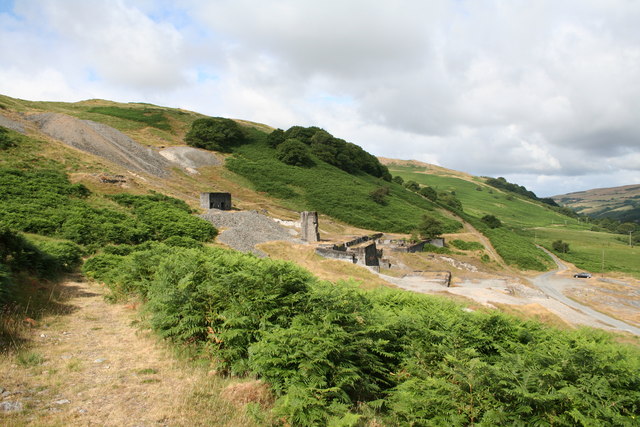
Abandoned and at least partly flooded underground; the concrete mill and dressing buildings built around 1909 survive on the surface, standing over the former trackbed of the short-lived Plynlimon and Hafan Tramway. Underground, as recorded during a 2002 field visit, the upper adit remains accessible using rope techniques and still retains an intact headframe, cages and winder mechanism, though partly flooded; the lower adit's own headframe is also used to access the lower level. In December 2014 two mine explorers had to be rescued from the site by the Mines Rescue Service, Mid and West Wales Fire and Rescue Service and Brecon Mountain Rescue Team after getting into difficulty, without serious injury.
Concrete mill and dressing buildings from the 1909 rebuild survive on the surface, built directly over the abandoned trackbed of the Plynlimon and Hafan Tramway, which had closed a decade earlier.
Nearby mines
- Hafan Mine — 2.0 miles (3.2 km) SE
- Eaglebrook Mine — 2.1 miles (3.4 km) E
- Esgair Hir and Esgair Fraith Mines — 2.3 miles (3.8 km) NE, Powys
- Rhyd Fach Mine — 2.4 miles (3.8 km) E
- Ystrad Einion Mine — 2.8 miles (4.5 km) N
Straight-line distance, within 9 miles (15 km). Show on the map.
Recorded claims
Individual factual claims, each attached to the source(s) that support it below. Where sources disagree, both are kept.
- In 1910, the mine's peak year, 154 tons of lead and 1,250 ounces of silver were produced, with 135 underground and up to 169 surface workers. 1
- Edward Evans of Talybont, who also ran the Leri Store and worked the Allt-y-crib mine, carried out early trials at Bwlch Glas in the 1880s; by 1889 a mine report by Edmund Spargo recorded that a cross-cut (No. 1 adit) had been driven to intercept two parallel lodes. 2
- A tramway built in 1896-97 by a partnership of Captain John Davis and Thomas Molyneux to serve Bwlch Glas and the Hafan quarries opened for minerals in August 1897 and to passengers in March 1898, but closed again in summer 1899, its operating company wound up that December. 3,4
- Real production began only once the Scottish Cardigan Lead Mining Company took over in 1909 and built a new mill directly over the by-then-abandoned tramway trackbed; the mine returned a cumulative total of around 1,240 tons of ore by 1916, before closing in 1923. 2,4
- A 2002 field visit recorded an intact underground headframe, cages, winder mechanism, signal bell and sliding safety gates in the upper level, accessible via the upper adit using rope techniques, alongside a flooded stope and a compressed-air pipe. 4
- In December 2014, two mine explorers in their seventies had to be rescued from Bwlch Glas by the Mines Rescue Service, Mid and West Wales Fire and Rescue Service and Brecon Mountain Rescue Team after getting into difficulty underground; neither sustained serious injury. 5
Sources
- (secondary) Bwlch Glas Mine
- (secondary) Bwlch Glas — Buddlepit Mine Database (citing Bick 1988, Foster-Smith 1979, Wade 1997, Jones 1922)
- (secondary) Plynlimon and Hafan Tramway — Wikipedia
- (secondary) Bwlch Glas Lead & Zinc Mine - Underground — Copsewood.org (Mike Munro, NAMHO 2002 field trip record)
- (secondary) Two rescued from disused mine in Ceredigion, Wales — Sciency Thoughts (blog, citing contemporary news coverage)
- (primary) Bwlch Glas Lead Mine (BGS Mine Plan #23335) — British Geological Survey
Record created: 22 August 2026 · Last researched: 27 August 2026