 MineArchive
Burntbroom Colliery
| Location | Broomhouse, near Mount Vernon, east of Glasgow — 55.8413, -4.1327 (exact) |
|---|---|
| Commodity | Coal |
| Type | Coal |
| Worked | By 1873–after 1905 |
| Operators | Dunn Bros. (owner) — Owner in 1894 (Durham Mining Museum; 1894 deaths list) Glasgow Coal Co., Ltd. (owner) — Later owner (Durham Mining Museum); owned the Burntbroom houses in 1910 |
Dunn Brothers' and later the Glasgow Coal Company's colliery at Broomhouse, east of Glasgow, which employed 287 people in 1900 and was served by two railways.
Location
Recorded location. The large pin is this mine; the small round markers are the nearest mines on record. Click one for its page. View on full map
History
Burntbroom Colliery stood at Broomhouse, near Mount Vernon, about five miles east-south-east of Glasgow. Dunn Brothers held it in 1894, and it later passed to the Glasgow Coal Company Ltd. Listed by the railways as Burntbroom Colliery Pit No. 1, it was served by the Glasgow, Bothwell, Hamilton and Coatbridge Railway and by the Caledonian Railway's Rutherglen and Coatbridge branch.
The colliery raised household and steam coal in 1894 and 1900, and gas, household and manufacturing coal in 1905. It employed 109 people in 1894, 92 of them underground, 287 in 1900 and 229 in 1905. The inspectors recorded single deaths there from 1873 to 1901: men struck by the cage or drawn into the shaft with a hutch, falls of roof and stone, a firedamp explosion in 1874, and in 1889 an explosion of compressed powder set off by a spark from a brusher's lamp. In May 1894 a 55-year-old brusher was killed by a fall of roof.
Burntbroom also gave its name to a group of miners' houses. In 1910 the Glasgow Coal Company owned five one-storey brick houses there, built about fifty years before, with floors below ground level and no damp-proof course; seven of the men from its Daldowie mine lived at Burntbroom.
Workings
At least one shaft, listed as Burntbroom Colliery Pit No. 1, with sidings to two railways.
Closure
The colliery was still at work in 1905, with 229 employees. When and why it closed is unknown.
What remains
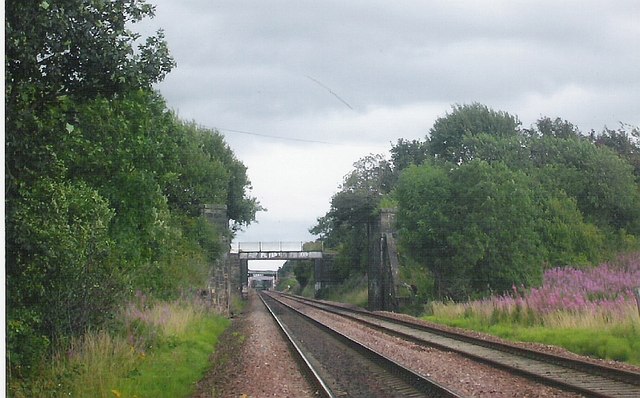
The site lies on the eastern edge of Glasgow near Baillieston; the bridges of the dismantled railways at Burntbroom were still standing in 2003.
Related mines
- Broomhouse Colliery — Both were owned by the Glasgow Coal Co., Ltd.
- Daldowie Colliery — Both were owned by Dunn Bros. and then the Glasgow Coal Co., Ltd., and in 1910 Daldowie miners lived in the company's houses at Burntbroom.
- Kenmuirhill Colliery — Both were owned by Dunn Bros. and then the Glasgow Coal Co., Ltd.
Nearby mines
- Daldowie Colliery — 0.4 miles (0.6 km) E
- Broomhouse Colliery — 0.7 miles (1.2 km) E
- Kenmuirhill Colliery — 0.9 miles (1.4 km) SW
- Calderbank Colliery — 1.0 miles (1.7 km) E
- Clydeside Colliery — 1.2 miles (1.9 km) SE, South Lanarkshire
Straight-line distance, within 9 miles (15 km). Show on the map.
Further reading
Owners, output, employment and recorded deaths at Burntbroom Colliery.
View sourceThe railways that served the colliery.
View sourceSources
- (primary) Burntbroom Colliery (Durham Mining Museum) — Durham Mining Museum
- (secondary) Fatal accidents in mines in Scotland, 1894 — Scottish Mining Website
- (secondary) Burntbroom Colliery Pit No 1 (RAILSCOT) — RAILSCOT
- (secondary) Old Monkland Parish: 1910 housing (Scottish Mining Website) — Scottish Mining Website
Record created: 5 November 2026 · Last researched: 8 November 2026