 MineArchive
Burnhope Colliery
| Location | Burnhope, near Lanchester, County Durham — 54.8281, -1.7028 (approximate) |
|---|---|
| Commodity | Coal |
| Type | Coal |
| Worked | Sinking from April 1850–22 July 1949 |
| Maximum depth | Unknown; the 1850 sinking was carried to the Hutton seam |
| Operators | Utrick Alexander Ritson (1894–1900), National Coal Board (1947–1949) |
Overview
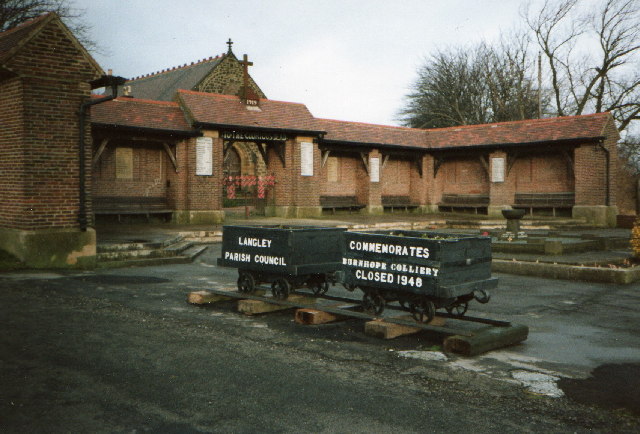
A colliery north-west of Durham whose sinking began in April 1850 after boring on the Burnhope estate, and which grew into a group of pits and drifts -- Annie, Betty, Engine, Fell, Fortune and the Polo Drift. Whellan's directory of 1894 found it the property of Utrick Alexander Ritson, with a royalty of 837 acres, all the well-known Durham seams represented, and 800 to 900 tons a day coming out; the owners had built the village schools in 1855. It closed on 22 July 1949, and coal tubs at the war memorial commemorated it for many years afterwards.
History
Boring on the Burnhope estate began in 1847 and the sinking of the colliery followed in April 1850, reaching the Hutton seam. Over its life the colliery worked through several pits and drifts: the Annie, Betty, Engine, Fell -- sunk from 11 July 1893 -- and Fortune pits, and the Polo Drift. Whellan's Directory of County Durham described it in 1894 as the property of Utrick Alexander Ritson, with a royalty of 837 acres in which all the well-known seams of the Durham coalfield were represented: the Busty yielding a splendid coking coal, and the Harvey, Hutton, Low Main and Five Quarter unexcelled for gas making. The output then reached 800 to 900 tons a day. The same account describes the colliery village eight miles north-west of Durham, lately improved with new cottages and a water supply, and the colliery schools -- mixed and infants -- built in stone by the owners in 1855 and enlarged in 1876 and 1884 to hold 333 children. Employment was 433 in 1883 and 754 by 1894, and the colliery worked on under the National Coal Board from 1947 until it closed on 22 July 1949. The Durham Mining Museum names 82 men and boys killed there and records no disaster of five or more.
Geology
All the well-known seams of the Durham coalfield were represented in the 837-acre royalty: the Busty yielding a coking coal and the Harvey, Hutton, Low Main and Five Quarter valued for gas making. The sinking of 1850 was carried to the Hutton seam.
Geological setting: Sedimentary Beds and Seams (well documented example)
Workings
A group of pits and drifts rather than a single shaft: the Annie, Betty, Engine, Fell (sinking begun 11 July 1893) and Fortune pits and the Polo Drift.
Closure
The colliery closed on 22 July 1949 under the National Coal Board. The coal tubs set up at the village war memorial to commemorate it carried the date 1948, a year earlier than the museum's; they had gone from the memorial site by 2006.
What remains
The colliery is gone. Coal tubs commemorating it stood at the Burnhope war memorial into the 1990s but were no longer there in 2006.
Nothing of the colliery survives; the village stands along the ridge above the old workings.
Redevelopment
Unknown.
Nearby mines
- Craghead Colliery — 3.2 km NE
- Edmondsley Colliery — 3.9 km E
- Sacriston Colliery — 4.3 km E
- Louisa Colliery — 4.4 km N
- Cornsay Colliery — 5.1 km SW
Straight-line distance, within 15 km. Show on the map.
People
- Utrick Alexander Ritson · owner, 1894–1900 — via the operator record
What's uncertain
Points where sources disagree or the record could not be settled; both accounts are kept. All open questions in the archive.
- Burnhope Colliery closed on 22 July 1949; the coal tubs commemorating it at the village war memorial gave the date as 1948. (disputed) 1
Recorded claims
Individual factual claims, each attached to the source(s) that support it below. Where sources disagree, both are kept.
- Boring on the Burnhope estate began in 1847 and the sinking of the colliery followed in April 1850, carried to the Hutton seam. 1,2
- The colliery comprised several pits and drifts over its life: the Annie, Betty, Engine, Fell -- sunk from 11 July 1893 -- and Fortune pits and the Polo Drift. 1,2
- Whellan's directory of 1894 gives the colliery as the property of Utrick Alexander Ritson, with a royalty of 837 acres in which all the well-known Durham seams were represented and an output of 800 to 900 tons a day. 1
- The colliery owners built the village schools in stone in 1855, enlarged in 1876 and 1884 to hold 333 children, and the village had lately been improved with new cottages and a water supply when Whellan wrote in 1894. 1
- Burnhope Colliery closed on 22 July 1949; the coal tubs commemorating it at the village war memorial gave the date as 1948. (disputed) 1
Photographs & further reading
Newcastle University's community archive page for the colliery, listing its pits and drifts and gathering photographs and records.
View sourceSources
- (secondary) Burnhope Colliery — Durham Mining Museum
- (secondary) Burnhope Colliery (1850 - 1949) — Co-Curate, Newcastle University
Record created: 20 September 2026 · Last researched: 20 September 2026