 MineArchive
Bradford Colliery
| Location | Bradford, Manchester, Greater Manchester — 53.4830, -2.1957 (exact) |
|---|---|
| Commodity | Coal |
| Type | Coal |
| Worked | By the early 17th century (deep shaft from 1840)–1968 |
| Maximum depth | 955 yards (Parker Pit, deepened 1944-48) |
| Operators | Bradford Colliery Company (1896–1900), Fine Cotton Spinners and Doublers Association (1900–1935), Manchester Collieries Ltd (1935–1947), National Coal Board (1947–1968) |
Overview
One of Manchester's own inner-city collieries, worked from at least the early seventeenth century and by deep shaft from 1840, closed in 1968 despite vast remaining reserves once subsidence compensation made it uneconomic — the site is now occupied by the Etihad Stadium.
History
Coal had been worked at Bradford, close to Manchester's centre, since at least the early seventeenth century, with documented records from 1740; a deep shaft followed in 1840. Nine seams were eventually worked — the Parker, Two Foot, Doctor, New, Yard, Bradford Four Foot, Three Quarters, Charlotte and Roger mines — containing an estimated 310 million long tons of workable coal. The colliery's Parker shaft reached 540 yards by 1856 and was deepened to 955 yards between 1944 and 1948; a second shaft, the Deep mine, reached 902 yards after 1906. Most of the coal raised was consumed locally by the adjoining Bradford Ironworks, and from 1947 a 460-yard underground tunnel delivered 200 long tons of coal an hour directly to the nearby Stuart Street Power Station. Ownership passed from the Bradford Colliery Company (from 1896) to the Fine Cotton Spinners and Doublers Association (1900-1935), Manchester Collieries (1935-1947) and the National Coal Board after nationalisation. Employment grew from 529 workers in 1896 to 1,500 by the colliery's final year, when it produced 530,298 long tons of coal. By the 1960s, subsidence damage to the surrounding, increasingly built-up area had become severe enough that the National Coal Board was paying five shillings and twopence in compensation per ton extracted — reportedly the highest rate in the region — and despite its enormous remaining reserves, the colliery closed in 1968 as no longer economic to work.
Geology
Coal of the Lancashire field: nine seams — the Parker, Two Foot, Doctor, New, Yard, Bradford Four Foot, Three Quarters, Charlotte and Roger mines — holding an estimated 310 million long tons.
Workings
Nine seams worked from two principal shafts — the Parker shaft, reaching 955 yards by 1948, and the Deep mine shaft at 902 yards — connected from 1947 by a 460-yard tunnel to the adjacent Stuart Street Power Station.
Closure
Closed in 1968 not because its coal was exhausted — an estimated 310 million long tons remained workable — but because subsidence damage to the surrounding built-up area of Manchester made the National Coal Board's compensation payments, at the highest rate in the region, uneconomic to sustain.
What remains
The 17-acre site, renamed Eastlands, was cleared after closure and is now occupied by the City of Manchester Stadium (Etihad Stadium).
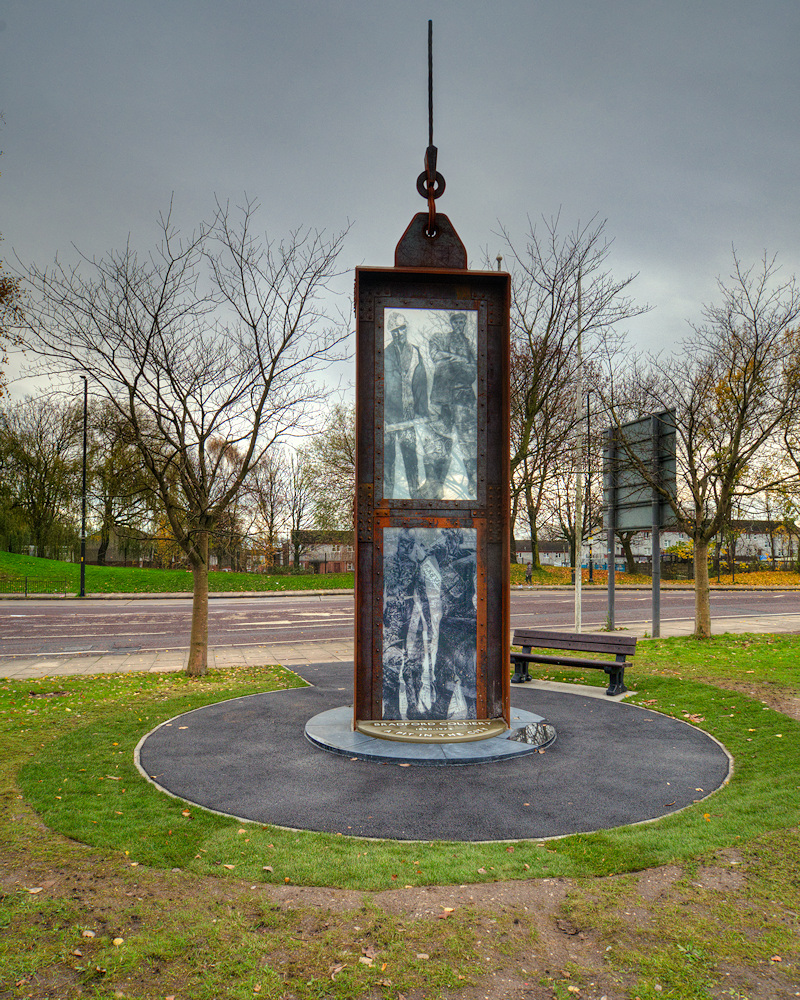
No colliery structures survive, but an eight-metre steel memorial — in the form of a lift-shaft cage, with glass panels depicting miners' underground journey — was erected on the site and opened to the public on 19 November 2020, inscribed in remembrance of Bradford Colliery and its mining community.
Related mines
- Oak Colliery, Hollinwood — Oak's workforce moved to Bradford Colliery on closure in 1956, and Bradford was to work the Roger Mine Oak had left (NMRS).
- Woodpark Colliery — Woodpark's remaining reserves were worked from Bradford Colliery after it closed in 1955 (NMRS).
Nearby mines
- Oak Colliery, Hollinwood — 3.9 miles (6.3 km) NE
- Agecroft Colliery — 4.2 miles (6.8 km) W
- Bardsley Colliery — 4.2 miles (6.8 km) NE
- Woodpark Colliery — 4.2 miles (6.8 km) NE
- Pendleton Colliery — 4.3 miles (6.9 km) W
Straight-line distance, within 9 miles (15 km). Show on the map.
Disasters & major incidents
-
Bradford Colliery roof fall, 1863
23 April 1863 · Collapse / Roof Fall · 2 fatalities
Two miners were killed at Bradford Colliery in Manchester on 23 April 1863 when the roof came in as they cut through into old workings.
Recorded claims
Individual factual claims, each attached to the source(s) that support it below. Where sources disagree, both are kept.
- Nine seams were worked at Bradford Colliery, containing an estimated 310 million long tons of workable coal. 1,2
- The Deep Pit downcast shaft was deepened to 927 yards around 1900; output rose from 171,557 tons in 1937 to 243,363 tons in 1940 as the deep Crombouke seam, worked under some 3,800 feet of cover by 1935, was developed. 2
- The Parker shaft reached 540 yards by 1856 and was deepened to 955 yards between 1944 and 1948; the Deep mine shaft reached 902 yards after 1906. 1
- From 1947 a 460-yard underground tunnel delivered 200 long tons of coal an hour directly to the adjacent Stuart Street Power Station. 1
- The colliery closed in 1968 because subsidence damage to the surrounding built-up area made the National Coal Board's compensation payments, the highest rate in the region at five shillings and twopence per ton, uneconomic, despite an estimated 310 million long tons of coal remaining. 1
- An eight-metre steel memorial in the form of a lift-shaft cage, with glass panels depicting miners' underground journey and a stone base inscribed in remembrance of Bradford Colliery and its mining community, was erected on the east side of the Etihad Campus and opened to the public on 19 November 2020. 3
Photographs & further reading
Geograph photos and description of the 2020 memorial erected on the former colliery site.
View sourceSources
- (secondary) Bradford Colliery — Wikipedia — Wikipedia
- (secondary) Bradford Colliery (????-1968) — Northern Mine Research Society
- (observational) The Bradford Colliery Memorial — Geograph Britain and Ireland
Record created: 2 September 2026 · Last researched: 2 September 2026