 MineArchive
Blaenavon Ironworks
| Also known as | Blaenafon Ironworks |
|---|---|
| Location | Blaenavon, Torfaen — 51.7770, -3.0894 (exact) |
| Commodities | Iron, Coal |
| Type | Iron |
| Worked | 1788-89–1904 |
Overview
A pioneering ironworks built where coal, ironstone and limestone all outcropped together, the first in Wales designed from the outset as a multi-furnace site and the first anywhere to use a steam-powered blowing engine, in 1789. Now a museum at the heart of the Blaenavon Industrial Landscape UNESCO World Heritage Site.
History
In 1788 Henry Nevill, 2nd Earl of Abergavenny, leased around 12,000 acres of his Blaenavon estate to three Midlands businessmen — Thomas Hill, Thomas Hopkins and Benjamin Pratt — who had already opened the district's first coal mine in 1782. The site was chosen because coal, ironstone and limestone all outcropped in the same hillside, letting all three raw materials be worked by horizontal levels rather than deep shafts. Blaenavon was the first ironworks in Wales designed from the start as a multi-furnace site, with three blast furnaces built immediately; by 1789 these were powered by a steam blowing engine, the first ironworks anywhere to use one. Output reached 5,400 tons of iron in 1796, and by 1812 a fourth and fifth furnace had brought capacity up to around 14,000 tons a year, making Blaenavon the second-largest iron producer in Wales after Cyfarthfa. The works drew skilled workers from across Britain and Ireland, and the surrounding district's population grew from around 1,000 in 1800 to more than 5,000 by 1840. A forge for wrought-iron production was built at Garn-Ddyrys in 1817 to work alongside the furnaces.
Ownership changed hands more than once as the 19th century wore on: the business became the Blaenavon Coal and Iron Company in 1837 and then the Blaenavon Iron Company under C. Waring's ownership from 1864. The works' most significant later contribution came in 1877-78, when the chemist Sidney Gilchrist Thomas and his cousin Percy Gilchrist carried out experiments at Blaenavon that produced the 'Gilchrist-Thomas process' — a method allowing phosphoric iron ores, previously unusable for steelmaking, to be converted efficiently into steel. The discovery had a bittersweet effect on Blaenavon itself: by making Continental and American phosphoric ore deposits newly workable, it removed much of the advantage that had drawn iron production to south Wales in the first place, and hastened the district's long decline. Iron production at the original furnace site ceased in 1904, though steel manufacture continued at Blaenavon more broadly until 1938. The ironworks site is now a museum under the care of Cadw, at the heart of the Blaenavon Industrial Landscape, designated a UNESCO World Heritage Site in November 2000.
Geology
Coal, ironstone and limestone all outcropping in the same hillside, which is why the works was built here: every one of the three raw materials could be won by horizontal level rather than deep shaft.
Workings
Three blast furnaces built from the outset in 1788-89, expanded to five furnaces by 1812; a wrought-iron forge was added at Garn-Ddyrys in 1817 to work alongside them. Coal, ironstone and limestone were all worked from outcrops in the same hillside via horizontal levels, avoiding the need for deep shaft mining.
Closure
Iron production at the original furnace site ceased in 1904, though steel was made at Blaenavon more widely until 1938.
What remains
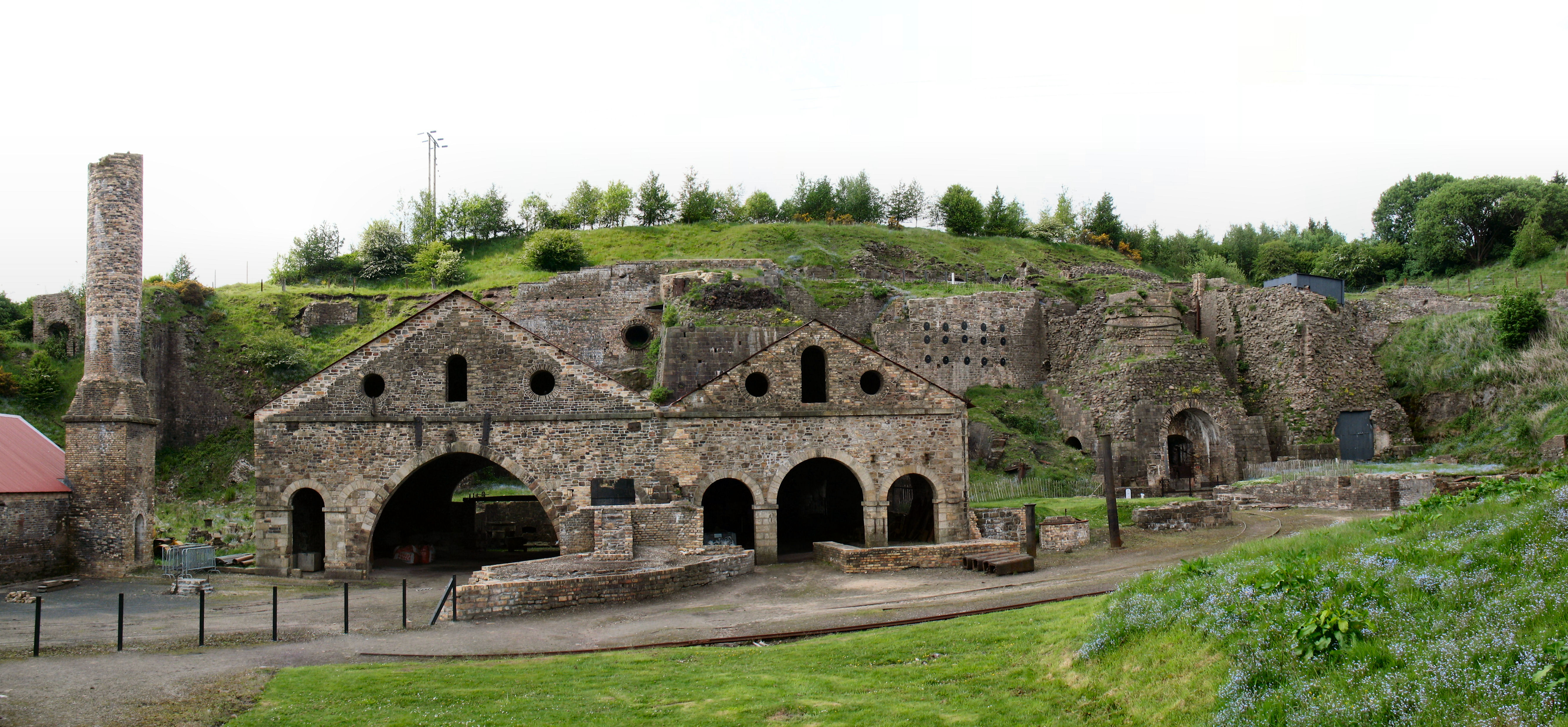
The remains of the late 18th-century furnaces, together with later 19th-century additions, are considered the best-preserved of their period in the United Kingdom. The site operates today as a museum under Cadw, within the wider Blaenavon Industrial Landscape UNESCO World Heritage Site, designated in November 2000.
Related mines
- Big Pit — Big Pit's earliest shaft was sunk in 1812 specifically to work ironstone for the adjoining Blaenavon Ironworks.
- Forge Slope Colliery — The slope existed to feed the Blaenavon works, and the Forgeside plant it served is where the basic steel process was proved in 1877.
Nearby mines
- Cinder Pits — 0.3 miles (0.4 km) SE
- Forge Slope Colliery — 0.6 miles (1.0 km) SW
- Big Pit — 0.7 miles (1.2 km) SW
- Kay's Slope — 1.0 miles (1.6 km) W
- Garn Colliery, Blaenavon — 1.6 miles (2.5 km) W
Straight-line distance, within 9 miles (15 km). Show on the map.
Recorded claims
Individual factual claims, each attached to the source(s) that support it below. Where sources disagree, both are kept.
- The ironworks was established in 1788 when Lord Abergavenny leased land to Thomas Hill, Thomas Hopkins and Benjamin Pratt, chosen because coal, ironstone and limestone all outcropped together, allowing horizontal rather than deep working. 1,2
- By 1789 Blaenavon's three blast furnaces were powered by a steam blowing engine, the first ironworks anywhere to use one. 1
- Output reached 5,400 tons of iron in 1796; by 1812 five furnaces were capable of making around 14,000 tons a year, making Blaenavon the second-largest iron producer in Wales after Cyfarthfa. 1,2
- The business became the Blaenavon Coal and Iron Company in 1837 and the Blaenavon Iron Company under C. Waring from 1864. 2
- In 1877-78 Sidney Gilchrist Thomas and Percy Gilchrist conducted experiments at Blaenavon that produced the Gilchrist-Thomas process, enabling efficient steelmaking from phosphoric iron ore. 1
- Iron production ceased in 1904, though steel manufacture continued until 1938; the site was designated part of a UNESCO World Heritage Site in November 2000. 1,2
Sources
- (secondary) Blaenavon Ironworks — Wikipedia
- (secondary) Blaenavon Ironworks — Grace's Guide to British Industrial History
Record created: 26 August 2026 · Last researched: 26 August 2026