 MineArchive
Bishop Middleham Quarry
| Location | Bishop Middleham, near Sedgefield, County Durham — 54.6878, -1.4858 (exact) |
|---|---|
| Commodity | Limestone |
| Type | Quarry |
| Worked | By 1905–1934 |
| Operators | Pease & Partners Ltd. (1908–1912, owner) — Owners in the accident returns, 1908-1912 W. and M. Thompson (Quarries) Ltd — Raising limestone in the 1980s (Durham Mining Museum, 1984 directory) |
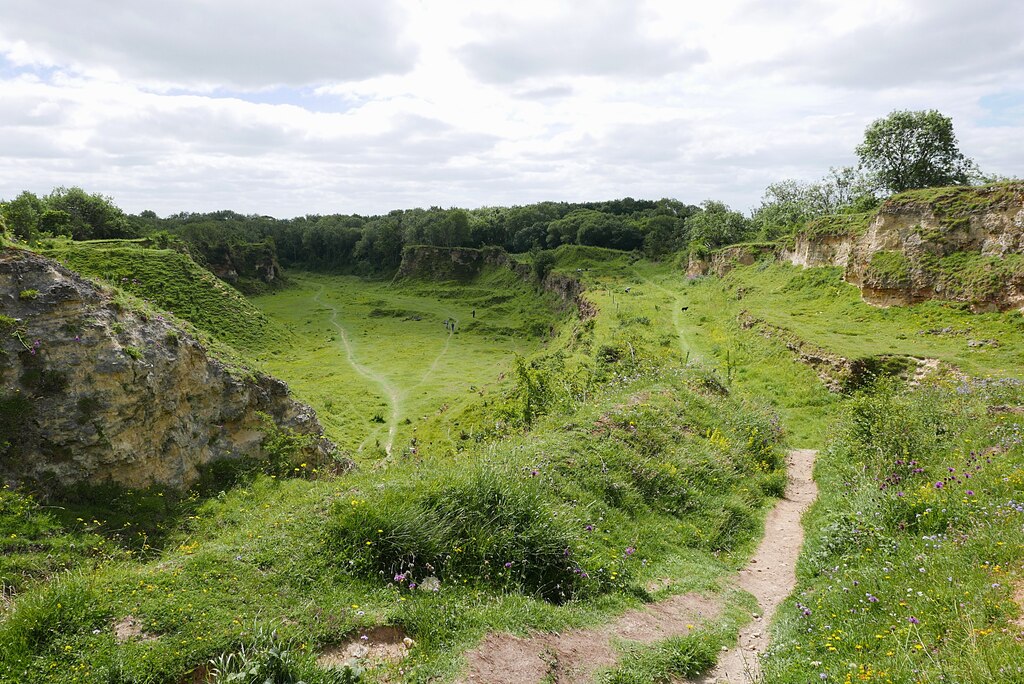
A Magnesian Limestone quarry north-west of Sedgefield, owned by Pease and Partners before the First World War and abandoned in 1934. It is now a nature reserve rich in orchids.
Location
Recorded location. The large pin is this mine; the small round markers are the nearest mines on record. Click one for its page. View on full map
History
Bishop Middleham Quarry worked the Magnesian Limestone about four kilometres north-west of Sedgefield. In 1905 it employed 47 people raising limestone; by 1922 it was producing dolomite as well, with 116. Pease and Partners owned it in the years before the First World War, and the accident returns of that time record three deaths: a labourer who failed to step out of the way of a slow-moving truck in 1908, a quarryman caught by a rolling stone while wheeling stones to a wagon in 1910, and a locomotive fireman crushed in 1912 while coupling wagons in a gullet barely wide enough for them.
Working in the old quarry stopped in 1934. Left alone, it was taken over by the plants and animals of limestone soils, and in 1968 it was made a Site of Special Scientific Interest. Tipping and reworking later destroyed the wildlife interest of much of the wider quarry complex, and the protected area was cut back in 1982; limestone was still being raised there in the 1980s by W. and M. Thompson (Quarries) Ltd.
The old quarry is now a nature reserve, known for its dark red helleborines (nearly 1,700 flowering spikes in a 2010 count) and its colony of the Durham argus butterfly. In 2002 a pair of bee-eaters raised two young there, only the third breeding attempt recorded in Britain.
Geology
Magnesian Limestone, worked for limestone and dolomite.
Workings
An open quarry with benches and a floor reached by rail; a gullet carried loaded wagons out of the workings.
Closure
Working in the old quarry ceased in 1934; parts of the wider quarry complex were reworked later and were still producing limestone in the 1980s.
What remains
A disused quarry of about 8.6 hectares grown over with limestone grassland and scrub, managed as a nature reserve by Durham Wildlife Trust and protected as a Site of Special Scientific Interest.
The quarry faces, floor, benches and old spoil heaps.
Redevelopment
Nature reserve.
Nearby mines
- Bishop Middleham Colliery — 0.7 miles (1.1 km) S
- Thrislington Colliery — 1.6 miles (2.6 km) NW
- Mainsforth Colliery — 1.7 miles (2.7 km) W
- Raisby Hill Quarry — 1.8 miles (2.9 km) N
- Fishburn Colliery — 1.9 miles (3.0 km) E
Straight-line distance, within 9 miles (15 km).
Further reading
The quarry's closure in 1934, its SSSI designation, its wildlife and the bee-eaters of 2002.
View sourceThe official reasons for designation, and the 1982 reduction after tipping and reworking.
View sourceThe trust's reserve page: abandoned in the 1930s, its grassland, orchids, butterflies and birds.
View sourceSources
- (primary) Bishop Middleham Quarry (Durham Mining Museum) — Durham Mining Museum
- (secondary) NMRS deaths and injuries database: Bishop Middleham Quarry, 1908 — Northern Mine Research Society
- (secondary) NMRS deaths and injuries database: Bishop Middleham Quarry, 1910 — Northern Mine Research Society
- (secondary) NMRS deaths and injuries database: Bishop Middleham Quarry, 1912 — Northern Mine Research Society
- (secondary) Bishop Middleham Quarry (Wikipedia) — Wikipedia
- (secondary) Bishop Middleham Quarry nature reserve (Durham Wildlife Trust) — Durham Wildlife Trust
- (primary) Bishop Middleham Quarry SSSI citation (Natural England) — Natural England
Record created: 20 November 2026 · Last researched: 20 November 2026