 MineArchive
Bickerstaffe Colliery
| Location | Bickerstaffe, near Four Lane Ends and Skelmersdale, Lancashire — 53.5347, -2.8275 (approximate) |
|---|---|
| Commodity | Coal |
| Type | Coal |
| Worked | 1840s–September 1936 |
| Maximum depth | Unknown. |
| Operators | Foster, Williams & Co. Ltd, Bickerstaffe Collieries Ltd (1899–1929), P. H. Swift (1930–1936) |
Overview
A colliery on the Earl of Derby's land at Bickerstaffe near Skelmersdale, worked from the 1840s, re-sunk from 1899 and abandoned in September 1936.
History
Bickerstaffe Colliery lay on the west side of the St Helens to Ormskirk road, about 500 yards south of Four Lane Ends, near Bickerstaffe village and just south of what is now junction 3 of the M6. Pits had been sunk here, probably in the 1840s, on the Earl of Derby's land; unlike Lord Skelmersdale, the Earl leased his coal to other operators, and the Bickerstaffe pits passed through a variety of hands.
In 1892 the owners were Foster, Williams & Co. Ltd, and a new sinking was made from 1899, after which the colliery was worked by Bickerstaffe Collieries Ltd as Nos. 1 and 2 Pits with a drift, the Wash Drift. Employment rose from 273 in 1894 to 678 in 1910.
Bickerstaffe Collieries Ltd went bankrupt in July 1929. P. H. Swift restarted the colliery in April 1930, and in 1931 it raised 130,000 tons with 460 men underground and 110 on the surface, working the Park, Arley, Rushy Park and Mountain mines with 440-volt electric power. The Wash Drift was abandoned in November 1931 and Nos. 1 and 2 Pits in September 1936.
Geology
Lancashire Coal Measures of the Skelmersdale coalfield. The colliery worked the Lindsay mine in 1905 and later the Arley, Park, Rushy Park, Mountain, Earthy and Park Yard mines.
Workings
Nos. 1 and 2 Pits and the Wash Drift. A Walker Brothers 'Indestructible' fan, 11 feet by 5 feet, was installed in 1900, driven by a tandem compound engine; by 1931 the colliery ran on 440-volt A.C. power.
Closure
Bickerstaffe Collieries Ltd went bankrupt in July 1929 and P. H. Swift restarted the colliery in 1930. The Wash Drift was abandoned in November 1931 and Nos. 1 and 2 Pits in September 1936.
What remains
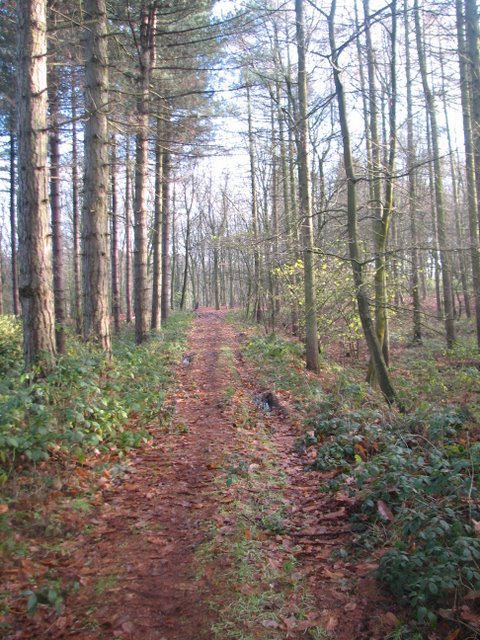
The colliery's spoil heap is wooded, and the Bickerstaffe Colliery Trail runs along its crest through the Colliery Plantation.
The wooded spoil heap of the colliery.
Redevelopment
The spoil heap has been planted as woodland, the Colliery Plantation, with a public trail along it.
Nearby mines
- Holland Colliery — 3.2 miles (5.2 km) E
- Alexandra Colliery — 7.1 miles (11.5 km) SE, Merseyside
- Ravenhead Colliery — 7.4 miles (11.9 km) SE, Merseyside
- Eccleston Quarry — 7.7 miles (12.3 km) NE
- Garswood Park Colliery — 7.6 miles (12.3 km) SE, Merseyside
Straight-line distance, within 9 miles (15 km). Show on the map.
What's uncertain
Points where sources disagree or the record could not be settled; both accounts are kept. All open questions in the archive.
- The owners were Bromilow, Foster and Co. and then Bickerstaffe Collieries Ltd. (disputed) 3
Recorded claims
Individual factual claims, each attached to the source(s) that support it below. Where sources disagree, both are kept.
- Pits had been sunk near Bickerstaffe village, probably in the 1840s, on the Earl of Derby's land, and passed through a variety of hands before closing in 1936. 1
- Foster, Williams & Co. Ltd owned the colliery in 1892; a new sinking followed from 1899, later as Bickerstaffe Collieries Ltd, and P. H. Swift worked it from April 1930. 2
- The owners were Bromilow, Foster and Co. and then Bickerstaffe Collieries Ltd. (disputed) 3
- In 1931 the colliery raised 130,000 tons with 460 men underground and 110 on the surface, working the Park, Arley, Rushy Park and Mountain. 2
- Employment was 273 in 1894 and 678 in 1910. 3
- Bickerstaffe Collieries Ltd went bankrupt in July 1929; the Wash Drift was abandoned in November 1931 and Nos. 1 and 2 Pits in September 1936. 2
- Until October 1936 Bickerstaffe Colliery was located just south of what is now M6 junction 3. 4
- The Bickerstaffe Colliery Trail runs along the crest of the colliery's spoil heap. 5
Photographs & further reading
The G. Hayes collection record of the colliery's owners, shafts, fan, power, seams, output and closure.
View sourceOwners, employment and seams from 1894 to 1933, and the names of those killed at the colliery.
View sourceSources
- (secondary) Skelmersdale and District - Northern Mine Research Society — Northern Mine Research Society
- (secondary) Bickerstaffe Colliery - Northern Mine Research Society — Northern Mine Research Society
- (primary) Durham Mining Museum - Bickerstaffe Colliery (UK) — Durham Mining Museum
- (secondary) Bickerstaffe — Wikipedia
- (observational) Bickerstaffe Colliery Trail (Geograph via Wikimedia Commons, K A) — Wikimedia Commons

Record created: 1 October 2026 · Last researched: 1 October 2026