 MineArchive
Baton Colliery
| Location | Moorland east of Shotts, North Lanarkshire — 55.8338, -3.8113 (exact) |
|---|---|
| Commodity | Coal |
| Type | Coal |
| Worked | by 1881–after 1947 |
| Operators | Morningside Coal Company (1894–?, owner) — Morningside Coal Co. (DMM) Baton Collieries Ltd (1911–?, owner) — Baton Collieries Ltd, also owners of Fortrigg Pit (DMM, SMW) Shotts Iron Company (?–1947, owner) — Shotts Iron Co., Ltd. by 1938 (DMM, SMW) National Coal Board (1947–?) — 100,000 tons with 304 men in 1947 (DMM) |
A Shotts colliery worked by the Morningside Coal Company, then Baton Collieries and the Shotts Iron Company, which grew from a pumping pit to some 600 men in the 1930s and left the great Baton Bing on the moor.
Location
Recorded location. The large pin is this mine; the small round markers are the nearest mines on record. Click one for its page. View on full map
History
Baton Colliery lay on the moors at Shotts, in North Lanarkshire, and was at work by 1881, when a screenman was jammed between two empty waggons at the screens. In the 1890s it belonged to the Morningside Coal Company and employed about a hundred; by 1905 it was down to four men pumping, and in 1910 it served as a pumping pit and washery. Under Baton Collieries Ltd it came back into production, with 213 men in 1915 working the Laigh coal and 234 in 1920 in the Laigh and Smithy. Baton Collieries also worked the Fortrigg Pit, where a burst steam pipe at the washing machine scalded three men in February 1915, one of them fatally.
There was a steady toll in Baton Pit itself: a miner killed on the night shift by a stone from the roof in 1895, men killed by falls of stone in 1915, 1916 and 1919, and a new worker who went over the dirt hill with his hutch in May 1915. By 1933 the colliery employed 610. In September 1934 a coal machineman was killed by a fall of stone, and the miners stayed idle for the day as a mark of respect. By 1938 it belonged to the Shotts Iron Company. The National Coal Board took over in 1947, when 304 men raised 100,000 tons.
Geology
The Lanarkshire coal measures: the Laigh and Smithy coals in 1920, and the Mill coal, abandoned in 1940.
Workings
Baton Pit, with a washery, worked alongside Baton Collieries' Fortrigg Pit; a pumping pit in the 1900s.
Closure
The Mill coal workings were abandoned in 1940; the colliery passed to the National Coal Board in 1947. The date of final closure is unknown.
What remains
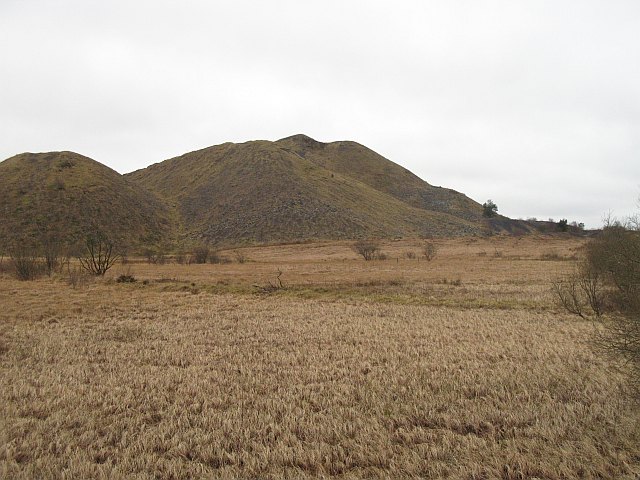
Baton Bing, the largest of several colliery spoil heaps on the moors near Shotts, survives.
Baton Bing.
Related mines
- Batonrigg Colliery — Both belonged to the Morningside Coal Company and then to Baton Collieries Ltd, and lay about a kilometre apart at Shotts.
Nearby mines
- Hillhouserigg Colliery — 0.4 miles (0.7 km) S
- Batonrigg Colliery — 0.6 miles (0.9 km) W
- Calderhead Colliery — 0.7 miles (1.1 km) E
- Hassockrigg Colliery — 0.9 miles (1.5 km) NE
- Hartwoodhill Colliery — 1.1 miles (1.7 km) SW
Straight-line distance, within 9 miles (15 km). Show on the map.
Further reading
Newspaper reports of accidents at Baton and other Shotts pits.
View sourceSources
- (primary) Baton Colliery (Durham Mining Museum) — Durham Mining Museum
- (secondary) Shotts Parish: accidents pre-1900 (Scottish Mining Website) — Scottish Mining Website
- (primary) Shotts parish accidents post 1900 — Scottish Mining Website — Scottish Mining Website
- (primary) BGS mine plan: BATON, Mill, abandoned 1940 — British Geological Survey
- (observational) Baton Bing, Richard Webb (Geograph 1131105) — Geograph
Record created: 5 November 2026 · Last researched: 6 November 2026