 MineArchive
Avonhead Colliery
| Location | Avonhead, near Longriggend, North Lanarkshire — 55.9043, -3.9074 (exact) |
|---|---|
| Commodity | Coal |
| Type | Coal |
| Worked | 1869 (sinking)–1948 |
| Operators | Avonhead Coal Company (1894–?, owner) — Avonhead Coal Co., and later Avonhead Coal Co., Ltd. (DMM) United Collieries Limited (owner) — United Collieries, Ltd. (DMM) Arden Coal Co., Ltd (owner) — Arden Coal Co., Ltd. (DMM) |
A colliery on the moss at Avonhead, near Longriggend in North Lanarkshire, with its own village of Avonhead Rows, worked from the 1860s by a run of small companies; two sinkers died in 1869 when the engine was left out of gear.
Location
Recorded location. The large pin is this mine; the small round markers are the nearest mines on record. Click one for its page. View on full map
History
Avonhead Colliery lay on the moorland at Avonhead, near Longriggend, about fourteen miles east of Glasgow, and had its own colliery village, Avonhead Rows. A pit was being sunk there in June 1869 when, after firing a shot, three sinkers climbed back on to the kettle to be lowered. The engine-keeper had not put the machinery into winding gear, and the kettle ran straight to the bottom of the shaft: two of the men were killed outright and the third, John Henderson of Arden, was badly hurt. The engine-keeper, John Anderson, was charged with culpable neglect of duty and committed for trial.
Plans of workings in the Johnstone and Ladygrange coals were abandoned between 1878 and 1885. The colliery passed through several hands (the Avonhead Coal Company, United Collieries, the Arden Coal Company and the Avonhead Coal Company Ltd) and employed 122 in 1894 and 130 in 1905, working the Lady Grange, Soft, Splint and Upper Drumgray coals. In 1901 a brusher from Low Avonhead Rows was crushed by a stone of half a ton while brushing the roadhead in the Splint coal of No. 4 pit. By 1915 only 39 men were employed, in the Ladygrange. Several pits were worked, among them No. 9, joined to the main colliery and the Slamannan Railway by a mineral line, and plans of No. 4A in the Virtuewell were deposited as abandoned in 1948.
Geology
The Lanarkshire coal measures: the Johnstone (Virtuewell), Ladygrange, Soft, Splint, Upper Drumgray and Kiltongue Musselband.
Workings
Several pits, Nos. 1, 4, 4A, 5 and 9 among them, with No. 9 joined to No. 1 and the Slamannan Railway by a mineral line.
Closure
Employment was down to 39 by 1915; plans of No. 4A's Virtuewell workings were abandoned in 1948.
What remains
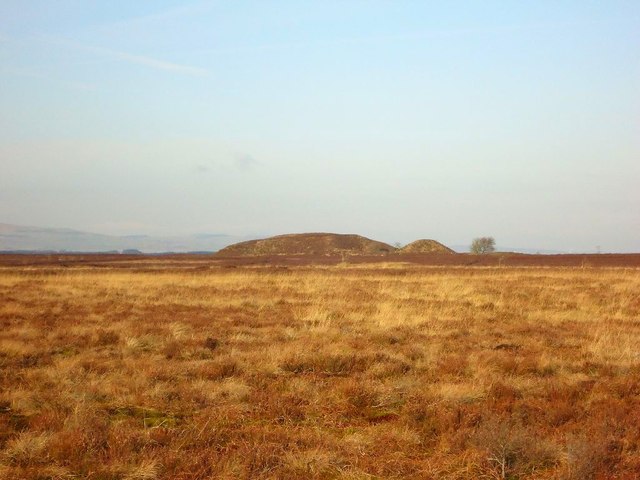
The bings of Avonhead Pit No. 9 stand on Arden Moss.
Bings, among them those of No. 9 pit.
Nearby mines
- Longriggend Colliery — 1.1 miles (1.8 km) E
- Stanrigg Colliery — 1.1 miles (1.8 km) SW
- Boglea Colliery — 1.2 miles (2.0 km) W
- Darngavil Colliery — 1.2 miles (2.0 km) W
- Lochend Colliery — 2.5 miles (4.0 km) E
Straight-line distance, within 9 miles (15 km). Show on the map.
Further reading
Owners, output, employment and seams.
View sourceNewspaper reports including the 1869 Avonhead sinking accident.
View sourceSources
- (primary) Avonhead Colliery (Durham Mining Museum) — Durham Mining Museum
- (secondary) New Monkland Parish: accidents to 1870 (Scottish Mining Website) — Scottish Mining Website
- (secondary) Scottish Mining Website: Lanarkshire accidents 1901-1914 (Airdrie, Calderbank) — Scottish Mining Website
- (primary) BGS mine plan: AVONHEAD NO.5, Johnstone (Virtuewell) and Ladygrange, abandoned 1880 — British Geological Survey
- (primary) BGS mine plan: AVONHEAD NO 4A, Virtuewell, abandoned 1948 — British Geological Survey
- (observational) Arden Moss: the bings of Avonhead Pit No. 9, Robert Murray (Geograph 2788933) — Geograph
Record created: 5 November 2026 · Last researched: 8 November 2026