 MineArchive
Avon Colliery
| Also known as | Afan Colliery, Abergwynfi Colliery |
|---|---|
| Location | Abergwynfi, Afan Valley, Neath Port Talbot — 51.6535, -3.5989 (approximate) |
| Commodity | Coal |
| Type | Coal |
| Worked | 1877–1882 (sinking)–26 September 1969 |
| Maximum depth | 1,528 feet 2 inches (North Pit) |
| Operators | Great Western Railway (1877–1912), Ocean Coal Company (1912–1947), National Coal Board (1947–1969) |
Overview
The Great Western Railway's own colliery at Abergwynfi, at the head of the Afan valley, sunk from 1877 under Sir Daniel Gooch to fuel the company's locomotives. It opened and closed so often that it was called the 'Umbrella Pit', worked steadily under the National Coal Board from 1946, and closed in September 1969.
History
When the Great Western Railway's branch from Bridgend reached Blaengwynfi, the company's chairman, Sir Daniel Gooch, decided to fuel its locomotives from a mine of its own. Avon Colliery was sunk at Abergwynfi between 1877 and 1882 to the Six Feet seam, through two shafts 75 feet apart on either side of the Glyncorrwg fault: the South Pit to 1,504 feet and the North Pit to 1,528 feet. A level was driven nearby to fuel the sinking engines, and the first upcast winder was a locomotive engine, the 'Alexander', in use until 1907. Four men drowned in the shaft in 1880 (see Disasters, below).
Geology held the pit back. It employed 559 in 1896 and 907 in 1909, but it closed from August 1903 to March 1904, and after a strike over the price list for a new seam in 1907, when the women of the village held a 'white shirt' parade to keep men from returning, it was shut in 1908. The Ocean Coal Company bought it, in 1911 or 1912 by different accounts, and restarted production in 1915. From 1922 it worked slack time or stood idle, and it closed again from 1924 to 1929.
When France fell in 1940 Avon lost its market and closed until 1946. Under the National Coal Board it was modernised in 1953-55, with pithead baths and a medical centre, double-deck cages and an electric winder said to be the first in Britain with dynamic braking; it employed 669 in 1954. Methane drawn from its Six Feet seam was piped with gas from Glyncorrwg and Duffryn Rhondda to the Aberavon gasworks. The colliery closed on 26 September 1969, working the Four Feet.
Geology
The Six Feet, Two Feet Nine, Four Feet and Red seams of the South Wales Coalfield, either side of the Glyncorrwg fault, which had a throw of 140 feet.
Workings
North and South Pits 75 feet apart, with a level driven to supply the sinking engines; double-deck cages and an electric winder from the 1950s.
Closure
Closed on 26 September 1969 on the poor quality of its coal; it had repeatedly closed and reopened since 1903.
What remains
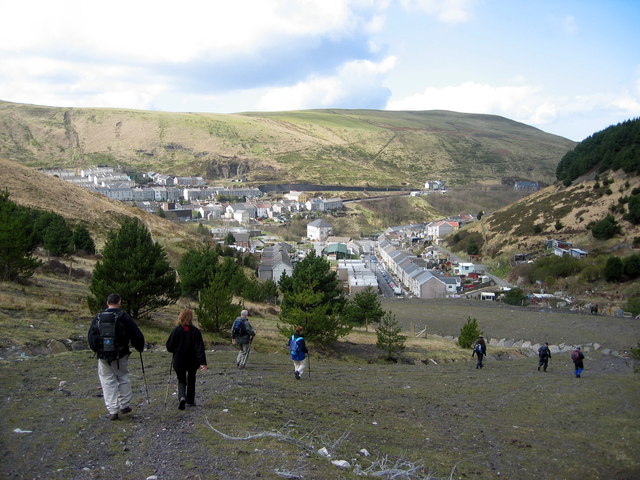
The former coal tip above Abergwynfi is crossed by footpaths.
Redevelopment
Unknown.
Nearby mines
- Glenavon Colliery — 1.2 miles (1.9 km) W
- Garw Colliery — 2.0 miles (3.2 km) S, Bridgend
- Caerau Colliery — 2.1 miles (3.4 km) SW, Bridgend
- Glenrhondda Colliery — 2.1 miles (3.4 km) NE, Rhondda Cynon Taf
- Nantewlaeth Colliery — 2.2 miles (3.5 km) NW
Straight-line distance, within 9 miles (15 km). Show on the map.
Disasters & major incidents
-
Avon Colliery shaft accident, 1880
6 September 1880 · Winding / Shaft Accident · 4 fatalities
Four men drowned in the flooded sump of the Great Western Railway's new Avon Colliery shaft at Abergwynfi on 6 September 1880 when a rope holding their walling stage broke.
What's uncertain
Points where sources disagree or the record could not be settled; both accounts are kept. All open questions in the archive.
- The Ocean Coal Company took over the running of the colliery in 1911. (disputed) 1
- The Ocean Coal Company took over the colliery in 1912. (disputed) 2,3
Recorded claims
Individual factual claims, each attached to the source(s) that support it below. Where sources disagree, both are kept.
- Sir Daniel Gooch sank the colliery between 1877 and 1882 to work the Six Feet seam. 1,2,3
- Gooch, as chairman of the Great Western Railway, decided to supply its locomotives with coal from the company's own mine once the Bridgend to Blaengwynfi branch was completed. 2
- The South Pit was sunk to 1,504 feet 4 inches and the North Pit to 1,528 feet 2 inches, 75 feet apart on either side of the Glyncorrwg fault. 2
- In 1896 the colliery employed 559 men producing steam coal. 1,2,3
- The Ocean Coal Company took over the running of the colliery in 1911. (disputed) 1
- The Ocean Coal Company took over the colliery in 1912. (disputed) 2,3
- Its intermittent working earned it the name the 'Umbrella Pit'. 2
- Its electric winder of 1955 was the first in the United Kingdom to use dynamic braking. 2
- The colliery closed on 26 September 1969. 1,2,3
Photographs & further reading
The Royal Commission's photograph of the pit head at the time of closure in 1969, with a short history.
View sourceSources
- (secondary) Avon Colliery, Abergwynfi — Welsh Coal Mines
- (secondary) Avon Colliery, Abergwynfi, Afan Valley — Northern Mine Research Society
- (secondary) Avon Colliery; Afan Colliery, Abergwynfi (RCAHMW photograph, 1969) — People's Collection Wales (Royal Commission on the Ancient and Historical Monuments of Wales)
Record created: 8 October 2026 · Last researched: 8 October 2026