 MineArchive
The Testimony of Patience Kershaw
| Category | Music |
|---|---|
| Also known as | The Testament of Patience Kershaw (Title used by the Yorkshire Garland Group.) |
| Dates | Commission appointed 1840; evidence taken 15 May 1841; report published 1842; Mines and Collieries Act Aug 1842; song written 1969 or 1972; Unthanks recording 2009 |
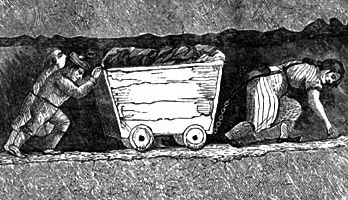
A song by the Birkenhead folk and blues singer Frank Higgins, built closely on the evidence a seventeen-year-old hurrier, Patience Kershaw, gave in 1841 to the Children's Employment Commission at Booth Town Pit, Halifax. Her account of hauling coal underground among naked men, published in the Commission's 1842 report, is one of the best known in it; the song carried it into the folk revival.
The mining history in this record
In 1840 Parliament set up a Royal Commission into the employment of children, and in the Halifax, Huddersfield and Bradford district the evidence was taken by Samuel Scriven, who went underground and questioned children at their work. Calderdale Local Studies notes that 28 children had died in the Halifax, Huddersfield and Low Moor pits between 1838 and 1841, and that public attention had been drawn partly by the drowning of eleven girls and fifteen boys in a Barnsley pit in 1838, the Huskar disaster.
Patience Kershaw, aged seventeen, was witness No. 26, examined on 15 May 1841 at Booth Town Pit, Halifax, worked by Joseph Stocks. Scriven's list of the district's pits gives Booth Town as a day hole, a tunnel entrance rather than a shaft. She was a hurrier, pushing the corves of coal out from the face, eleven a day, a mile and more underground and back, with a belt and chain at the workings. She told Scriven the bald patch on her head came from thrusting the corves; that she went to Sunday school but could not read or write; that the getters she worked for were naked and sometimes beat her if she was slow; and that she was the only girl among about twenty boys and fifteen men, and would rather work in the mill. Scriven walked, crept and rode 1,800 yards along the waterlogged road to the nearest face, and summed her up in his report in contemptuous terms, as a deplorable object. The report shocked its readers, and the Mines and Collieries Act of August 1842 barred women and girls, and boys under ten, from working underground.
People
Patience Kershaw, hurrier at Booth Town Pit, aged seventeen in 1841. Samuel S. Scriven, the sub-commissioner who took her evidence. Joseph Stocks, who worked the pit. Frank Higgins, who wrote the song. The Unthanks and Hilary Simpson, who recorded it.
Legacy today
Frank Higgins, a blues singer and guitarist who lived in Birkenhead and played the Liverpool folk clubs, set her evidence to music; the song keeps close to her own words, addressed to the commissioner. The date is given as 1969 by A Liverpool Folk Song a Week and as 1972 in the Ian Campbell Folk Group's notes quoted by the Yorkshire Garland Group. The Unthanks recorded it on Here's the Tender Coming (2009), the version that brought it to a wider audience, and Hilary Simpson recorded it, as The Testament of Patience Kershaw, for the Yorkshire Garland Group's archive of Yorkshire song in the same year. Calderdale Local Studies calls her the most famous of the Halifax children the Commission interviewed.
Mining language in this record
Words and phrases in this record that are genuine mining terminology, occupations, methods or economic practice — not scenery or ordinary regional language that merely appears in a mining-adjacent work.
| Expression | Meaning | MineArchive connection |
|---|---|---|
| hurrier | The child or young woman who moved the loaded corves from the face towards the shaft or entrance. (West Riding of Yorkshire) | Putter — Close to the putter: both moved the coal from the face. Hurrier is the West Riding word, and at Booth Town the work was done by hand, pushing and with a belt and chain. |
| corve | The wagon or tub the coal was loaded into at the face and hurried out. (West Riding of Yorkshire) | Tub — The same working object as the tub; corve (or corf) is the older local word. |
| getter | The collier who cut the coal at the face, for whom the hurriers worked. (West Riding of Yorkshire) | Hewer — The same job as the hewer, under the Yorkshire name. |
| belt and chain | The belt and chain Kershaw wore at the workings to draw the corves out. (Coalfields generally) | No term page; it is described here as Kershaw's own equipment. |
Recorded claims
Individual factual claims, each tagged with how solidly it's grounded and attached to the source(s) that support it. Where sources disagree, both are kept.
- Patience Kershaw, aged 17, gave evidence as witness No. 26 at Booth Town Pit, Halifax, worked by Joseph Stocks, on 15 May 1841. (documented fact) 1
- Kershaw hurried eleven corves a day, wearing a belt and chain at the workings, and said the bald place on her head was made by thrusting the corves. (contemporary account) 1,2
- Kershaw said she was the only girl in the pit, with about twenty boys and fifteen men, that the getters were naked, and that they sometimes beat her. (contemporary account) 1,2
- Scriven walked, crept and rode 1,800 yards along the road in Booth Town Pit to the nearest face, the floor waterlogged throughout. (contemporary account) 1
- The song was written by Frank Higgins in 1969. (later recollection, disputed) 2,3
- The song was written by Frank Higgins of Liverpool in 1972. (later recollection, disputed) 4
- The song is based closely on Kershaw's actual evidence to the Commission. (documented fact) 2,4,3
- The Unthanks recorded the song on their 2009 album Here's the Tender Coming. (documented fact) 3
- The Mines and Collieries Act of August 1842 made it illegal to employ women and girls underground, or boys under ten. (documented fact) 5,4
- In the Halifax pits girls and boys did identical work as hurriers. (documented fact) 1,5
Disasters
- Huskar Pit Flooding, 1838 — 4 July 1838
The drowning of eleven girls and fifteen boys at Huskar in 1838 is credited with drawing public attention to children in mines before the Commission.
People
- Frank Higgins · author — Birkenhead folk and blues singer who wrote the song from Kershaw's evidence.
- Patience Kershaw · witness, 1841 — Gave evidence to Samuel Scriven at Booth Town Pit on 15 May 1841; the song is built on it.
- Samuel S. Scriven · official, 1841 — Sub-commissioner for the Children's Employment Commission who took Kershaw's evidence in the Halifax pits.
Regions
Commodities
Real-world mining concepts used here
Sources
- (primary) Children's Employment Commission 1842: Report by Samuel S. Scriven on the collieries of the West Riding of Yorkshire — Coal Mining History Resource Centre (transcription)
- (secondary) 15: The Testimony of Patience Kershaw — A Liverpool Folk Song a Week
- (secondary) The Unthanks – The Testimony of Patience Kershaw — For Folk's Sake
- (secondary) The Testament of Patience Kershaw — The Yorkshire Garland Group
- (secondary) The Royal Commission into Children's Employment in Mines 1842, a Halifax example — Calderdale Local Studies
Record created: 18 September 2026 · Last researched: 18 September 2026