 MineArchive
Stockwork
| Also known as | Stringer zone (Another name for a stockwork.) |
|---|---|
| Category | Mine Workings & Access |
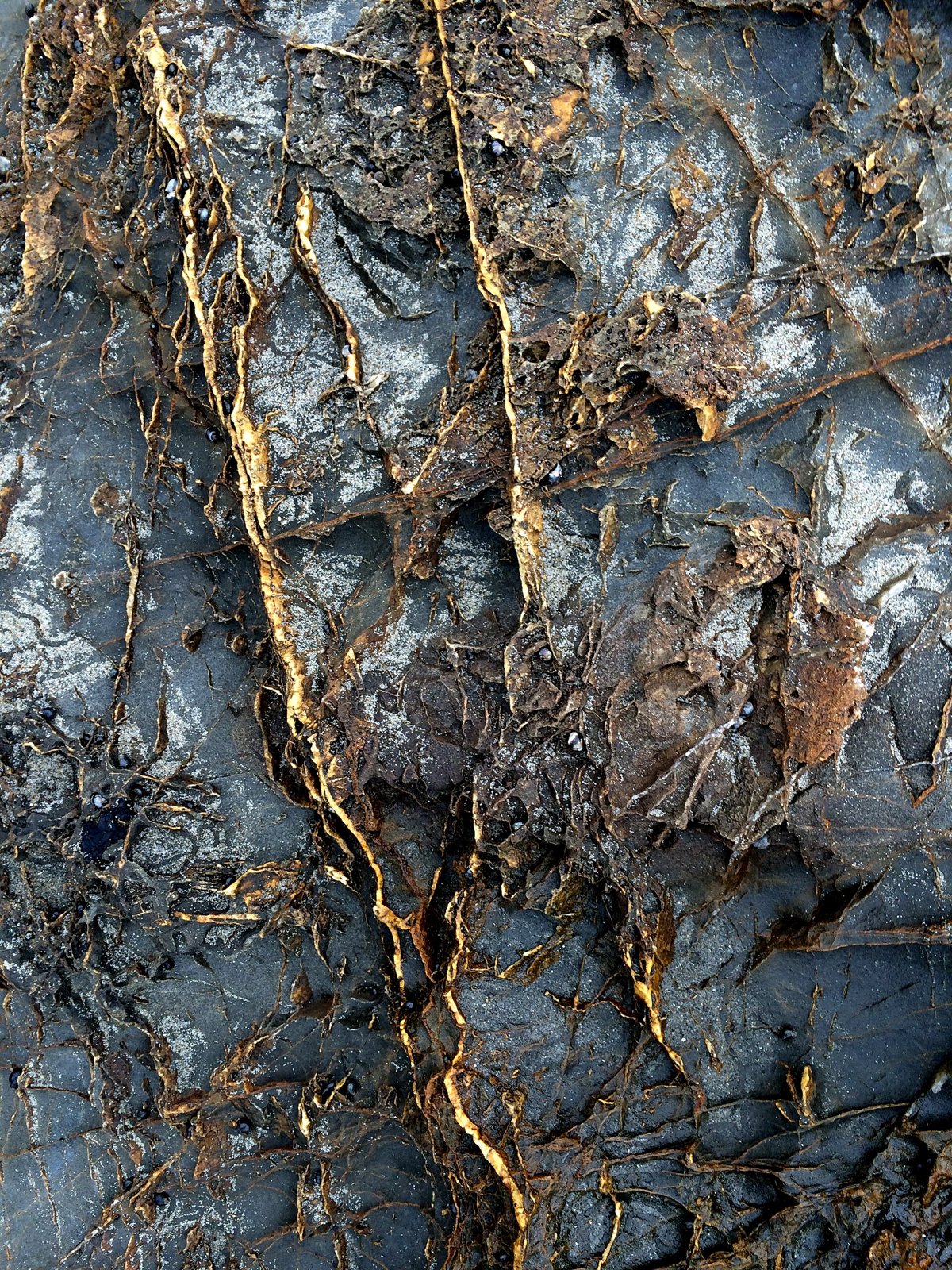
A stockwork is a mineral deposit made up of a network of small, irregular veins so closely spaced that the whole mass of rock can be mined as a unit, rather than vein by vein. It is also called a stringer zone.
Historical usage
Stockworks are common in many types of ore deposit and in greisens. In the tin field of south-west England, early tin and tungsten stockwork mineralisation belongs to the main stage of mineralisation that came with the granites, before the tin and copper lodes. The best-known Cornish example is Carclaze Old Tin Pit near St Austell, where a massive stockwork of tin-bearing, greisen-bordered quartz-tourmaline veins beside the granite margin was worked as an open pit; it was a 'must-see' for geological visitors from the French engineer Jars in 1764 onwards.
How it worked
Because the veinlets were too small to follow individually, the ore was won by taking the whole rock. At Carclaze the tin ore, mixed with schorl and quartz, was quarried rather than mined, and the whole rock was crushed and washed to separate the tin. Jars described the ground being carried away in small boats along an underground canal, and thought the canal important because it let the immense quantity of ground forming the stockwork be removed without having to be raised eight to ten fathoms.
Why it was used
The word describes how the ore lies, and that settles how it has to be worked: in bulk, by open pit or a large openwork, rather than by following a single lode.
Regional variation
Also called a stringer zone.
Mines associated with this term
Included only where MineArchive's own research gives a reasonable evidential basis — not every mine where this might plausibly apply.
- Wheal Fortune — Cornwall (well documented example)
Named twice in this record, first in the geology: “…events are exposed here: an early ENE-trending sheeted stockwork of tin-bearing cracks bordered by greisen alteration, carrying…” - Carclaze Pit — Cornwall (well documented example)
Named 3 times in this record, first in the history: “…following a rich vein up to its crest until an enormous open stockwork of tin ore was exposed and worked as a pit rather than a streamwork.…” - Great Weeke Mine — Devon (well documented example)
Named in this record’s geology: “Tin lodes in a stockwork worked by a large openwork, a north-west lode intersected by a…” - Trevaunance Mine — Cornwall (well documented example)
Named in this record’s geology: “…Cassiterite occurs on joint planes in the metamorphosed killas, a stockwork, and the mine was known for fluorite crystals of an unusual…”
Sources
- (primary) Late 18th and early 19th Century forays into economic geology: Carclaze — Ussher Society
- (secondary) Carclaze — Wikipedia
- (secondary) Dominy, Bussell and Camm, 'Geology and mining of complex narrow veins in south-west England', British Mining 57 (1996) — Northern Mine Research Society
- (secondary) Stockwork — Wikipedia
- (secondary) stockwork (A Dictionary of Earth Sciences) — Encyclopedia.com (Oxford University Press)
Record created: 26 November 2026 · Last researched: 26 November 2026