 MineArchive
Square-set Timbering
| Category | Structures & Machinery |
|---|
A support system of interlocking cubic timber frames, stacked honeycomb-fashion, used to hold open wide underground stopes in ground too weak to stand unsupported.
Historical usage
Invented in April 1860 by Philipp Deidesheimer, a German-trained mining engineer hired by the Ophir Mine on Nevada's Comstock Lode, after existing timbering methods -- unchanged since the 16th century -- proved unable to hold open the unusually wide, weak ground the Comstock's silver veins demanded. Deidesheimer is said to have taken his inspiration from the internal structure of a honeycomb. He never patented the design, and it spread rapidly to become the international standard for wide-stope hard-rock mining for the next fifty years, reaching British mining too: Brightling and Mountfield Gypsum Mines in Sussex worked a square-set duplex room-and-pillar system, applying the same cubic-frame principle to gypsum extraction.
How it worked
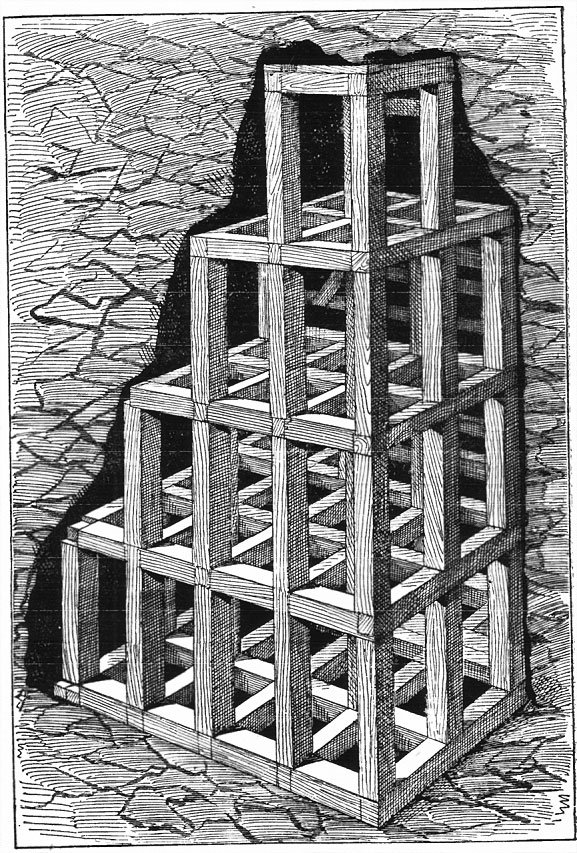
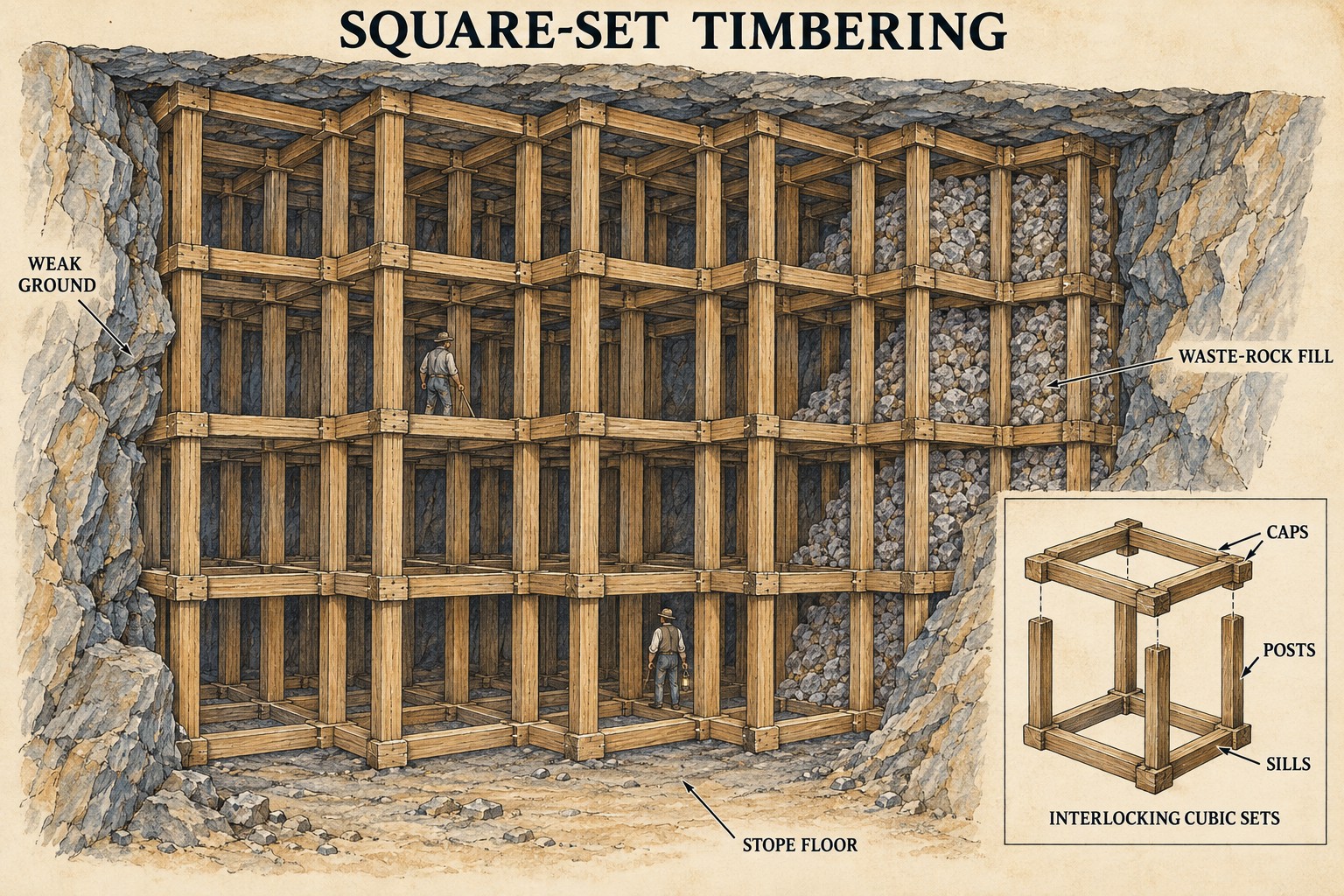
Timber was framed into simple cubic units -- posts, caps and sills of equal length joined at right angles -- and stacked in three dimensions to fill the void left by ore extraction, each cube bearing directly on the ones below and beside it. Where a stope was especially large, the cubes could be filled with waste rock, turning the whole structure into a solid composite pillar of timber and rock running from floor to roof.
Why it was used
Square-set timbering let a mine open a cavity of essentially any size or shape in ground that could not support itself, rather than being limited to the narrow stopes that simpler stull or post-and-cap timbering could hold open.
Risks & limitations
The timber itself was not a permanent solution: ground pressure and gradual decay eventually crushed even well-built square sets, and the Comstock's mines consumed timber on an industrial scale to keep replacing failed sets, denuding the surrounding hillsides of trees within a few decades.
Related terminology
Mines associated with this term
Included only where MineArchive's own research gives a reasonable evidential basis — not every mine where this might plausibly apply.
- Brightling and Mountfield Gypsum Mines — East Sussex (well documented example)
Brightling and Mountfield's extraction method is described in its own record as square-set duplex room-and-pillar working.
Sources
- (secondary) Square set timbering — Wikipedia
- (secondary) The Timber Square Set — Engines of Our Ingenuity (Univ. of Houston)
Record created: 29 August 2026 · Last researched: 30 August 2026