 MineArchive
Wheal Glynn
| Also known as | Hurtstock Mine |
|---|---|
| Location | Cardinham Woods, near Bodmin, Cornwall |
| Commodities | Lead, Silver |
| Type | Metal |
| Worked | 1854–1859 |
| Maximum depth | 34 fathoms below adit |
Overview
A small lead and silver mine in Cardinham Woods near Bodmin, also called Hurtstock Mine, worked from 1854 to 1859 as one of the speculative 'bubble mines' of the Crimean War years. Its engine house is ruined, but its ornate chimney, the only one of its style in East Cornwall, still stands among the trees.
History
Wheal Glynn, also known as Hurtstock Mine, lies deep in Cardinham Woods near Bodmin. It was one of the 'bubble mines' of the 1850s, when the Crimean War and unrest abroad made metal imports difficult and high prices drew investors into new ventures.
Underground work began in 1854 with a new adit, which was recorded as containing mundic, lead and barytes. In 1857 a new shaft was sunk 34 fathoms below adit and an engine set to work on it in January. Two lodes were worked, No. 1 for lead and silver and No. 2 for iron, copper and lead.
In October 1859 all the machinery and materials were put up for sale, and the mine closed having made a heavy loss. Its only recorded output, from that year, was 18 tons of lead ore at 67 per cent. A restart as Cardinham Wheal Rose was proposed in 1864 but came to nothing.
Geology
Two lodes: No. 1 carrying lead and silver, No. 2 iron, copper and lead; the adit cut mundic, lead and barytes.
Workings
An adit begun in 1854 and an engine shaft sunk in 1857 to 34 fathoms below adit, worked by an engine from January 1857.
Closure
A speculative venture that made a heavy loss; its machinery was sold in October 1859 and a proposed revival in 1864 never started.
What remains
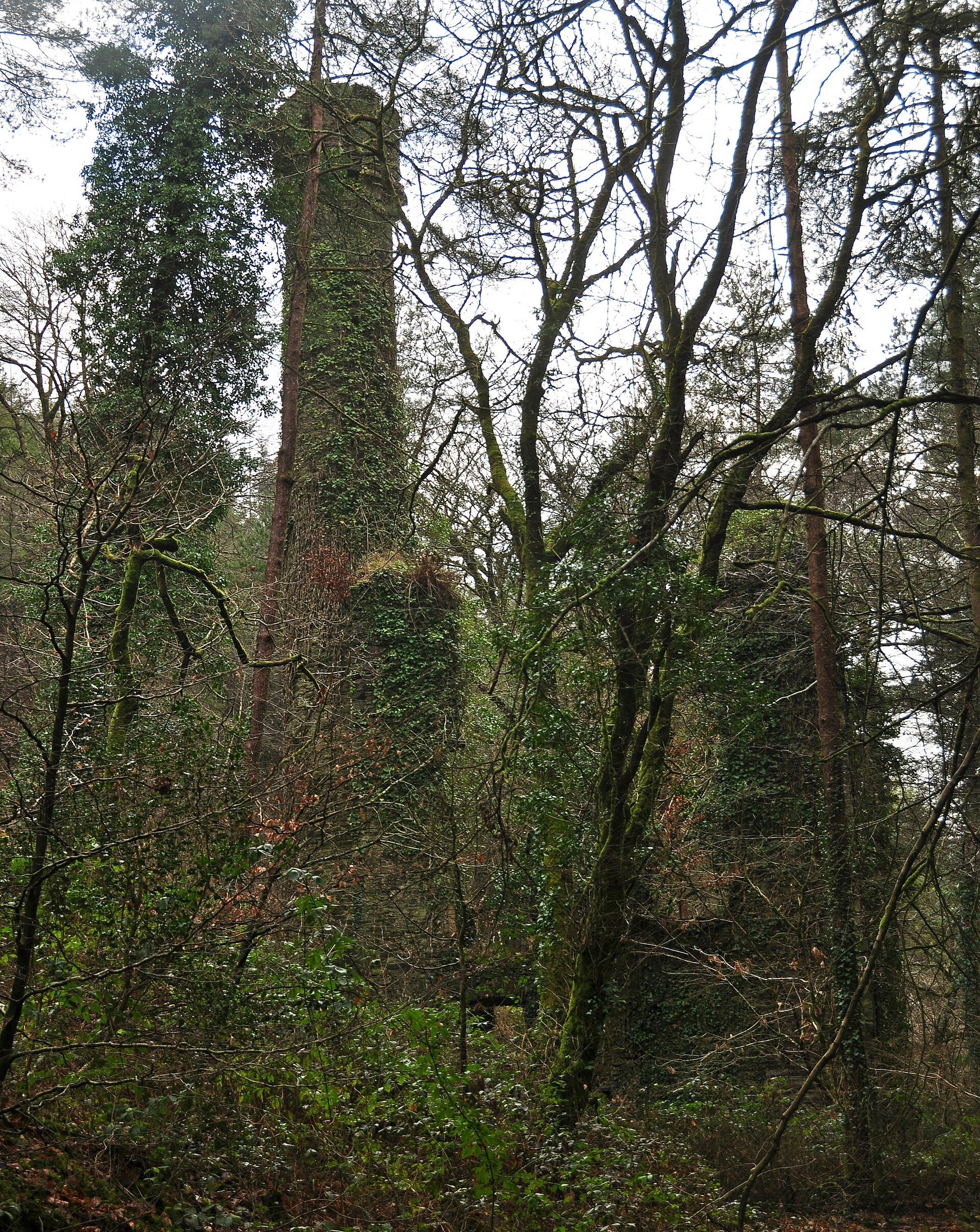
The engine house is in very poor condition among the trees of Cardinham Woods, but its tall chimney stands; the site lies on a waymarked Forestry England trail.
The ruined engine house and its ornate chimney stack, which may once have been whitewashed.
Redevelopment
Woodland in Cardinham Woods, managed by Forestry England.
Recorded claims
Individual factual claims, each attached to the source(s) that support it below. Where sources disagree, both are kept.
- Underground work began at Wheal Glynn in 1854 with a new adit. 1
- It worked a lode of lead and silver and a lode of iron, copper and lead. 1,2
- The mine closed in 1859 with a heavy loss, its machinery offered for sale that October. 1,2
- It was one of the speculative 'bubble mines' started during the high metal prices of the 1850s. 2
- Its ornate chimney is the only one of its style in East Cornwall. 2
Photographs & further reading
The mine's story as told on the Cardinham Woods trail.
View sourceThe mine's working history and recorded output.
View sourceSources
- (secondary) Explore Cornwall: Wheal Glynn — Explore Cornwall
- (secondary) Forestry England: Wheal Glynn walk at Cardinham Woods — Forestry England
Record created: 11 October 2026 · Last researched: 11 October 2026