 MineArchive
West Hallam Colliery
| Also known as | West Hallam Collieries, West Hallam Coal and Iron Works |
|---|---|
| Location | North of High Lane, West Hallam, between Mapperley and Ilkeston in the Erewash valley, with the Nutbrook Canal to the east., Derbyshire — 52.9771, -1.3387 (approximate) |
| Commodities | Coal, Pyrite |
| Type | Coal |
| Worked | 1795–About 1930 |
| Maximum depth | 120 yards, the deeper of the two West Hallam No. 1 shafts. |
| Operators | H. B. Whitehouse and Sons (1848–1886), West Hallam Colliery Company Limited (1888–?) |
Overview
Four pits on High Lane at West Hallam, near Ilkeston, worked alongside an ironworks and a brickyard as H. B. Whitehouse and Sons' coal and iron works and then, from 1888, as the West Hallam Colliery Company, whose 953 employees in 1910 made it one of the larger Erewash pits; coal winding ended about 1930 and the shafts were sealed in 1941.
History
Coal was drawn here long before the colliery took its name: the earliest known shaft on the site dates from 1795 and was called the Engine Pit, and by the 1850s several small collieries were at work along Mapperley Brook, running eastwards towards the Nutbrook Canal. H. B. Whitehouse and Sons took an ironworks lease in 1848 and built up a single industrial complex of collieries, ironworks and brickworks north of High Lane, which the first edition twenty-five-inch Ordnance Survey map shows in about 1880. Of the pits then at work, West Hallam 1 had two shafts of 117 and 120 yards, West Hallam 2 was 105 yards deep and closed about 1880, and West Hallam 3 worked the shallow hard coal seams. By the time the Whitehouses left, most of the shallow measures had been worked out; the ironworks stopped in 1881 and the lease ended in 1886. In 1888 Francis Nicholas Smith of Wingfield Park, near Ripley, began trading as the West Hallam Colliery Company, and he or his family were still in the chair thirty-five years later. The company worked three or four numbered pits at a time and its workforce rose from 712 in 1894 to 953 in 1910, under a succession of managers: J. W. Liddell, Joseph Trueman, N. Gething and, by 1923, William Large. The coal was household and manufacturing, and pyrites was returned as a by-product. Meanwhile the thousands of tons of furnace slag left behind in 1881 became a business of its own: a plant was built to break it up for ballast and road stone, the Great Northern Railway laid a line and sidings to take it away, and by 1915, when the work finished, every trace of the ironworks had gone with it. Coal winding came to an end about 1930, though the company still appeared in the Colliery Year Book of 1933 working the Tupton and High Main seams on five-hundred-volt electric power, and the shafts were sealed in 1941. Wartime demand brought the site back in 1943, not as a mine but as a disposal point where opencast coal from the surrounding sites was screened and loaded; that closed in 1964 and the plant was dismantled in 1986, ending about two hundred years of coal work on the ground.
Geology
The Derbyshire and Nottinghamshire coalfield. The shallow hard coal seams were worked out first, and by 1933 the company was working the Tupton and High Main. Pyrites was returned as a mineral worked besides the coal.
Workings
Originally four numbered pits, of which the one marked West Hallam Colliery on the 1900 Ordnance Survey map is the No. 4 pit of the 1879 survey. West Hallam 1 had two shafts, 117 and 120 yards deep; West Hallam 2 was 105 yards; West Hallam 3 took the shallow hard coal. A brick kiln stood beside No. 4 in 1879, and by 1900 a larger brickworks had been built beside the Nutbrook Canal on the site of the former ironworks, near No. 1 pit. The Great Northern Railway laid a line and sidings into the works in 1896 to carry away broken furnace slag.
Closure
Coal mining had ceased by 1930 according to the county Historic Environment Record, though the company still has a Colliery Year Book entry for 1933 and appears in mining lists as in production from 1893 to 1933, and was still listed in 1940 with no men returned either below ground or on the surface. The shafts were sealed in 1941.
What remains
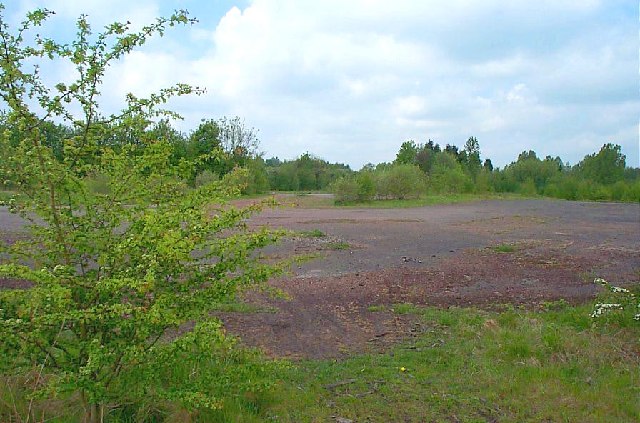
Disused and largely levelled. Only residual spoil heaps and the remains of bricked-up shafts survived by 1986, and the ground has since gone to scrub and trees, with earthworks of the works and the mineral railways still traceable.
Residual spoil heaps, remains of bricked-up shafts, and earthworks marking the mineral railway lines and the former works. The Blue Fly shaft's earthworks and spoil heaps survive nearby with the embankments and cuttings of its tramway, and stone sleeper blocks lie in a stream bed where the tramway crossed it.
Redevelopment
Nothing built. The screening plant that occupied the site from 1943 was dismantled in 1986 and the ground has returned to scrub and woodland.
Related mines
- Mapperley Colliery — The neighbouring pit between Mapperley and West Hallam; the ironworks on the Nutbrook Canal stood between the two.
Nearby mines
- Mapperley Colliery — 2.3 km NW
- Cossall Colliery — 3.3 km E, Nottinghamshire
- Awsworth Colliery — 4.0 km NE, Nottinghamshire
- Wollaton Colliery — 4.3 km SE, Nottinghamshire
- Digby Colliery — 4.8 km NE, Nottinghamshire
Straight-line distance, within 15 km. Show on the map.
The shafts were sealed in 1941 but the site keeps residual spoil heaps and the remains of bricked-up shafts; it is open ground, not a managed site.
What's uncertain
Points where sources disagree or the record could not be settled; both accounts are kept. All open questions in the archive.
- The Derbyshire Historic Environment Record says all coal mining on the site had ceased by 1930 and the shafts were sealed in 1941, while mining references have the colliery in production from 1893 to 1933 and still listed in 1940 with no men returned either below ground or on the surface. (disputed) 1,2
Recorded claims
Individual factual claims, each attached to the source(s) that support it below. Where sources disagree, both are kept.
- West Hallam Colliery and West Hallam Iron Works appear on the first edition twenty-five-inch Ordnance Survey map of about 1880 as one industrial complex of collieries, ironworks and brickworks, worked by H. B. Whitehouse and Sons as the West Hallam Coal and Iron works. 1
- The earliest known mineshaft on the site dates from 1795 and was known as the Engine Pit; by the 1850s several smaller collieries were working along Mapperley Brook eastwards towards the Nutbrook Canal. 1
- West Hallam 1 had two shafts, of 117 and 120 yards; West Hallam 2 was 105 yards deep and closed about 1880; West Hallam 3 worked the shallow hard coal seams. The pit marked West Hallam Colliery on the 1900 Ordnance Survey map is the No. 4 pit of the 1879 survey. 1,2
- The Whitehouse ironworks lease began in 1848 and ended in 1886, the ironworks itself having ceased production in 1881; by the time the firm left, most of the shallow coal measures had been worked out. 1
- In 1888 Francis Nicholas Smith of Wingfield Park near Ripley began trading as the West Hallam Colliery Company; the 1923 Colliery Year Book still lists Francis N. Smith of Wingfield Park, Ambergate, as the company's chairman. 1,3
- Several thousand tons of furnace slag were left on the site after 1881; a purpose-built plant was erected to break it up for ballast and road building and the Great Northern Railway laid a line and sidings to take the processed material away. The work ran from 1896 to 1915, by which time all evidence of the ironworks had disappeared. 1
- The company's workforce rose from 712 in 1894, through 746 in 1896 and 693 in 1900, to 869 in 1905 and 953 in 1910, under the managers J. W. Liddell, Joseph Trueman and N. Gething; by 1923 a single mine named West Hallam employed 450 men underground and 115 on the surface under William Large. 3
- The company's coal was classed as household and manufacturing, pyrites was returned as another mineral worked, and by 1933 the seams worked were the Tupton and the High Main, with electric power at five hundred volts. 3
- A brick kiln stood beside the No. 4 pit on the 1879 Ordnance Survey map; by 1900 a larger brickworks had been built beside the Nutbrook Canal on the site of the former West Hallam Iron Works, and it had gone by the 1913 map. 2
- The Derbyshire Historic Environment Record says all coal mining on the site had ceased by 1930 and the shafts were sealed in 1941, while mining references have the colliery in production from 1893 to 1933 and still listed in 1940 with no men returned either below ground or on the surface. (disputed) 1,2
- The site was reopened in 1943 as a coal disposal point handling opencast coal from the surrounding sites, part of it at SK 445 424 being used to screen the output; that closed in 1964 and the equipment and buildings were dismantled in 1986, ending about two hundred years of coal mining operations on the site. 1
- Only residual spoil heaps and some remains of bricked-up shafts survived by 1986, and by 2012 the site was scrub and trees with earthworks of the former works and mineral railways still apparently surviving. 1
- The earthworks and spoil heaps of the Blue Fly shaft survive to the west with the embankments and cuttings of its tramway, which the 1880 Ordnance Survey shows running east until it disappears into the later West Hallam Colliery workings. 4
Photographs & further reading
The county record for the whole complex: the 1795 Engine Pit, the Whitehouse lease, the depths of the numbered pits, the foundation of the colliery company in 1888, the slag breaking of 1896-1915 and the site's later life as a coal disposal point.
View sourceEmployment at each numbered pit from 1894 to 1910 with its managers, and the 1923 and 1933 Colliery Year Book entries giving the directors, the classes of coal, the pyrites and the seams worked.
View sourceThe colliery and its two brickyards read off the 1879, 1900 and 1913 Ordnance Survey maps, with the production dates from mining references.
View sourceSources
- (secondary) MDR5791 - West Hallam Ironworks and Colliery (site of), north of High Lane, West Hallam — Derbyshire Historic Environment Record
- (secondary) Stanley & West Hallam Brickworks — East Midlands Named Bricks
- (primary) West Hallam Colliery Co., Ltd. — Durham Mining Museum
- (secondary) MDR5793 - Blue Fly Colliery and associated tramway (site of), West Hallam — Derbyshire Historic Environment Record
Record created: 23 September 2026 · Last researched: 24 September 2026