 MineArchive
Turf Copper Mine
| Location | Coed y Brenin, near Capel Hermon, between the Afon Wen and Afon Mawddach, north of Dolgellau, Gwynedd — 52.8123, -3.8694 (approximate) |
|---|---|
| Commodity | Copper |
| Type | Metal |
| Worked | Early 19th century–Unknown; mostly worked out by the mid-19th century |
| Maximum depth | Surface peat working: the upper peat bed was 0.45-0.6 m thick, on stony debris, a lower uneconomic peat and over 30 m of glacial till. |
Overview
A peat bog in Coed y Brenin, north of Dolgellau, where copper leached from the huge Coed y Brenin porphyry deposit had replaced leaves, nuts and wood as native metal. In the early 19th century about 70 acres of peat were dug and slowly burned, and the copper-rich ash sold for smelting; one year's 2,000 tons of ash reportedly made about £20,000 profit. The site is now a Geological Conservation Review site where copper still kills planted trees and sea thrift flowers in the forest.
History
Most of the work was done early in the 19th century. The peat bed was eighteen inches to two feet thick, and its richest part, at the base, was a mixture of grass and rotten oak and hazel wood in which native copper coated leaves, replaced acorns and hazelnuts, and sometimes formed layers in wood that showed alternating metal and timber when cut. Some was so rich that it went straight to the Swansea smelting works. The rest was dried and burned to ash over eight to ten days, with great care to stop it bursting into flames, because slagging would make the copper hard to smelt. Every tool except the peat cutters had to be made of copper, since iron was quickly destroyed, and peat under 2.5% copper was left undug. W.J. Henwood, who visited in 1856 while the workings were still fresh, was told of one year in which 2,000 tons of peat ash sold at a profit of about £20,000. Where the copper came from puzzled prospectors, who riddled the slopes with trials looking for a 'mother lode', including the Dolfrwynog vein workings nearby. Ramsay suggested in 1866 that the copper was finely dispersed through the rock, and more than a century later Riofinex's drilling proved the Coed y Brenin porphyry copper deposit, over 200 million tons, and a buried valley beneath the bog. The peat formed after the last glaciation on till blocking that old valley, and groundwater carried copper down into it from sulphides exposed by glacial erosion. The ground is still so rich in copper that trees planted there have died, and thrift, a seaside plant, covers the clearing each May and June.
Geology
Native copper replacing organic matter in post-glacial peat, deposited from groundwater that leached the Coed y Brenin porphyry copper deposit. The bog lies on till filling a buried valley of the former Afon Wen, 4.5 to 36.8 m deep where drilled.
Workings
About 70 acres of copper-rich peat were dug, dried and burned; trial diggings for a supposed mother lode surround the site.
Closure
Most of the work was done in the early 19th century; Henwood saw the workings still fresh in 1856. Most of the rich peat has been removed.
What remains
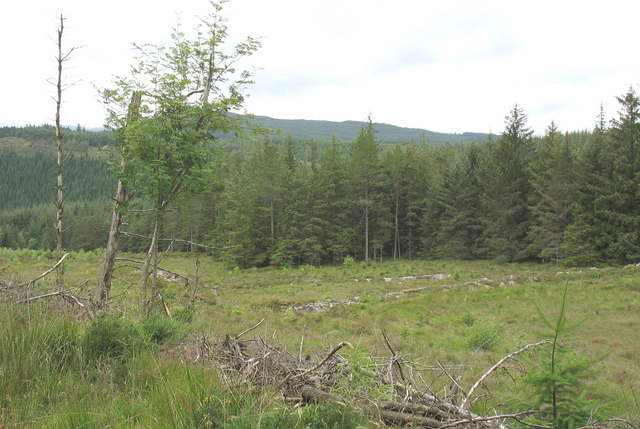
A low-lying boggy clearing in conifer forest, stripped in places to glacial drift, where copper-rich groundwater still deposits copper minerals on ditch sides and copper-tolerant thrift flowers in early summer.
Scant: residual low-grade peat, drainage ditches and trial diggings.
Redevelopment
Forestry plantation around the site; a Geological Conservation Review site of botanical and geochemical importance.
Related mines
- Glasdir Mine — Both belong to the Coed y Brenin porphyry copper system mapped in the GCR volume.
- Tyddyn Gwladys Mine — Neighbouring Coed y Brenin mine sites about 1.4 km apart.
Nearby mines
- Cefn Coch Gold Mine — 0.3 km S
- Gwynfynydd Gold Mine — 0.3 km NE
- Tyddyn Gwladys Mine — 1.4 km NW
- Glasdir Mine — 5.8 km SW
- Vigra Mine — 8.1 km SW
Straight-line distance, within 15 km. Show on the map.
People
- W.J. Henwood · author, 1856 — Visited the workings while still fresh and described the copper peat in 1856.
What's uncertain
Points where sources disagree or the record could not be settled; both accounts are kept. All open questions in the archive.
- Buddlepit gives working dates of 1824-47 and 183 oz of gold recovered 1854-65, figures its Dolfrwynog page attributes to Dolfrwynog; unresolved. (disputed) 2
Recorded claims
Individual factual claims, each attached to the source(s) that support it below. Where sources disagree, both are kept.
- The peat was dug and burned so its ash could be smelted for copper; Henwood (1856) was told of one year when 2,000 tons of peat ash sold at a profit of about £20,000. 1,2
- Ashing took a slow 8-10 day burn, all tools but the peat cutters were copper, and peat under 2.5% copper was left undug. 1
- About 70 acres of copper-rich peat were dug, dried and burned in the early 19th century. 3
- Henwood described native copper coating leaves and nuts and lying between wood fibres; the richest peat went directly to Swansea for smelting. 1,4
- The copper was leached after the last glaciation from the 200-million-ton-plus Coed y Brenin porphyry copper deposit and precipitated as native copper in the peat. 1,2
- Riofinex drilling found overburden of 4.5 m and 36.8 m in two holes, revealing a buried east-west valley under the site. 1
- Copper-tolerant thrift (Armeria maritima) covers the site in early summer, and copper in the soil has killed planted trees. 1,5
- Buddlepit gives working dates of 1824-47 and 183 oz of gold recovered 1854-65, figures its Dolfrwynog page attributes to Dolfrwynog; unresolved. (disputed) 2
Photographs & further reading
Geological Conservation Review account of the copper peat, Henwood's 1856 description, origin and ecology.
View sourceBGS field itinerary through the Coed y Brenin porphyry deposit, including the Turf copper site and Dolfrwynog workings.
View sourceMineralogy of Wales entry quoting Henwood on copper replacing leaves, nuts and wood at the Turf Copper Mine.
View sourceSources
- (secondary) Turf Copper Mine (GCR site, Mineralization of England and Wales, GCR Series 36) — Scottish Geology Trust GeoGuide, from JNCC (Bevins et al. 2010)
- (secondary) Turf Copper Mine — Buddlepit Mine Database
- (secondary) Capel Hermon (Harlech Dome excursion 4) — Scottish Geology Trust GeoGuide, from BGS
- (secondary) Copper (Mineral Database) — Amgueddfa Cymru – Museum Wales, Mineralogy of Wales
- (observational) The site of the Dol-frwynog Turf Copper Mine — Wikimedia Commons (Eric Jones, Geograph)

Record created: 17 September 2026 · Last researched: 17 September 2026